Showing posts with label Old Word/New Meaning. Show all posts

Saturday, October 13, 2007

Use Your Reimagination

I'm sure by now everyone has noticed this, but the taglines for two miserable-looking comedies out now are almost exactly alike. The curiously ubiquitous Dane Cook's GOOD LUCK CHUCK's tagline is "Sometimes, Love Blows" while "Love Blows" sells us THE HEARTBREAK KID, Ben Stiller's ill-conceived remake of the 1972 Charles Grodin vehicle.

Nobody can curl a lip like Grodin

How unimaginative, right?

Perhaps, when they're remade in the future, someone will "reimagine" the taglines too.

Hollywood has apparently become dissatisfied with the term "remake", because lately I've been reading that films like Rob Zombie's 2007 HALLOWEEN aren't remakes, but "reimaginings" of the source material.

From Wikipedia:

Recently, the term "reimagining" has become popular to describe remakes that do not closely follow the original. The term is used by creators in the marketing of films and television shows to inform audiences that the new product is not the same as the old.

But how close is "closely"? Is there a definitive dividing line that separates the mere remake from the far more grandiose-sounding reimagining?

I've been plagued by/secretly enjoying nightmares "adapted from" John Carpenter's HALLOWEEN my entire adult life

First we have to sort the "reinterpretations" out of the equation. BATMAN BEGINS (2005) is not a remake of nor a sequel to BATMAN (1989), but rather a reinterpertation of the same DC comic book source material that inspired BATMAN the movie and BATMAN the 1960's TV series. So, then, it would seem that BATMAN BEGINS (and its 2008 sequel THE DARK KNIGHT) are technically "readaptations", right?

Who the hell knows. It just seems depressing to me that rather than fostering new ideas, we're doomed to a neverending cycle of cannibalism and reheating of leftovers. The Wikipedia section listing film remakes is so long that it has to be broken up into two sections: A-M and N-Z.

Back to reimagining. All of the film and TV franchises that have been deemed reimaginings are in the horror and sci-fi genre: TEXAS CHAINSAW MASSACRE (1974 & 2003), BATTLESTAR GALACTICA (1978 & 2003), DAWN OF THE DEAD (1978 & 2004), BIONIC WOMAN (1976-2007), etc.

I wonder why that is? Why is Michael Bay, who as producer has already re-somethinged the AMITYVILLE HORROR, THE HITCHER and TEXAS CHAINSAW MASSACRE franchises, now turning his attention to FRIDAY THE 13th?

It's hard to believe FRIDAY THE 13TH: THE FINAL CHAPTER was 23 years ago...

Because IT'S EASY! Is there anything more American than following the path of least resistance to the pot of gold? These films and franchises have brand equity and name value, so it doesn't really MATTER how wildly they're reimagined or bastardized... basically the same format and structure are gonna unfold whether or not it's a no-name low-budg horror film or it's a big-budg "Rising/Birth of" chapter or a THEORETICALLY daring shift of location or temporal setting (JASON GOES TO HELL and/or MANHATTAN, Aliens fight Predators, etc).

A large group of teens/scientists/mercenaries are gonna be whittled down by the killer, at least one in a sexually compromising position, until a final showdown where the killer is vanquished... or is/are they?

Repeat as necessary.

Wednesday, August 22, 2007

Meatspace Odyssey

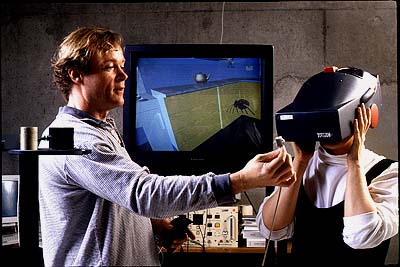
There was a time when Virtual Reality meant putting goggles and sensors on and running through a Tron-esque maze fleeing pterodactyls or walking through the floorplan of a proposed building. Today we have an entire Virtual World in Second Life, an online universe whose existence I only stumbled upon a few days ago. When a client mentioned that a very real world company has set up shop in Second Life, I pretended I knew what she was talking about then bounced to Wikipedia to look it up after the call was over.

didn't I blow your mind this time? didn't I?

There I learned that "residents" of Second Life refer to our traditional, corporeal world as "meatspace", a term that made me laugh and frown. That lead me to an even more interesting word, one that you may be familiar with but was new to me.

Meatspace is an example of a "Dysphemism", which is defined by The Columbia Guide to Standard American English as:

The process and the result of substituting an ugly or otherwise unpleasant locution for one more attractive in sound or meaning are both called dysphemism, of which the World War I sailors’ name for tapioca pudding, fisheye soup, is a graphic and printable example. Dysphemism is an antonym of euphemism.


That's mighty fine fish-eye soup Admiral.

So basically, you use a dysphemism when you want to make a neutral term sound awful or extreme. Instead of saying "I was thrilled when the Angels defeated the Yankees 18-9", I'd say "I was thrilled when the Angels annihilated the Yankees 18-9." That dude is dumb as a box of rocks... this coffin nail is really refreshing... etc etc.

Here's an entertaining read on the concept of the "Dysphemism Treadmill" from Wikipedia:

Similar to the concept of the euphemism treadmill, a complementary “dysphemism treadmill” exists, but is more rarely observed. In these cases, notions of profanity, obscenity and other words once called “offensive” are later described as “objectionable,” then “questionable,” and in some cases, they reach near or outright acceptability.

One modern example is the word “sucks.” “That sucks” began as American slang for “that is very unpleasant,” and is the shortened version of “that sucks cock/dick.” It developed over the late-20th century from being an extremely vulgar phrase to mainstream slang. (The origin of the intransitive usage, “sucks,” is disputed and may derive from more innocuous slang. See the archived discussions of The American Dialect Society. The same may be said of the use of “screw,” often used as slang for sexual intercourse (and a euphemism for “fuck”), in such usages as “to screw up” (to make a major mistake).)

Sometimes a term will go from being a euphemism to being a dysphemism and then go back to being a euphemism. “Queer” and “gay,” for example, both started as euphemisms for “homosexual,” and then got on the euphemism treadmill and became insults—but are now the preferred adjectives amongst the gay community themselves.

If anyone calls me a tub of lard again, I'll put my flipper in their ass.

I imagine that "Dysphemism Treadmill" is a great cocktail party subject. I can almost see a board game...

Anyway, next time you're considering using a played-out euphemism like "Kitty went to live on a farm", know that you can always go the opposite direction and say that "Kitty is worm food now."

Sunday, June 10, 2007

The More Dominatrices, the Better.

There was a time when I read a handful of scripts and a book or two every week. I never really minded writing the "comments" section of coverage, but I quickly grew to hate the relentless synopsizing. I sympathized with Newman when he would rant about his job as a postal carrier:

"...the mail never stops. It just keeps coming and coming and coming."

Thankfully (warning: rationalization ahead) all that "practice" I had synopsizing has helped immensely with my copywriting work. Far more often than not, I've been hired to help the client synthesize a copious amount of copy (inc. big ideas, pertinent product factoids, wide-ranging corporate philosophy, etc) into brief bursts of text.

The briefest burst possible is the headline, which, fortunately for me, requires blending a number of my personaly predilections like wordplay, potent quotables, and... synopsizing.

Heart'safire!

One of my favorite columns in The New York Times is William Safire's "On Language"... such a great way to keep up with the vernacular (and, for fellow wordplayers, a great source of sly humor too). Today's installment featured a delicious description of the synopsizing and headline writing process borne of Safire's puzzlement at the following headline from Brit-written The Financial Times:

"Murdoch denies Beijing kowtow as Dow Jones rhetoric hots up."

No, not "heats up"... "hots up." Wondering if perhaps the editors of The Financial Times were eager to save space by cutting "ea" and replacing it with a single "o," Safire writes:

"Granted, brevity is a whip-bearing dominatrix in the discipline of headline writing."

Combining S&M imagery with wordplay hots a brother up, no?

you never know what you'll get when you google-image "kowtow"!

Monday, June 4, 2007

BACKSPACE: old word, new meaning?

I was just reading a good article about composer/musician David Axelrod in the usually pretty worthless "magazine" West that comes with the Sunday Los Angeles Times when I noticed author Lynell George's unusual use of the word "backspace." Twice.

"David Axelrod grew up in the Los Angeles of the '30s and '40s, when jazz was the popular music–on the radio, in the clubs, in the backspace of daily life."

and

"Axelrod's imprint... was an essential part of the backspace of the day, after-the-fireworks music or a dimmer-switch for a quiet Thursday night."


I had never heard or read "backspace" used in such a way, and I assumed she meant it as a more three-dimensional variation of "background" that takes more of the general ambiance into account. Then I looked it up, and found nothing on "backspace" outside of its use on a keyboard or videocamera.

So did she decide to repurpose a familiar word, or are my research skills not sharp enough to check exhaustively in four minutes? Is she hoping her use of "backspace" will catch on? Is this something her editors should have caught? Will I start using "backspace" that way and pretend everyone else should know what I'm talking about? Or, is "backspace" so close to "background" that few if any will notice at all?


Has he ever been Experienced? He has.

Also–How cool is David Axelrod? Aside from his enormous and continuing contributions to music, he voiced an opinion that I wholeheartedly agree with:

"I always thought the ideal record store would have the whole thing alphabetical instead of broken down into what kind of music it is. Why is that necessary? Will you tell me?"