Showing posts with label LOST. Show all posts

Wednesday, January 21, 2009

Previously on LOST

Yesterday Facebook was buzzing with Inauguration Day chatter and commentary. These days, even the most exciting news gets old quickly, so I thought I'd make light of the big day with this post on a thread at a new friend's page.

ME
"now we can focus on the real issue- where did the island go on LOST?"

PERSON I DON'T KNOW
"huh? Ohhhhhhhh....I don't watch T.V. it'll rott your brain"

Don't you just love getting lectured by someone you've never met? I wanted to say something about how LOST, unlike most shows, actually stimulates lively conversation, encourages reading of the classics and exploration of history, etc. but I also didn't want to get into it with a stranger from San Francisco on someone else's page.

Later on down the thread, I did get a kick out of a follow-up post by the same person.

PERSON I DON'T KNOW
I do enjoy the forensic shows though:}

So which is it? "Kill Your television" people who still watch multiple cop shows are kinda like vegans who smoke cigarettes. Which one is it gonna be, because you can't be both and still ride the high horse!

Anyway.

I forgot about that brief exchange until this morning when I was thinking about LOST in the shower. Sorry if that's TMI, but the Season 5 Premiere is tonight.

Maybe my brain is showing signs of "rott" after all...

I was thinking about why the show still holds so much interest to me, and I think it goes beyond the usual razzle-dazzle of the much-discussed mysteries of the Island, the Numbers, the Dharma Initiative, the Hanso family, the Smoke Monster, the Donkey Wheel, etc.

It's about people.

Yes, I know how cheesy that sounds, but bear me out here. I have become a big believer in the importance of reaching a point in one's life where you can no longer point your finger at anyone else for your failings, and you only have to look in the mirror to see the source of your successes. That may be an idealistic state of mind, but it seems to me that even striving for it is extremely beneficial because of the burgeoning awareness gained that you can no sooner change your parents or your genes than you can change your past.


The Dharmacakra, symbolizing the path to enlightenment, is featured prominently on LOST.


But what you can change is the future. That is, unless, you continue to let the unchangeable past dictate who you are today.

Someone close to me has let the phrase "I've had a hard life" enter the conversation a few times lately. Now, it's not up to me to determine the veracity of that statement, and even if I could, those kinds of statements are all relative. But what I feel I can determine is how much the belief that one's life has been "hard" up to now hinders one's ability to create a less "hard" life from this point forward.

What I want to say is "That may be true, but a lot of people's lives have been hard. Would you rather have an excuse ("You've had a hard life") for your present state of unhappiness, or would you rather achieve happiness and use that same statement to signal how it used to be BEFORE YOU TOOK CONTROL OF YOUR LIFE and did what you had to do to make your hard life easier and more enjoyable?"

People win despite being dealt bad hands all the time, and the same is true for people dealt fabulous hands finding a way to lose anyway.

***LOST SPOILERS FROM SEASONS 1-4 AHEAD****

Our characters on LOST all have "daddy issues" that they are being forced, one way or another, to overcome. And isn't that a good thing? I don't recommend literally killing the father figure, as Ben Linus and Kate and Locke and Sawyer have, but isn't some sort of ceremonial dumping of those issues necessary for one to really flower as an adult?

Virtually all of the characters have endured struggles directly related to their socioeconomic status as well. The poorer have either compromised themselves by turning to crime (Sawyer, Kate, Eko) or to status-seeking (Jin, Desmond). The richer have felt it constricting (Sun, Jack), divisive (Boone, Shannon) or downright dangerous (Hurley, Charlie).

On the island, all material things are stripped away so that everyone is playing the same game with the same tools. To borrow the marketing tagline for this season, destiny has called every single one of them, and we will see who answers the call.

This sensation is the primary correlation with my own life and, I think it's fair to say, all of our lives. Destiny is calling every one of us, and we all have the tools inside of us to hear the call and to embark on a life that we make our own.

To me, life is the best possible combination of fate AND free will.

A quick look at the name "Dharma Initiative", the organization that I believe tried to harness the island's power to force people to evolve into a higher state of consciousness, is revealing:

dharma
noun
1 Hinduism: the principle of cosmic order.
• virtue, righteousness, and duty, esp. social and caste duty in accord with the cosmic order.

initiative
noun
1 the ability to assess and initiate things independently :
2 [in sing. ] the power or opportunity to act or take charge before others do :

LOST is so compelling because I believe one of its major underlying themes is that no matter where one is from, every individual must take charge of their own lives in a virtuous way if collectively we are ever going to overcome the suffering of this world.

Well, that and the time travel and cool monsters and stuff.

Thursday, January 8, 2009

The Zen of the Bridesmaid

I don't know about you, but I read in bed almost every night before I go to sleep. So does Mrs. Word Player.

Several years ago, when the wife in a couple we were friends with discovered this about us, she could barely contain her jealousy. I had no idea... I thought every couple read in bed together. It was a strange exchange, in that from that point forward I looked at what I have as lucky rather than just the status quo. In life it's all about perspective, wouldn't you say?

So a few nights ago, MWP leans over and says "read this." I took the book she'd just started, Thoughts Without a Thinker by Mark Epstein, M.D., and read the first sentence in the Forward, which was written by the Dalai Lama.

"The purpose of life is to be happy."

Whoa. The simplicity of that powerful statement packs an incredible wallop. It certainly goes against the Catholic upbringing I received, where suffering and deprivation are lionized and true happiness is deferred to the afterlife.

I bet the Lama is a big LOST fan. Maybe HE is this "Jacob" we keep hearing about...

Lately, my happiness has been yo-yoing quite a bit, but the biggest X factor has been my work life. When work is plentiful, I am practically exuberant. That sensation pervades the rest of my life quickly- I hadn't been happy with my "Development Guy" work in several years, so the 3+ years I've been relying on my copywriting work (which I genuinely enjoy) has been a boon to my overall mood.

I've also been on indefinite hiatus from my screenwriting projects since spring of '07, work that was often as torturous emotionally as it was fulfilling creatively. And I've been OK with that arrangement for a long while now... until recently.

First, work slowed down in December, and it's continued to be slow into January. My mood destabilized. Then, an odd confluence of events suddenly made me revisit my career path and the happiness factor attached to it. It started with LOST. We received Season 4 on DVD for Christmas, and since we already had Seasons 1 and 2, we went out and bought Season 3 to complete the collection. In watching it, for some reason, my eye kept catching on Jeffrey Lieber's name in the credits. He is a co-creator of the show, and someone I used to know. Even though he's had his own issues with LOST, for some reason seeing his name in the credits over and over had a different effect on me than it had in the past.

It wasn't schadenfreude, it was "why him and not me?" I came into (and then lost) contact with Jeffrey long before LOST. I was a newly hired development guy for Civilian (then known as Spoke Film) and I cast my net wide looking for submissions. Naturally, I hated most of the stuff that agents sent me, but when I read Jeff's scripts (one was called "Conspiracy of Weeds" and I can't remember the name of the second) I called and set up a meeting. Nothing ever came of my interest in the scripts ("Conspiracy" was later made with the far less interesting title TANGLED), but I became friends with Jeff and his wife Holly and for a while he even rented office space from Civilian.

Jeff was talented and a very nice guy, and remembering the clever twists and turns in his scripts that I read it's not hard to see how his contributions to LOST earned him a co-creator credit. "But aren't I ALSO a nice and talented guy who has clever twists of my own to share with the world?" that stubborn part of my brain kept saying every time I saw his name on the screen during our LOST-athon.

Try as I might, I couldn't silence that little voice. In fact, a rapid succession of similar events only made it more insufferable. I saw TWILIGHT and, lo and behold, one of the producers is I guy I used to work with at Wendy Finerman Productions. He was a junior development exec then (hey, kinda like I once was!) and LOOK AT HIM NOW. At the grocery store, I saw a girl I went to UNC with and was once friends with who is now producing Adam Sandler movies. We're the same age, and moved out to LA around the same time, but LOOK AT HER NOW. I watch an episode of GOSSIP GIRL and hey, I used to take meetings with the co-creator and occasionally go for drinks with our mutual friend. Damn, what did she have that I don't have?

Yeah, but would dealing with Chuck Bass' problems be any easier?

I know, of course, that it's an enormous oversimplification of the way lives and careers play out to compare myself to them, and I also know that the choices I've made have taken me out of the running for some of the successes that they are now enjoying.

BUT STILL!

Anyway, having all those things happen within a span of a few days really bummed me out for a while. But the more I thought of it, the more my mood improved. I've achieved a pretty damn high level of happiness without the industry success that I'd pursued for over a decade. I've indulged and explored my creative side and expanded and tested my business acumen while developing a personal life that I'm proud of.

And who knows, the best may be yet to come? But the biggest thing that came out of all this for me is the sensation that no matter what happens from this point forward, I was in the game. I played alongside some of the game's top players, even though I never won the big game myself. I've taken the sum of my experiences and spun them into a state of mind that, I feel, is at the very least prepared for any number of challenging paths the future may hold.

Should I happen to find my way back onto the industry path, I'll be ready. And if it doesn't ever "happen" the way I longed for it to? Well, I'll be ready for that too.

Saturday, March 15, 2008

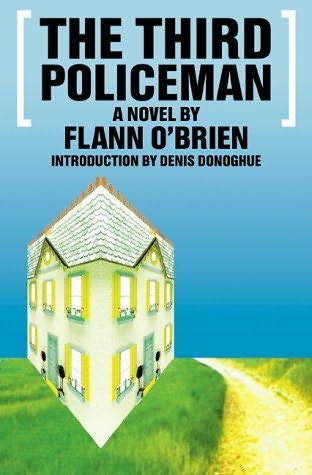
Dog Ears #12: The Third Policeman

To honor my Irish heritage and the arrival once again of St. Patrick's Day, I read The Third Policeman by celebrated Irish author Flann O'Brien (the pen of name Brian Ó Núalláin, who also wrote as Myles na gCopaleen).

The cover art feels poorly illustrated... until you hit page 52 and things begin to fall into place

Wellll... O.K., it's only a coincidence that I'm writing this two days before St. Patrick's Day. The real reason I selected this book is that I'm a big LOST nerd and a few years back one of the writers (Craig Wright) remarked, after the book was seen in Desmond's bunk in The Hatch, that the book "was selected for a reason" and contained key insights into the show.

There were some interesting echoes between the two, but the primary possible connection (which I will discuss in a moment) seems to already have been discounted by LOST honchos Lindelof and Cuse.

*THE THIRD POLICEMAN SPOILERS AHEAD*

I'm not a big fan of spoilers, but in this case I feel I can't avoid talking about them. The reason? The Introduction to The Third Policeman gave away the twist ending.

The Introduction!

p.vii (taken from a 1940 letter from O'Brien to William Saroyan):

When you get to the end of this book you realize my hero or main character (he's a heel and a killer) has been dead throughout the book and that all the queer ghastly things which have been happening to him are happening in a sort of hell which he has earned for the killing.

How can it be OK to divulge this kind of information in the Introduction, especially for a book that isn't widely known and therefore not something that everyone pretty much has heard of before à la what happens at the end of Romeo and Juliet or Of Mice and Men? Or maybe the better question is, are we not supposed to read the Introduction until after we've read the book proper? I'm at a loss here- anyone knowing the proper reading and writing etiquette please chime in.

Since the folks at LOST have repeatedly denied that the scenario we've been watching for four seasons now is a representation of limbo or the afterlife, the "big" connection doesn't resonate. That said, there are some interesting minor connections in the dog-ears to follow.

SEE! Desmond was reading it RIGHT HERE and, and it has to mean something, right?

One more (proper?) nugget from the Intro before we smooth back the dog-ears. This bit of information completely endeared me to the author before ever reading a line of his work:

He could not face the humiliation of telling Dublin that his second novel had been rejected in two continents, so he took a desperate step. He pretended that the sole typescript of the novel had been lost and that he could not write it again. Donagh MacDonagh was the only friend to whom he confided the truth. The book was not published till 1967, a year after O'Brien's death.

O'Brien wrote what is now considered a minor masterpiece in 1939-40, but he lived with feelings of deception and shame about it until his death twenty seven years later... when it was promptly published to great acclaim!

Life's a bitch and then you die and then you get published.

With no further ado, here are my selections from this most unusual, Seussian, frustrating, Escherian, frightening, Carrollian, bicycle- and pancake-obsessed and realistically surrealist novel:

p21 "The softening and degeneration of the human race he* attributes to its progressive predilection for interiors and waning interest in the art of going out and staying there. This in turn he sees as the result of the rise of such pursuits as reading, chess-playing, drinking, marriage and the like, few of which can be conducted in the open."

* the "he" in question is the deep-in-left-field (and fictional) philosopher de Selby, who the unnamed narrator is obsessed with, committing murder to bankroll his pursuit of writing a definitive commentary on de Selby's life. It says a bit about the narrator that some of de Selby's core beliefs are that the world is not round, but "sausage-shaped," and that the dark of night is brought on by an accumulation of "dark air" from "a staining of the atmosphere due to volcanic eruptions too fine to be see." This may also be a good time to point out that the author O'Brien is described as "a natural alcoholic" and writes as though he were crazy in the coconut.

p24 "In the darkest corner of the room near the window a man* was sitting in a chair, eying me with a mild but unwavering interest."

* the description of this man Mathers is eerily reminiscent of LOST's favorite apparition Jacob.


p44 (the one-legged narrator discusses the value of life with the one-legged thief Finnucane):

Is it life? Many a man has spent a hundred years trying to get the dimensions of it and when he understands it at last and entertains the certain pattern of it in his head, by the hokey he takes to his bed and dies! He dies like a poisoned sheepdog.

p47 desideratum | diˌsidəˈrätəm; -ˈrātəm; -ˌzidə-|
noun ( pl. -ta |-tə|)
something that is needed or wanted : integrity was a desideratum.
ORIGIN mid 17th cent.: from Latin, ‘something desired,’ neuter past participle of desiderare (see desiderate ).

p48 factivity/factive |ˈfaktiv|
adjective Linguistics
denoting a verb that assigns the status of an established fact to its object (normally a clausal object), e.g., know, regret, resent.

p50 "Of all the many striking statements made by de Selby, I do not think any of them can rival his assertion that 'a journey is an hallucination'."

De Selby's theory of night bears a strong resemblance to the island's "smoke monster"

p59 "'The first beginnings of wisdom,' he said, 'is to ask questions but never to answer any. You get wisdom from asking and I from not answering.'"

p66 sempiternal |ˌsempəˈtərnl|
adjective
eternal and unchanging; everlasting : his writings have the sempiternal youth of poetry.
DERIVATIVES
sempiternally |ˈˈsɛmpəˈtərnli| adverb
sempiternity |-ˈtərnitē| |ˈsɛmpəˈtərnədi| noun
ORIGIN late Middle English : from Old French sempiternel or late Latin sempiternalis, from Latin sempiternus, from semper ‘always’ + aeternus ‘eternal.’

p72 "It was so faultless and delightful that it reminded me forcibly, strange and foolish as it may seem, of something I did not understand and had never even heard of."

p75 acatalectic |āˌkatlˈektik| Prosody
adjective
(of a line of verse) having the full number of syllables.
noun
a line of verse of such a type.

p83 banjaxed/banjax |ˈbanˌjaks|*
verb [ trans. ] Brit., informal
ruin; incapacitate : he said the scheme was banjaxing the tourist industry.
ORIGIN 1930s: originally Anglo-Irish, of unknown origin.

*"banjax" is offically my new favorite word. Please, don't make me banjax you.

p 105 pari passu |ˌpärē ˈpäˌsoō|
adverb
side by side; at the same rate or on an equal footing : early opera developed pari passu with solo song.
ORIGIN Latin, literally ‘with equal step.’

nolle prosequi |ˌnälē ˈpräsiˌkwē|
noun Law
a formal notice of abandonment by a plaintiff or prosecutor of all or part of a suit or action.
• the entry of this in a court record.
ORIGIN late 17th cent.: Latin, literally ‘be unwilling to pursue.’

p123

'And he lay looking at the map for five years more before he saw that it showed the way to eternity.'
'To eternity?'
'Certainly.'
'Will it be possible for us to come back from there?' I whispered.
'Of course. There is a lift.'


p133

'How big is all this place?'
'It has no size at all,' the Sergeant explained, 'because there is no difference anywhere in it and we have no conception of its unchanging coequality.'


p138 "'But the secret of it all-in-all,' continued the Sergeant, 'is the daily readings*. Attend to your daily readings and your conscience will be as clear as a clean shirt on Sunday morning. I am a great believer in the daily readings.'"

*do you get the sense that Locke was a big fan of the "daily readings" before he screwed the pooch at the end of Season Two?

p158 "'Strange enlightenments are vouchsafed," I murmured, 'to those who seek the higher places.'"

Monday, January 21, 2008

Empathy for the Devil

HEDLEY LAMARR
My mind is a raging torrent, flooded with rivulets of thought
cascading into a waterfall of creative alternatives.

TAGGART
God darnit, Mr. Lamarr, you use your tongue
purtier than a twenty dollar whore.

Too often I find myself thinking like Hedley and speaking like Taggart. Hopefully I write somewhere in between.

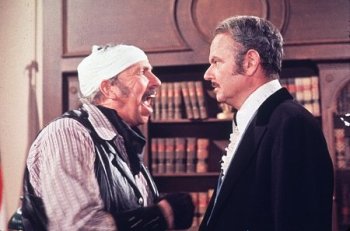
The solution to all life's riddles can be found in BLAZING SADDLES

My mind HAS been flooded with a variety of rivulets lately, and they seem to be begging me to tie them together somehow.

Here they are, separately:

1. A desire to finally write down definitions of classically descriptive terms like "pathos" and "bathos" that I (and many others) seem to misuse and often misunderstand.
2. A desire to finally write down translations of still-in-use Latin phrases that I (and many others) seem to misuse and often misunderstand.
3. A desire to finally write down crib-sheet style descriptions of all the philosophers and thinkers overtly referenced in the character names in LOST in preparation for the premiere next Thursday.

We'll see, I suppose, if there's a connection other than the tenuous one that they were all in play at one time or another as I pursued my BA in Poli-Sci. Hopefully, at the very least, they'll look purty all wrote out in a row.

pathos: Greek for "to suffer".
  1. The aspect of something which gives rise to a sense of pity.
  2. In its rhetorical sense, pathos is a writer's attempt to persuade an audience through appeals involving the use of strong emotions. In this sense, pathos is not strictly limited to pity. In its critical sense, pathos denotes an author's attempt to evoke a feeling of pity or sympathetic sorrow for a character.
  3. In theology and existentialist ethics following Kierkegaard and Heidegger, a deep and abiding commitment of the heart, as in the notion of "finding your passion" as an important aspect of a fully-lived, engaged life.

The urge to make a groan-inducing pun with the word "bathos" is all-but overwhelming

bathos
: Greek for "depth". Used metaphorically from 1638 (Robert Sanderson). First used ironically by Alexander Pope (Bathos, 1727), in contrast to "sublime".
  1. Depth, Bottom.
  2. An abrupt change in style, usually from high to low; an unintended transition of style; an anticlimax.
  3. Triteness; triviality; banality.
  4. Overly sentimental and exaggerated pathos.
pathetic:
1. arousing pity, esp. through vulnerability or sadness : she looked so pathetic that I bent
down to comfort her. See note at moving .
• informal miserably inadequate : his test scores in Chemistry were pathetic.
2. archaic relating to the emotions.

empathy:
1. the intellectual identification of the thoughts, feelings, or state of another person
2. capacity to understand another person's point of view or the result of such understanding

sympathy:
  1. A feeling of pity or sorrow for the suffering or distress of another; compassion.
  2. The ability to share the feelings of another; empathy.
  3. (psychology) A mutual relationship between people such that they are correspondingly affected by any condition.
  4. (physiology) A mutual relationship between organs such that a condition of one part causes an effect in the other.
a priori: deductive reasoning, from cause to effect

a posteriori: inductive reasoning, from effect to cause

factotum: one who does everything

sine qua non: fundamental cause; necessary precondition

flagrante delicto: in the heat of the crime
(I always thought this had a more lurid meaning...)

persona non grata: an unacceptable person

cogito ergo sum: I think, therefore I am (first busted out by ya boy René Descartes in 1637)

amor fati: (this one I've been thinking about a lot lately because of the beautiful Nietzsche quote I stumbled across, so excuse the lengthier wikipedia definition in this already lengthy post)

Amor fati is a Latin phrase that loosely translates to "love of fate" or "love of one's fate". It is used to describe an attitude in which one sees everything that happens in one's life, including suffering and loss, as good. That is, one feels that everything that happens is destiny's way of reaching its ultimate purpose, and so should be considered good. Moreover, it is characterized by an acceptance of the events that occur in one's life.

The phrase is used repeatedly in Nietzsche's writings and is representative of the general outlook on life he articulates in section 276 of The Gay Science, which reads,

I want to learn more and more to see as beautiful what is necessary in things; then I shall be one of those who make things beautiful. Amor fati: let that be my love henceforth! I do not want to wage war against what is ugly. I do not want to accuse; I do not even want to accuse those who accuse. Looking away shall be my only negation. And all in all and on the whole: some day I wish to be only a Yes-sayer.

John Locke is named after John Locke (1632-1704) the Enlightenment philosopher who dealt with the relationship between nature and civilization, later to have great influence on founders of democratic governments. He believed that, in the state of nature, all men had equal rights to punish transgressors; to ensure fair judgment for all, governments were formed to better administer the laws.

Anthony Cooper is John Locke's father. It seems he's based on two Anthony Coopers:
Anthony Ashley-Cooper (1621-1683) was an English politician who was the mentor and patron of real-life philosopher, John Locke.

Anthony Ashley-Cooper (1671-1713) was an eighteenth-century moral philosopher who posited that people are basically good, and that morality is a foundational (if not innate) part of humanity.

"Desmond" David Hume is named after David Hume (1711-1776). Hume was the first great philosopher of the modern era to carve out a thoroughly naturalistic philosophy. This philosophy partly consisted in the rejection of the historically prevalent conception of human minds as being miniature versions of the Divine mind; a notion that has been entitled the ‘Image of God’ doctrine. This doctrine was associated with a trust in the powers of human reason and insight into reality, which powers possessed God’s certification.

Danielle "Rousseau" is named after Jean-Jacques Rousseau (1712-1778), a philosopher and composer of the Enlightenment whose political philosophy influenced the French Revolution, the development of both liberal and socialist theory, and the growth of nationalism. With his Confessions and other writings, he practically invented modern autobiography and encouraged a new focus on the building of subjectivity that would bear fruit in the work of thinkers as diverse as Hegel and Freud. His novel Julie, or the New Heloise was one of the best-selling fictional works of the eighteenth century and was important to the development of romanticism.

I think Alpert's backstory will go a long way in telling us if time travel is in play on LOST

Richard Alpert (the eyebrowish "Other" who recruited Juliet to the island) is named after Dr. Richard Alpert (born April 6, 1931), also known as Baba Ram Dass, is a contemporary spiritual teacher who wrote the 1971 bestseller Be Here Now. He is well-known for his association with Timothy Leary at Harvard University in the early 1960s, both having been dismissed from their professorships for experiments on the effects of psychedelic drugs on human subjects. He is also known for his travels to India and his association with the Hindu guru Neem Karoli Baba.

Mikhail Bakunin (aka "Patchy") is named after Mikhail Bakunin (1814-1876) was a well-known Russian revolutionary and anarchist philosopher. He "rejected governing systems in every name and shape", every authority figure, including God, or a sovereign. Bakunin denied the concept of "free will" and advocated a materialist explanation of natural phenomena. Bakunin believed that the proper form of social organization is that of free association between individuals and between communities. Thus, "The freedom of all is essential to my freedom."

Whew. I feel better now. Thank you to Wikipedia, Wiktionary, Apple's Dictionary, Latin Phrases & Quotations by Richard A. Branyon, and Lostpedia.

Finally, for other LOST fans beginning to loosen up their theory-belts for Season 4, check out this intriguing line of thinking at Lost in Shangri-La.

Thursday, August 30, 2007

Dog Ears #5: Crash

No no, not that CRASH, J.G. Ballard's 1973 novel CRASH. I was drawn to the book to see what longtime fave David Cronenberg was thinking when he adapted Ballard's work for his controversial 1996 film of the same name.

Hitchcock would've loved Deborah Kara Unger

Note to self- it can be dangerous to wonder what David Cronenberg was thinking.

Overall I found the book to be dated, repetitive and sophomoric, and not nearly as hot or disturbing as I expected from a quasi-legendary book of underground erotica. Thankfully it was short, 'cause if I read either of Ballard's favorite words ("glans" and "pubis") one more time I was gonna crash my foot into the book's spine.

After CRASH, I doubt I'll ever read Ballard's EMPIRE OF THE SUN which Spielberg adapted in 1987 (unless I hear good things about it from you of course).

The good news is that the book was chock full of dog-earable words that I'm excited to finally look up, not to mention a turn of phrase or two that aroused my literary side.

p22. "It was not the sexuality of the posture that stayed in my mind, but the stylization of the terrible events that had involved us..."

p39. "At times I had even speculated on the kind of traffic accident in which I would die."*

* I included this quote because it reminded me that during my first stint in Los Angeles (1995-2001) I had a premonition that I would eventually be killed on one of the city's many highways. Thankfully I haven't felt that same foreboding this time around.

p41. buccal |ˈbəkəl| |ˌbəkəl| |ˌbʌk(ə)l|
adjective / technical
of or relating to the mouth : the buccal cavity.
• of or relating to the cheek : the buccal side of the molars.
ORIGIN early 19th cent.: from Latin bucca ‘cheek’ + -al.

p42. "Listening in a bored way, the women patients lay in their beds. Two of them were suspended with their legs in traction, as if involved in the fantasies of a demented gymnast."

p50. autogeddon. I assume this word was the creation of the author... it bugged me every time I read it. As far as neologisms go, though, it's pretty weak salsa.

p54. penumbra |peˈnəmbrə| |pəˌnəmbrə| |pɪˌnʌmbrə|
noun
the partially shaded outer region of the shadow cast by an opaque object.
• Astronomy the shadow cast by the earth or moon over an area experiencing a partial eclipse.
• Astronomy the less dark outer part of a sunspot, surrounding the dark core.
• any area of partial shade.

p57. vitrified > vitrify |ˈvitrəˌfī| |ˌvɪtrəˈfaɪ| |ˌvɪtrɪfʌɪ|
verb ( -fies, -fied) [ trans. ] (often be vitrified)
convert (something) into glass or a glasslike substance, typically by exposure to heat.

i had to vitrify that glass

p65. invigliator > invigilate |inˈvijəˌlāt| |1nˌvɪdʒəˈleɪt| |ɪnˌvɪdʒɪleɪt|
verb [ intrans. ] Brit.
supervise candidates during an examination.
DERIVATIVES
invigilation |-ˌvijəˈlā sh ən| |1nˈvɪdʒəˌleɪʃən| |-ˌleɪʃ(ə)n| noun
invigilator |-ˌlātər| |1nˌvɪdʒəˈleɪdər| noun

p77. "A week after the inquest she was waiting at the taxi rank of the Oceanic* Terminal as I drove away from Catherine's office."
* LOST fans will enjoy the name of Ballard's fictitious airline.

p99. treadle |ˈtredl| |ˌtrɛdl| |ˌtrɛd(ə)l|
noun
a lever worked by the foot that imparts motion to a machine.
• any of a row of metal spikes set on an angle on a spring within a plate laid across the entrance or exit of a parking facility, used to prevent drivers from using the facility without paying.

p144. sulcus |ˈsəlkəs| |ˌsəlkəs| |ˌsʌlkəs|
noun / Anatomy
a groove or furrow, esp. one on the surface of the brain.

p148. anneal |əˈnēl| |əˌni(ə)l| |əˌniːl|
verb [ trans. ]
heat (metal or glass) and allow it to cool slowly, in order to remove internal stresses and toughen it.
• Biochemistry recombine (DNA) in the double-stranded form following separation by heat.

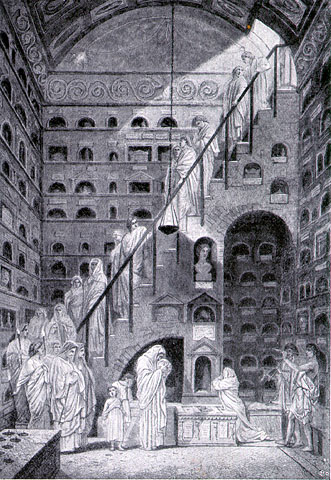
p151. columbarium |ˌkäləmˈbe(ə)rēəm| |ˈkɑləmˌbɛriəm| |ˈkɒl(ə)mˌbɛːrɪəm|
noun ( pl. -baria |-ˈbe(ə)rēə| |ˈkɑləmˌbɛriə|)
a room or building with niches for funeral urns to be stored.
• a niche to hold a funeral urn.
• a stone wall or walk within a garden for burial of funeral urns, esp. attached to a church.
ORIGIN mid 18th cent.: from Latin, literally ‘pigeon house’ .

mummy, where are the pigeons?

p177. invagination |inˌvajəˈnā sh ən| |1nˈvødʒəˌneɪʃən| |ɪnˈvadʒɪˌneɪʃ(ə)n|
noun chiefly Anatomy Biology
the action or process of being turned inside out or folded back on itself to form a cavity or pouch.
• a cavity or pouch so formed.

p205. hypogeum |ˌhīpəˈjēəm| |ˈhaɪpəˌdʒiəm| |ˈhʌɪpə(ʊ)ˌdʒiːəm|
noun ( pl. -gea |-ˈjēə| |ˈhaɪpəˌdʒiə| |-ˌdʒiːə|)
an underground chamber.
ORIGIN mid 17th cent.: from Latin, from Greek hupogeion, neuter of hupogeios ‘underground.’

Sunday, July 22, 2007

Dog Ears #3: Watchmen

As it's now been established that I'm a Newsweek reader, I had no idea that Time Magazine had published a list of "the 100 best English-language Novels from 1923-Present" in 2005 until I read the back jacket copy of my newly purchased graphic novel WATCHMEN.

There's a good reason they all look so glum.

WATCHMEN, written by Alan Moore (creator of the underrated V FOR VENDETTA), illustrated/lettered by Dave Gibbons, and originally published in serial form by DC Comics in 1986-87, was the only graphic novel named to the Time 100. I picked it up because Damon Lindelof, the co-creator of ABC's LOST, has dropped the occasional hint that some of the show's inspirations were derived from the apparently hugely influential WATCHMEN. I couldn't resist the challenge to see if I could glean some new insights into my favorite still-running show (where have you gone SAXONDALE!?), and other than a couple of Frank Miller graphic novels I hadn't read any comics since the Marvel-ocentric heyday of my youth.


WHAT IF? was more than a comic, it was a pre-teen mantra.

WATCHMEN quickly overcame my skepticism about its placement on the list (I've now read 24 of the Time 100 and am eager to read one more to get that nice round percentage) and continued my recent trend of reading books that really delivered the goods down the home stretch. As with TCOMC, I was struck by a number of exceptionally written (or just plain fun to read) passages and took note of words that were either unfamiliar or needed a look-up to refresh my memory.

If there seem to be some long quotes for a graphic novel, it bears noting that at the end of each chapter there are a variety of "inserts" in the form of articles, book excerpts, interviews, etc. taken from the world of the Watchmen.

OK, with no further ado...

Chapter 3, Page 31
nepenthes |nəˈpenθēz| noun 1 (also nepenthe) |-θē| poetic/literary, a drug described in Homer's Odyssey as banishing grief or trouble from a person's mind. • any drug or potion bringing welcome forgetfulness. ORIGIN: via Latin from Greek nēpenthēs ‘dispelling pain,’ from nē- ‘not’ + penthos ‘grief.’

The view from the aptly-named restaurant Nepenthe's deck in Big Sur.

Chapter 3, Page 31
The new breed of villains... weren't as much fun to fight. All the cases I ended up investigating during the 50's seemed sordid and depressing and quite often blood-chillingly horrible. I don't know what it was... there just seemed to be a sort of bleak, uneasy feeling in the air. It was as if some essential element of our lives, of all our lives, was vanishing before we knew entirely what it was."

Chapter 9, Page 6

"There is no future. There is no past. Do you see? Time is simultaneous, an intricately structured jewel that humans insist on viewing one edge at a time, when the whole design is visible in every facet."

Chapter 11, Page 23
... and from the decks above a cheer went up, both gross and black, its stench affronting heaven.

Chapter 11, Page 32
"Oh, and I've heard some interesting new music from Jamaica... a sort of hybrid between electronic music and reggae. It's a fascinating study in the new musical forms generated when a largely pre-technological culture is given access to modern recording techniques without the technological preconceptions that we've allowed to accumulate, limiting our vision. It's called dub music. You'd like it, I'm sure."

Chapter 12, Page 7
tachyon |ˈtakēˌän| noun, Physics, a hypothetical particle that travels faster than light. ORIGIN 1960s: from tachy- [swift] + -on .


Ah, NOW i understand what a tachyon is.

Chapter 12, Page 27

I did the right thing, didn't I? It all worked out in the end.

"In the end"? Nothing ends, Adrian. Nothing ever ends.

This last quote really affected me, in the same way that laying on the beach and staring up at the night sky does.

Monday, May 21, 2007

The Wikipediaization of Film and Television

LOST: the world's biggest book club?

Making Pop Culture references in movies and TV shows is a high-risk, high-reward proposition. Producers gladly endure blank stares Thursday for a big laugh today. Pop culture references require no education or sophistication from audiences, just the safe bet that most Americans have watched tens of thousands of hours of programming in their lives to choose from.

Some will know that I just made a pop-culture reference to Wimpy, a supporting character from the Popeye comics and cartoons known for his famous (?) catchphrase "I'd gladly pay you Tuesday for a hamburger today." Those not familiar with Wimpy will wonder what the hell I'm talking about. In this case, the tiebreaker is my long held belief that once a character has risen up beyond the page and the screen and manifested into a fast-food chain (see UK burger chain Wimpy's) they are fair game for referencing.

spinach=good, hamburgers=bad

Anyway... is it possible to please those in the know while not alienating the uninitiated? What is the rate for acceptable "losses"?

Lately, the cover-every-base strategy seems to pour in avalanches of so-called "high culture" references too in hope that the two-pronged attack will include something for everyone.

I'm a big fan of ABC's LOST, which has just completed it's third season and has been the topic of much discussion and deconstruction by critics and fans virtually since day one. Following is an excerpt from a column regarding the Season 3 finale (posted 5/24) on Entertainment Weekly's website, written by Jeff Jenson :

"We got it wrong, didn't we? All the so-called clues in the text, all the suspected hints tucked in the subtext — Stephen Hawking and his time-warping black holes, Ms. Hawking and her symbolically loaded ouroboros pin, the Room 23 film and its hidden message, ''Only fools are trapped in time and space.'' For much of season 3, the freaky theorists among us suspected that Lost was setting us up for some continuum-contorting twist of Hiro Nakamura-esque proportions."

Is populist mag Entertainment Weekly willing to risk ticking off the presumably sizeable segment of readers who don't know their ouroboros from their outer boroughs and have never heard of the anime director or quantum physicist or whoever this Nakamura guy is?

this ouroborous is from Staten Island

Not any more! Why? Because we the non-MENSA readers and viewers are expected to become temporary faux Renaissance men and women in the LOST loop using the very same methods that the writing staff of LOST used to become instant experts on the symbolism of the ouroborous, Hermann Minkowski's theory of four-dimensional space-time, Jacques-Marie-Émile Lacan's philosophy of psychoanalysis, and the hundreds of other high-minded high culture references that we're meant to believe is propelling the show's mysterious narrative.

How, you ask? Why Wikipedia of course! Wikipedia has become "The Entirety of Humankind's Knowledge for Dummies." As long as we're not asked to provide any sort of depth to that message board post on wormholes or ever engage in conversation in a "live" setting, everybody with a keyboard and an ounce of curiosity is an expert in all fields. sadly, many of us have also become opinionated experts on these topics that we just learned two sentences about last week, but that's another rant. This is no knock on the smarts or creativity of creators/showrunners Carlton Cuse (48, Harvard grad) and Damon Lindelof (34, NYU Film School), I just doubt that they were able to amass PhD level educations in philosophy, literature, physics, etc. and absorb every comic book, horror novel and sci-fi pulp of the 20th century all while cranking out episodes of BRISCO COUNTY, JR., CROSSING JORDAN and NASH BRIDGES. Fortunately, the internet doesn't require a library card and is damn good at summarizing enormous amounts of info into easily digestible paragraphs.

PS. As some of you knew immediately and others like myself had no clue about (until I Wiki'd him), "Hiro Nakamura" is a character from a show I've never seen but apparently is also rich in references- NBC's HEROES. I wonder if it's meaningful that his name sounds a lot like the show's name?