Showing posts with label Movie Marketing. Show all posts

Friday, February 27, 2009

Now Playing: 365 Original Feature Film Titles, Loglines and Taglines

Has a movie ever changed your life?

I can point to one that absolutely, positively, irrevocably altered the direction my life has taken.

In the spring of 1992, as my junior year at UNC-CH was winding down, I went to see the new Robert Altman film THE PLAYER at the Varsity Theater on Franklin Street in Chapel Hill. I was already a big movie nut before seeing the film, but the majority of my knowledge about the movie industry came from SISKEL & EBERT, ENTERTAINMENT TONIGHT and what I heard on the tram of the Universal Studios tour.

I'm not sure what it says about me that I felt a connection to the murderous sleazeball studio exec

THE PLAYER changed all that. I walked out of that movie wishing I could be Griffin Mill, the oily studio exec played so brilliantly by Tim Robbins. My mind reeled that someone's job was sitting at a desk, hearing writers pitch movie ideas and then saying "yea" or "nay." I loved the intrigue of the studio lot and the satiric look at the creative process that so often requires a deal with the devil.

That movie got me thinking about where I was going with my life and what my career path would be (the number one topic of most college juniors methinks). I had chosen my Poli Sci major because it was one of the top pre-law majors, but my feelings about law school had been steadily eroding for some time. I headed to Alaska the summer of '92 experiencing a real crisis of identity and generally feeling the fear.

Me, in Alaska, on the verge of an epiphany (and needing a shave + shower).

Long story short, you have a lot of time to think working the slime line of a salmon cannery, and my mind kept coming back to THE PLAYER. One day I had an epiphany of sorts at my campsite after a particularly long shift: no matter what you do you have to give working in Hollywood a shot. I graduated in '93 and by '95 I was living in Los Angeles and learning how to be a development guy as an intern Wendy Finerman Productions on the Columbia/TriStar (aka Sony) lot in Culver City.

As I was wondering what to do with this here blog, my thoughts came back once again to THE PLAYER, and one particularly funny and prescient scene. Larry Levy (played by Peter Gallagher) is the new hotshot exec at the studio where Griffin Mill works. Larry is bemoaning how expensive screenwriters are to the studio, and wonders aloud if maybe the execs in the room couldn't come up with ideas for features that are just as good....

LARRY LEVY
I'm just saying there's time and money to be saved...
if we came up with these stories on our own.

GRIFFIN MILL
Where are these stories coming from?

LARRY LEVY
Anywhere. It doesn't matter.
The newspaper.
Pick any story.

BONNIE
'Immigrants protest budget cuts
in literacy program.'

LARRY LEVY
Human spirit overcoming human adversity.
Sounds like Horatio Alger in the barrio.
Put Jimmy Smits in it and you've got
a sexy STAND AND DELIVER.

BONNIE
How about 'Mud slide kills hundreds
in slums of Chile'?

LARRY LEVY
That's good. Triumph over tragedy.
Sounds like a John Boorman picture.
Slap a happy ending on it,
the script will write itself.

BONNIE
'Further bond losses
push Dow down.'
(beat)
I see Connery as Bond.

(Thanks to script-o-rama.com for this excerpt, which I edited for clarity.)

This scene, in turn, reminded me of the many, many times I've heard my fellow wanna-be screenwriters worrying about protecting their script ideas from nefarious producers and studios. Always registering, trademarking and speaking in hushed tones about their precious ideas...

In my experience, ideas are cheap... it's the execution that's expensive. The days of the writer selling a feature pitch for millions without the accompanying polished, ultra-tight, already-written screenplay are all but gone, and besides, it's much cheaper for a producer or studio to option or buy a script than to "steal" an idea, develop and write it on their own and risk a lawsuit and bad publicity if the film is a success.

Unfortunately, the days of original screenplays (i.e. not reboots, reimaginings, sequels, adaptations, etc) being made into studio films also seem to be in danger (but I digress).

I am going to put my belief that it should be relatively easy for writers to come up with movie ideas to the test, and write a new one every day for the next twelve months, starting this Sunday March 1.

I am going to hone my abilities to write taglines on these film pitches because I think I would be great at it in "real life" and I want to put that belief to the test.

And finally, I am going to focus on what I believe is the extreme importance of a great title for a film that seeks commercial success. I read the following in the storylink.com "eZine" that I subscribe to a few days ago and I think it hit the nail right on the head:

A spec script must have a strong concept and poster that is "primal" and easy to tell - and a title that "says what it is"!

I am a firm believer in the necessity of a title that, in some essential way, "says what it is." Quick, what was the movie BODY OF LIES about? That film was referenced in an article I was reading and I couldn't for the life of me remember. I had to look it up- it was the Ridley Scott-Russell Crowe-Leonardo DiCaprio flop ($70 million budget, $39 million domestic gross) from just last year. I haven't seen the movie, so I can't make any judgment on whether it was good or not, but I can say that a generic title like BODY OF LIES, that could just as easily be the title of a legal thriller or a woman-in-jeopardy film, did it no help. No one will have trouble remembering what the hell SLUMDOG MILLIONAIRE or THE SIXTH SENSE was about...

One final thought... if, by some chance, a producer or writer or actor or director reads one of my barebones movie pitches and happens to like it, I say "adapt away." As these pitches are my intellectual property, I fully expect a "Story By" credit and all the lucre that comes with it. That said, I fervently hope you take my pitch, spend a few months writing and polishing it and a year or two producing and marketing it, and make us lots and lots of money with it.

But wouldn't it be much simpler to hire ME to write it with you and/or for you?

Wednesday, November 28, 2007

Broadway Joe and His Super Biopic

OK, imagine Jake "Donnie Darko" Gyllenhall re-enacting this memorable scene from December, 2003...


That's right, the feature film version of "Broadway" life will be coming soonish to a theater near you starring Jake Gyllenhaal. As I read the news today on ESPN.com, I started thinking about the two Joe Namath scripts I read for work a few years back, both titled "Broadway Joe." Neither one really made a convincing case that Joe's life was worthy of a made-for-cable movie then, and I'm even less convinced that his story is compelling enough for the big screen today.

Let's look at the numbers:

On the plus side, he was QB for Alabama's 1964 National Championship team, as well as the only QB ever to lead the New York Jets to a title, winning Super Bowl III in 1968. He was very, very famous sex symbol and sports hero then, and is still a household name today.

On the minus side, his career numbers fall between ordinary and below average. His career Quarterback Rating is an eye-poppingly bad 65.5 (good for #131 on the list of the 148 QBs with at least 1500 Pass Attempts). His touchdown to interception ratio is 173-220. Although he is in the Hall of Fame, his career passing yardage of 27,663 ranks 43rd all time, just 61 yards ahead of Jeff George.

George led the league in MR (Mullet Rating) for six consecutive years

I guess you can throw those numbers out for two reasons:

1. He played in NYC
2. He had star power.

But is that enough to get moviegoers under 40, who weren't even born when his star burned the brightest, to pay $11 to see his story? If the movie takes the clichéd "celebrity is bad for your health" tack, my prediction is no.


I dug in my archives to see what I'd thought of the two other Namath scripts (I would instantly forget what I wrote when I was writing coverage for a living). I'll spare you the plot summaries and redact the names of the guilty (though I can tell you that neither were hired to write the Gyllenhaal film) while pasting in the coverage sections of both.

"Broadway Joe" by XXXX, written 2005

Joe Namath is indeed still famous, but XXXX’s BROADWAY JOE is unable to convincingly justify the biopic treatment for a man best known for backing up his guarantee that the New York Jets would win the Super Bowl 36 years ago. XXXX gives the material a slick, glossy feel but the resulting narrative is a fast-fading illusion of drama, not the real thing. Framing device of a look at the Namath of today backfires. If we open on the drunken mess of a man who embarrassed himself on ESPN and flashback to the past only to find that Namath was a drunken mess of a man then too (but happened to get his act together long enough one season to win a Super Bowl), what have we learned? Script stirs together a father complex, bad knees, the mafia, celebrity pop-ins by Warhol and Elizabeth Taylor, the friction between Pete Rozelle and Sonny Werblin (!!!) and plenty of sex and profanity, but cannot cobble together a central character strong enough to transcend. The description of the on-the-field action is gritty, but Namath’s sudden ability to diagram superior plays during the Super Bowl run comes from nowhere. XXXX loses more credibility when Namath, fresh off a second knee surgery and barely able to walk, dunks a basketball to impress an African-American teammate that he’s no fancy rich boy (p84). BROADWAY JOE tries strenuously, but is ultimately unable to convey that “the Joe Namath story” is somehow meaningful beyond his ability years ago to pass the football.

and

"Broadway Joe" by YYYY, written 2004

YYYY has undeniable skill in the craft of screenwriting, but shows little grasp of the art of it with BROADWAY JOE. Title is a bit of a misnomer, as the story is far more focused on Jets founder Sonny Werblin. When the titular character of a biopic comes off as a wooden prop, a certain degree of failure is inevitable. Sonny talks a big game about how he’s got Joe’s best interest at heart, thinks of him as a son, etc. but we never get a sense of why he does- Joe isn’t particularly infatuated with Sonny and he’s terrible in the field the first few years, too busy chasing skirt and getting loaded. Joe the character comes off as a bit of a dim bulb, except when convenient for the plot. The season they win the Super Bowl Joe is referred to as “the professor” on p70, yet when Sonny gives him a thematically-relevant book Joe looks through it and complains “No pictures?” (p85). Dialogue is very linear and uses heavy profanity as a spice to flavor otherwise bland interchanges. Very little football action. Script doesn’t cater to existing fans (his infamous guarantee that the Jets would beat the heavily favored Colts in the Super Bowl is only mentioned in passing after the fact), nor is it likely to convert any new ones with dull subplots centered on Joe’s gambler friends and Sonny’s rivalry with Pete Rozelle. BROADWAY JOE reads briskly but the journey is meandering and, at the end of the day, the character work is just not that compelling.

I guess time will tell whether or not my warnings not to walk down "Joe Willie's" cinematic path are borne out. I have a feeling that the deeper into the Deep Fried Media Age a subject lived in/found stardom in, the less likely people are going to be to plunk down money to see a dramatization of things they've already seen unfold in real time. No one can deny that the O.J. Simpson murders and trial were dramatic, but can you imagine anyone who lived through it wanting to see a two hour version of the story on the big screen?

A final note- biopics as a genre are fast becoming as tedious and uninspired as the remake. There will always be a place for the Illumination (an obscure-but-compelling life is brought to the forefront, à la John Nash in A BEAUTIFUL MIND) and the Revelation (what really made a mysterious figure tick, à la Ian Curtis in CONTROL), but the Demythologization approach (see ALI or THE LIFE AND DEATH OF PETER SELLERS) is a dicey gamble.

Who wants to see their heroes taken down a peg? Aren't there too few as it is?

I see Evangeline Lilly as Jett.

You know that a genre is reaching the tipping point when it's getting directly satirized (the 12/21 release WALK HARD: THE DEWEY COX STORY), but that doesn't mean there still aren't worthy subjects and films to come. Out of the following list of upcoming/planned musical biopics (taken from the pages of Vogue's Fall 2007 Supplement "Movies Rock"), I wonder which subject seems the most promising to you? (Actors listed are rumored or attached)

Miles Davis (Don Cheadle)
Joan Jett (TBD)
Otis Redding (TBD)
Rick James (Terrence Howard)
Muddy Waters (Terrence Howard)
Janis Joplin (Zooey Deschanel)
Iggy Pop (Elijah Wood)
Mötley Crüe (TBD)
Debbie Harry/Blondie (Kirsten Dunst)

In closing, a spot-on quote from Roger Ebert (discussing the Rubin Carter biopic THE HURRICANE):

Those who seek the truth about a man from the film of his life might as well seek it from his loving grandmother.

Saturday, October 13, 2007

Use Your Reimagination

I'm sure by now everyone has noticed this, but the taglines for two miserable-looking comedies out now are almost exactly alike. The curiously ubiquitous Dane Cook's GOOD LUCK CHUCK's tagline is "Sometimes, Love Blows" while "Love Blows" sells us THE HEARTBREAK KID, Ben Stiller's ill-conceived remake of the 1972 Charles Grodin vehicle.

Nobody can curl a lip like Grodin

How unimaginative, right?

Perhaps, when they're remade in the future, someone will "reimagine" the taglines too.

Hollywood has apparently become dissatisfied with the term "remake", because lately I've been reading that films like Rob Zombie's 2007 HALLOWEEN aren't remakes, but "reimaginings" of the source material.

From Wikipedia:

Recently, the term "reimagining" has become popular to describe remakes that do not closely follow the original. The term is used by creators in the marketing of films and television shows to inform audiences that the new product is not the same as the old.

But how close is "closely"? Is there a definitive dividing line that separates the mere remake from the far more grandiose-sounding reimagining?

I've been plagued by/secretly enjoying nightmares "adapted from" John Carpenter's HALLOWEEN my entire adult life

First we have to sort the "reinterpretations" out of the equation. BATMAN BEGINS (2005) is not a remake of nor a sequel to BATMAN (1989), but rather a reinterpertation of the same DC comic book source material that inspired BATMAN the movie and BATMAN the 1960's TV series. So, then, it would seem that BATMAN BEGINS (and its 2008 sequel THE DARK KNIGHT) are technically "readaptations", right?

Who the hell knows. It just seems depressing to me that rather than fostering new ideas, we're doomed to a neverending cycle of cannibalism and reheating of leftovers. The Wikipedia section listing film remakes is so long that it has to be broken up into two sections: A-M and N-Z.

Back to reimagining. All of the film and TV franchises that have been deemed reimaginings are in the horror and sci-fi genre: TEXAS CHAINSAW MASSACRE (1974 & 2003), BATTLESTAR GALACTICA (1978 & 2003), DAWN OF THE DEAD (1978 & 2004), BIONIC WOMAN (1976-2007), etc.

I wonder why that is? Why is Michael Bay, who as producer has already re-somethinged the AMITYVILLE HORROR, THE HITCHER and TEXAS CHAINSAW MASSACRE franchises, now turning his attention to FRIDAY THE 13th?

It's hard to believe FRIDAY THE 13TH: THE FINAL CHAPTER was 23 years ago...

Because IT'S EASY! Is there anything more American than following the path of least resistance to the pot of gold? These films and franchises have brand equity and name value, so it doesn't really MATTER how wildly they're reimagined or bastardized... basically the same format and structure are gonna unfold whether or not it's a no-name low-budg horror film or it's a big-budg "Rising/Birth of" chapter or a THEORETICALLY daring shift of location or temporal setting (JASON GOES TO HELL and/or MANHATTAN, Aliens fight Predators, etc).

A large group of teens/scientists/mercenaries are gonna be whittled down by the killer, at least one in a sexually compromising position, until a final showdown where the killer is vanquished... or is/are they?

Repeat as necessary.

Sunday, September 23, 2007

It Blows By Any Other Name?

Who's ready to get unscientific?!? Good, me too.

I've been seeing ads lately for IN THE VALLEY OF ELAH, the latest surefire post-MONSTER flop from Academy Award® Winner . I have no idea what the movie is about, but every time I see an ad for it I cringe at how awful the title is. With a title like that it HAS to be a flop, right?

Well, I think so.

The flag in the background counteracts the foreign-sounding word in the title

The first movie title that I can remember having this same effect on me was KRIPPENDORF'S TRIBE. I remember seeing the trailer for it and whispering to whoever it was next to me "Can you imagine ever speaking the words "'two for KRIPPENDORF'S TRIBE please'"? Unfortunately I can't immediately find the budget for KRIPPENDORF'S, but with a U.S. gross of $7.6 million for a Disney movie starring Richard Dreyfuss and Jenna Elfman, I can safely call it a flop.

I thought it would be fun to look back at the titles of the 3,296 films that have been/will be released from January 1, 2003 to December 31, 2007 and pick out the the titles that I hated strictly on their own merit. These are titles that made me cringe so viscerally that they actively made me NOT want to see the film they represented.

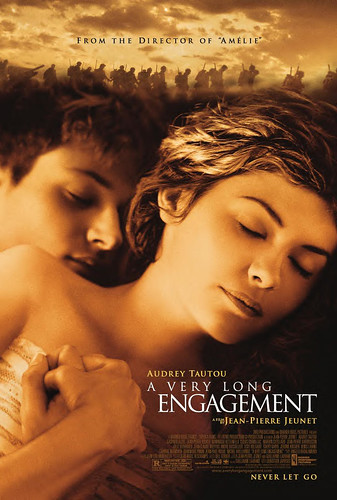
it just can't be a good idea to have "VERY LONG" in your movie's title

I came up with 20 films in all, and AFTER I selected them by title, I looked up their budgets and their box office performance in the U.S. Let's see how good a prognosticator I would have been if betting by title alone.

2003

THE LIFE OF DAVID GALE: budget- $50 million, U.S. gross- $19.7 million
POOLHALL JUNKIES: b. $4 mil, USg. $.56 mil
OWNING MAHOWNY: b. $10 mil, USg. $1 mil


2004

CHASING LIBERTY: b. $23 mil, USg. $12.2 mil
WELCOME TO MOOSEPORT: b. $26 mil, USg. $14.5 mil
THE UNITED STATES OF LELAND: b. ??, USg. $.34 mil
THE CHRONICLES OF RIDDICK: b.$120 mil, USg. $57.7 mil
A HOME AT THE END OF THE WORLD: b. $6.5 mil, USg. $1 mil
SKY CAPTAIN AND THE WORLD OF TOMORROW: b. $70 mil, USg. $37.8
A VERY LONG ENGAGEMENT: b.$55 mil, USg. $6.2 mil


2005

BECAUSE OF WINN-DIXIE: b. $15 million, USg. $32.6
ELIZABETHTOWN: b.$54 million, USg. $26.9


2006

LOOKING FOR COMEDY IN THE MUSLIM WORLD: b. ???, USg. $.89 mil
TRISTRAM SHANDY: A COCK AND BULL STORY: b. $4.7 mil, USg. $1.2
LUCKY NUMBER SLEVIN: b. $27 mil, USg. $22.5
LET’S GO TO PRISON: b. $4 mil, USg. $5.5 million


2007

CODE NAME: THE CLEANER: b. $20 mil, USg. $8.1 mil
I THINK I LOVE MY WIFE: b. $14 mil, USg. $12.5
THE WENDELL BAKER STORY: b. $8 mil, USg. $.13 mil
IN THE VALLEY OF ELAH: b. ??? USg. ???

Slevin? no really, Slevin??

So, without using LELAND and ELAH and MUSLIM in the equation (for lack of available figures) lets see what the numbers add up to for the other 17 films on Mr. Word Player's Terrible Title List™.

COMBINED BUDGET: $511.2 million
COMBINED GROSS: $260.1 million

COMBINED LOSS: $251.1 million

Now here's the question that I have no answer for-- with better titles, would these films have performed appreciably better? Or are titles such an integral part of a film that these were doomed to (collective) box-office failure, having been developed and rewritten for so long with weak titles at the eye of the storm?

I haven't seen any of the movies on the list (with the exception of the first 20 minutes of TRISTRAM), so I can't really comment on how their quality/perceived quality figured into the losses.

What do you think? What IS in a name when it comes to plunking down your hard earned entertainment dollar?

Saturday, June 23, 2007

American Blogger

I said stay away-hey
American Blogger
Listen what I say-ay-ay-ay-ay-ay

Sometimes the freedom to write anything your heart desires (or, more to the point, that pops into your head) isn't such a good thing... but I am going somewhere.

What does the word "American" mean? I ask this because yesterday I saw a trailer for the upcoming Universal Pictures film AMERICAN GANGSTER starring Denzel Washington as the titular protagonist and Russell Crowe as the (anti-American?) cop.

I'm gonna get you, sucker.

I won't go into how dreadfully tired and cliché it all looked, but the title jarred something loose that I've been thinking about off and on for years: why is the word "American" so overused in movie titles year after year? And even further, what exactly are the powers-that-be trying to communicate about the movie when they use "American" as a title descriptor?

Some on-the-fly research, courtesy of imdb.com:

When you search for the word “American” in Film and TV Titles you get 1397 results. when you cull out all the times it turns up in "American Film Institute salutes..." or "The 12th Annual American Music Awards"-type hits, there's still close to a thousand.

If you search for the word “Chinese” in Film and TV Titles? 232 results
"Brazilian"? 12
"Australian"? 41
"British"? 132
"French"? 204
"Spanish"? 114

Why does "American" beat the rest of the world combined?

I worked for one of the companies (Civilian Pictures) responsible for the documentary AMERICAN MOVIE that won the Grand Jury Prize at Sundance in 1999, a banner year for American-titled movies. I'm very, very fond of AMERICAN MOVIE, but I've often thought that if it wasn't called AMERICAN MOVIE that it wouldn't have had nearly the same amount of success. Well done Mr. Smith (who continued to feel patriotic and/or satirical after titling his 1995 film AMERICAN JOB). Sundance 1999 featured AMERICAN MOVIE, AMERICAN PIMP, and AMERICAN HOLLOW all in competition, and 1999 also saw the release of AMERICAN BEAUTY and the AMERICAN PIE franchise (now with a startling five entries).

Do any of these films have something definitive to say about America and/or Americans? Does "American" find its way into so many titles because it's meaningful in selling/marketing the films overseas, where +/- half of a film's gross will be earned?

Or does it mark a distinct lack of imagination on the filmmaker and/or studio's part that they are willing to take a shortcut and use such a generic-yet-familiar title?

the definitive American hero

What makes Denzel's based-on-a-true-story 1970's gangster so authentically American? Is an African-American gangster more "American" than the Italian-American gangsters that we see so much of? Maybe the war profiteering/drug smuggling angle defines American ingenuity: Denzel's character gets fabulously rich smuggling heroin from Vietnam to New York hidden in bodybags of dead GI's. Maybe a lot of people just think it sounds cool.

(As grandiose-yet-indifferent as AMERICAN GANGSTER is as a title, it's still far better than their working title "Tru Blu.")

I was looking around for dictionary definitions of "American" that might shed more light on the meaning of the word outside of the obvious "of or relating to America" part, and the only meaningful (for my purposes) description was in the wiktionary which mentioned "or pertaining to the United States of America, or American culture."

That sounds a little closer to what I think many of these films are shooting for... that their particular subject is the quintessential representative of the Pimp, President, Virgin, or Gigolo as found in American culture, and therefore is worth your entertainment dollar.

The next best theory is that it differentiates martial arts films featuring American stars and/or locations (AMERICAN NINJA, AMERICAN SAMURAI, AMERICAN KICKBOXER, AMERICAN DRAGON, AMERICAN SHAOLIN, AMERICAN CHINATOWN, etc) from all-Asian films.

audience confusion with European cyborgs was niftily avoided

A cool feature of the imdb Title Search is that the working title of films often pop up too. Thankfully, a few films that were slated to have "American" in the title decided against it before release. Does "American Vacation" have the same iconic ring as VACATION (1983)?

How about all-time great CITIZEN KANE (1941)? The working title for Orson Welles' masterpiece was only one word... "American."

Thursday, June 7, 2007

The Perils of the Well-Read Moviegoer

I saw Judd Apatow's new comedy KNOCKED UP on Tuesday, and despite having fast-forwarded through nearly every commercial for it and having seen only one theatrical trailer I still felt like I'd somehow already seen most of it.
oh, to be as delightful as Paul Rudd

The reason for this cinematic deja vu won't surprise anyone who reads the occasional magazine and/or newspaper: by the time the movie came out I'd read no fewer than TEN articles, reviews, and profiles of the film and its cast and crew. And I skipped a few that looked interesting too!

we are walking... we are smiling

Not enough apparently. I not only knew that several interchanges between characters in KNOCKED were derived from Apatow's real-life marriage to actress Leslie Mann (who stars in KNOCKED after stealing her scene in Apatow's THE 40 YEAR-OLD VIRGIN), but I could feel precisely which ones they were as they unspooled. Why? Because after reading features in Los Angeles Magazine, Newsweek, New York Times (2) and Los Angeles Times, I know more about Apatow and Mann's marriage than virtually all of my "real" friends'. The narrative and/or character impact of dozens of scene details were rendered powerless to me because my mind was too busy remembering that they were borne of heavy improv sessions and Apatow's stripmine-style explorations of the young cast's embarrassing pasts.

well, for actor/stoners anyway...

None of this is news, really, as studios with high hopes for their films will always get as much raw information about the film, cast and crew into the marketplace as possible to keep the hype machine humming until release. What I'm not used to is that the film (and filmmaker) being hyped is one I'm genuinely interested in.