Showing posts with label Donald E. Westlake. Show all posts

Monday, July 7, 2008

Dog Ears #16: 361

For a while, Dog Ears #16 was going to be H.P. Lovecraft's The Call of Cthulhu and Other Weird Stories, but I was unable to even read half of the Lovecraft collection. It seemed like a natural follow-up to Screaming Mimi, as Lovecraft was discovered in pulp horror magazines like Weird Tales and only later gained literary respect.

Ah, to be able to read with 11-year-old eyes again...

I found him painfully gothic, too overblown and repetitive and not creepy enough, although he certainly had his moments of inspired gruesomeness. Maybe his work has been plundered by later-20th century masters of the supernatural like Rod Serling and Stephen King to the point where it seems retroactively trite.

From the Introduction, p.xix

At its best Lovecraft's work becomes a kind of incantation, seducing the mind into a momentary acceptance of the fantastic incidents being related. At its worst it becomes pompous and bombastic.

Too often I sided with the latter, and the book was shelved before I could even finish the titular story Cthulhu. Maybe I need to revisit the 1985 Lovecraft adaptation RE-ANIMATOR, which I remember being disgusting in all the best ways when I saw it in high school.
Title is taken from Roget's Thesaurus's numbered entry for "Killing"

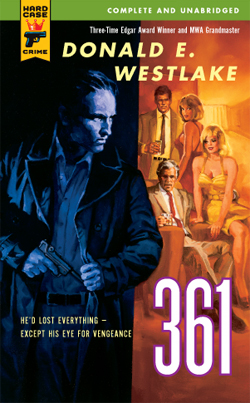
Anyway, when I ditched Cthulhu I had three newly ordered Hard Case Crime paperbacks to choose from so I picked Don Westlake's 361 and dove in. 361 really hit the spot. I can't articulate why, but sometimes there's nothing like the cathartic violence in a bleak tale of revenge to make you feel a touch more alive.

I was lucky enough to meet Don Westlake (who in addition to a celebrated career as a novelist was Oscar nominated for writing THE GRIFTERS) last December at a holiday party in Ancram, NY. I was introduced and asked him a few questions about writing, mostly about the great POINT BLANK (1967) which was based on his book The Hunter (written under the pseudonym Richard Stark). Westlake recounted how the film's star Lee Marvin was in a terrible place personally during the shoot, still apparently affected by the trauma of serving as a sniper in the Marines in WWII and fighting in the Pacific. He also remarked that, as is true with most writers being adapted, he didn't have much to do with the film's production at all. He was very gracious to me and I walked away with the buzz you feel when you meet a legend.

"I bet you're a big Lee Marvin fan, aren't ya?"

Here are some choice excerpts from 361, originally published in 1962 and re-released in 2005 after being out of print for over 40 years.

p37 hang fire phrase
delay or be delayed in taking action or progressing.

p42 "I got the eye from the dresser and went into the head. I washed my face and watched myself put the eye in."
- the protag Ray loses his eye early on and has to get used to a glass eye. I don't know if his wordplay here is deliberate or not, but I got a good chuckle.

p59 "Linda, the little girl, came over and started asking stupid questions. She was like her mother, interesting until she opened her mouth."

p129-30 "To begin with, every man has to have either a home or a purpose. Do you see that? Either a place to be or something to do. Without one or the other, a man goes nuts. Or he loses his manhood, like a hobo. Or he drinks or kills himself or something else. It doesn't matter, it's just that everybody has to have one or the other."

p140-41 "Aren't you gonna help him out of the water?"
"No, I wasn't playing. I don't play."
- I love that people were saying "I don't play" 45 years ago!

p173 "William Cheever's name was fourth of four on the frosted glass panel of the door. It wasn't a law firm, it was one of those set-ups where a number of unsuccessful professional men get together to share the rent and the receptionist and the futility."

p203 "I went into the first bar I came to on Lexington Avenue, but it was lunchtime and full of bland smooth people."


BONUS DOGEARS from The Call of Cthulhu and Other Weird Stories

p9 cenotaph |ˈsenəˌtaf|
noun
a tomblike monument to someone buried elsewhere, esp. one commemorating people who died in a war.

p16 mésalliancemāzəˈəns; ˌmāˌzalˈ n s|
noun
a marriage with a person thought to be unsuitable or of a lower social position.

p24 (from the story Celephaïs)
"There are not many persons who know what wonders are opened to them in the stories and visions of their youth; for when as children we listen and dream, we think but half-formed thoughts, and when as men we try and remember, we are dulled and prosaic with the poison of life."

Thursday, December 13, 2007

Dog Ears #8: Backstory 4

There was a time not too long ago when even the thought of reading anything in the Backstory series made me feel all icky inside. The four installments of Backstory are collections of interviews with screenwriters of different eras (1 is "The Golden Age", 2 is 1940s and 1950s, 3 is 1960s, and 4 is 1970s and 1980s) compiled and edited by Marquette film professor Patrick McGilligan. Thanks to my own efforts and the gift-giving prowess of Mrs. Word Player, I now have all four books in the excellent but largely out-of-print series, but after a really rough time writing my fifth screenplay Blood is Thicker (still unfinished after working on it for 11 months of '06 and early '07) I couldn't stomach reading all these success stories for a while.

You can't make this stuff up

Thankfully, time heals wounds of this sort pretty efficiently, so when I peeked into the one volume I hadn't read yet a few weeks ago I was happy to discover that my appetite for intimate conversations with working writers had returned. It's funny how the same words can be exasperating one day and inspiring the next...

The following are anecdotes, insights, self-recriminations and new lingo taken from Backstory 4: Interviews with Screenwriters of the 1970s and 1980s.

ROBERT BENTON
p. 29 "The banalities of married life are, for me, far more interesting and more poignant than the intensity of romance. There's something I find deeply moving about ordinary life."
re: his script for NADINE (1987)

p. 35 "There are two models (of screenplay structure). In one, plot grows out of character. This is the (Howard) Hawks model. In the other, character grows out of plot. This is the [Otto] Preminger model. When I do the architecture on a script of my own, I follow the Hawks approach. I do it so that characters become more complex, and they don't tell you where they're going until they get there."

LARRY COHEN
(Cohen's script for PHONE BOOTH, ultimately made in 2002 with Joel Schumacher at the helm, was once considered by Alfred Hitchcock.)

p. 77 "(Hitchcock) seemed very, very intimidated by Lew Wasserman and the Universal executives, who had more or less undermined his confidence in himself. While making him a very rich man, they'd also destroyed him as an artist. Hitch had severed his ties with [composer] Bernard Herrmann, for example, who had been a close friend and great collaborator, and mainly it was the Universal executives who poisoned his mind against Herrmann and convinced him he needed somebody like Henry Mancini to write songs and a hipper musical score. Which he never got, by the way."

BLAKE EDWARDS
p. 91 tsuris: |ˈtsoŏris; ˈtsər| noun, informal
trouble or woe; aggravation.
ORIGIN early 20th cent.: from Hebrew.

p. 95 "Therefore I consider that slapstick–literally slapstick–is not entirely what I do. Only some of it turns out to be slapstick. Slapstick comes from vaudeville–it comes from what they called "the slap stick" (slapping sound as he demonstrates), which made that sound."

WALTER HILL
p. 106 roustabout: noun
an unskilled or casual laborer.
• a laborer on an oil rig.
• a dock laborer or deckhand.
• a circus laborer.
ORIGIN mid 19th cent.: from the verb roust

"All of this taught me one important thing that carried over to writing. If you are capable of making a living out of your talent and imagination, you are a privileged soul. As to the actual writing, you learn about writing by reading. And then you learn to make use of your own particular attitudes, gifts, and skills by–writing, writing, writing."

p. 113 "I don't pretend to be a scholar about the history and evolution of screenwriting, and I think you have to approach it as a craft rather than an art. But it's the old story; if the craft gets good enough, it is an art."

p. 116 "My clearest impression is that (Michael) Eisner wanted movies to be a kind of pleasantly flavored chewing gum and was almost physically uncomfortable in dealing with anything about the dark side of the human heart."

Remind me to tell you my Harry Dean Stanton story some day

p. 122 (re ALIEN) "I named her "Ripley" (after "Believe It or Not"); later, when she had to have a first name for ID cards, I added "Ellen" (my mother's middle name). I called the ship Nostromo (from Conrad: no particular metaphoric idea, I just thought it sounded good). Some of the characters are named after athletes: Brett was for George Brett, Parker was for Dave Parker of the Pirates, and Lambert was Jack Lambert of the Steelers."

p. 128 "My favorite description of the dilemma of screenwriting comes from David Giler, "Your work is only read by the people who will destroy it."

RUTH PRAWER JHABVALA
p. 151 "What I do realize is that I mustn't have a single word that's not absolutely necessary, no "Oh yes, I see," nothing like that. You have to compress and compress and just give them the essence."

LAWRENCE KASDAN
p. 170 "That's what the STAR WARS saga is about–it's about following those things which are strongest in you and imposing them on the world. Making a career in Hollywood is like that if you want to do your own work. If you want to do what they want you to do, it's easy. You just say yes. But if you want to do what you want to do, you're constantly manipulating the chaos of the system."

p. 176 "That's what all great tragedies are about for me–that in this adherence to a single idea, we sometimes sacrifice everything."
re: his script for BODY HEAT (1981)

ELMORE LEONARD
p. 217 "What's amazing to me when I think about it, is that while Hollywood in general prefers plot-driven stories (they ask, "What's it about?"), thirty-three of my thirty-five books, all character-driven and talky, have either been optioned or bought outright for film."

PAUL MAZURSKY
p. 229 "I'm very sympathetic to those characters. I feel that the middle class is not treated in terms of tragedy. You have to be very rich or very poor to be thought of as a tragic figure."

Thulsa-Thulsa Doom y'all

JOHN MILIUS
p. 296 colloquy: |ˈkäləkwē| noun ( pl. -quies)
1 formal: a conversation : they broke off their colloquy at once | an evening of sophisticated colloquy. See note at conversation .
2 a gathering for discussion of theological questions.
ORIGIN late Middle English : from Latin colloquium ‘conversation.’

p. 299
PM: Was Robert Shaw really as drunk as they say, shooting the scene?
JM: He was totally drunk.

(Shaw had just been busted screwing the nanny by his wife, and kept interjecting his drunken thoughts about the situation into the Indianapolis scene from JAWS, a scene that Milius wrote as a favor to Spielberg. What we see in the final product, of course, has all the nanny bits cut out.)

FREDERIC RAPHAEL
p. 328 (this next bit speaks to questions I had after viewing TWO FOR THE ROAD (1967), written by Raphael)

PM: What was the genesis of the film you did make next, TWO FOR THE ROAD?
FR: (My wife and I) used always to just pack up and travel together. While we were driving down to the south of France from London on one of these trips, I said, "Imagine if we met ourselves as we were ten years ago," and of course the idea revealed itself as a movie.


p. 381 confrere: noun
a fellow member of a profession; a colleague : executives from the four broadcast television networks, along with their cable confreres.
ORIGIN mid 18th cent. : French, from medieval Latin confrater, from con- ‘together with’ + frater ‘brother.’

"The difference between a movie and a novel is that a movie is just the surface of things, and the meanings and emotions can only be implicit."