Monday, October 15, 2007

Prevorce?

The October 14 New York Times Magazine featured an extensive series of articles and polls that took a close look at what wealth means to the city's over 8 million residents. As a former, briefly-tenured, New Yorker my favorite stat was that only 51% of those polled "think that living in New York City is worth what it costs."

You only find out about the five months of winter AFTER you move there

Since I moved away from NYC, I've had to field many questions as to why I wanted to leave. My favorite answer is "New York is a city designed for the very young or the very wealthy, and by the time we left Mrs. Word Player and I were neither."

According to Mercer's 2007 Worldwide Cost of Living Survey, NYC is the most expensive city in North America (and 15th in the world- shockingly, Moscow edged London for the top spot). I remember a NYTimes article from a few years ago that really took the wind out my sails about NY. It's premise was basically that a married couple with two kids and an annual household income of $1 million could only break even living in Manhattan.

Depressing, no? In 2001, we paid $2000 a month for a 450 sq.ft. apartment in Manhattan... I shudder to think what it's going for now.

Anyway, this Sunday's Magazine had an article on the "superspecialized workers who serve the supperrich" of NYC, such as nannies, party planners, etc. One guy's profession in particular caught my eye- William D. Zabel, Postnup Lawyer.

If you're a "nonmoneyed spouse", this man is the Angel of Death

"What the hell is a postnup?!" I wondered. Here's the blurb from the magazine:

“Postnups” — or postnuptial agreements — “are usually for couples without prenups,” says Zabel, a trusts and estates lawyer with Schulte, Roth & Zabel. Why people get postnups: “Either the nonmoneyed spouse — usually the wife — in a 30-to-40-year marriage wants to know what she’s worth and gain some financial security, or the moneyed spouse in a newer relationship — usually the husband, and these days, often a young hedge-fund manager — wants to see if the wife is in it for the money and wants to cap the assets paid out if the marriage were to end in divorce.” Do his postnup negotiations ever lead to divorce? They usually help a marriage, because “everybody knows where they stand.”

Although I'd never heard of such a thing, my gut was in instant disagreement with Zabel's assertion that postnups usually help a marriage. After discovering that "postnuptial agreement" isn't even in the dictionary (though "prenuptial agreement" is), I poked around a little more and found a Time article from 2001 that made more sense to me.

After shocking me (I'm easily shockable these days apparently) with the stat that 20% of newly married couples get prenups, the article lists other reasons that couples get a postnup, including dramatic changes in finances from an inheritance, protection from liabilities one of the spouses may be experiencing in business, and controlling inheritance paths in blended families.

Blake Edwards' films contained hilarious/terrifying perspectives of marriage

I am a happily married man, and admittedly naïve when it comes to marital ruthlessness , but I have been around the block enough to understand (to a certain degree, anyway) why a party with a sizeable amount of wealth wants to protect themselves from someone entering into marriage under false pretenses.

What I don't understand is how any spouse could feel anything but impending doom if, after their marriage partner inherited a big chunk of change, called in the lawyers to cap how much they could get in the event of a divorce. Wouldn't that signal something awful on the horizon if it happened to you? Or am I just being Mr. Sensitive Guy?

Saturday, October 13, 2007

Use Your Reimagination

I'm sure by now everyone has noticed this, but the taglines for two miserable-looking comedies out now are almost exactly alike. The curiously ubiquitous Dane Cook's GOOD LUCK CHUCK's tagline is "Sometimes, Love Blows" while "Love Blows" sells us THE HEARTBREAK KID, Ben Stiller's ill-conceived remake of the 1972 Charles Grodin vehicle.

Nobody can curl a lip like Grodin

How unimaginative, right?

Perhaps, when they're remade in the future, someone will "reimagine" the taglines too.

Hollywood has apparently become dissatisfied with the term "remake", because lately I've been reading that films like Rob Zombie's 2007 HALLOWEEN aren't remakes, but "reimaginings" of the source material.

From Wikipedia:

Recently, the term "reimagining" has become popular to describe remakes that do not closely follow the original. The term is used by creators in the marketing of films and television shows to inform audiences that the new product is not the same as the old.

But how close is "closely"? Is there a definitive dividing line that separates the mere remake from the far more grandiose-sounding reimagining?

I've been plagued by/secretly enjoying nightmares "adapted from" John Carpenter's HALLOWEEN my entire adult life

First we have to sort the "reinterpretations" out of the equation. BATMAN BEGINS (2005) is not a remake of nor a sequel to BATMAN (1989), but rather a reinterpertation of the same DC comic book source material that inspired BATMAN the movie and BATMAN the 1960's TV series. So, then, it would seem that BATMAN BEGINS (and its 2008 sequel THE DARK KNIGHT) are technically "readaptations", right?

Who the hell knows. It just seems depressing to me that rather than fostering new ideas, we're doomed to a neverending cycle of cannibalism and reheating of leftovers. The Wikipedia section listing film remakes is so long that it has to be broken up into two sections: A-M and N-Z.

Back to reimagining. All of the film and TV franchises that have been deemed reimaginings are in the horror and sci-fi genre: TEXAS CHAINSAW MASSACRE (1974 & 2003), BATTLESTAR GALACTICA (1978 & 2003), DAWN OF THE DEAD (1978 & 2004), BIONIC WOMAN (1976-2007), etc.

I wonder why that is? Why is Michael Bay, who as producer has already re-somethinged the AMITYVILLE HORROR, THE HITCHER and TEXAS CHAINSAW MASSACRE franchises, now turning his attention to FRIDAY THE 13th?

It's hard to believe FRIDAY THE 13TH: THE FINAL CHAPTER was 23 years ago...

Because IT'S EASY! Is there anything more American than following the path of least resistance to the pot of gold? These films and franchises have brand equity and name value, so it doesn't really MATTER how wildly they're reimagined or bastardized... basically the same format and structure are gonna unfold whether or not it's a no-name low-budg horror film or it's a big-budg "Rising/Birth of" chapter or a THEORETICALLY daring shift of location or temporal setting (JASON GOES TO HELL and/or MANHATTAN, Aliens fight Predators, etc).

A large group of teens/scientists/mercenaries are gonna be whittled down by the killer, at least one in a sexually compromising position, until a final showdown where the killer is vanquished... or is/are they?

Repeat as necessary.

Thursday, October 4, 2007

The Colossus of Rhoda

For a long time, my job entailed reading screenplays that had been submitted to various film and TV production entities. During that decade I began paying a different kind of attention to the movies and TV shows I saw for pleasure and for work, trying to keep track of successful and unsuccessful screenplay structural trends. I continued studying structure (among other things) during a two year screenwriting program in NYC, where I applied what I'd learned from the thousands of scripts I'd read and tens of thousands of films and shows I'd seen to scripts I was now writing.

During this process, one of, if not the most important aspects of dynamic storytelling that was elevated from instinctual and/or unspoken to conscious, front-of-the-brain awareness was the pivotal role of the primary supporting character as it relates to the lead or "hero" character.

no word yet on whether the Bronx has a Rhoda statue in the works

I figured out that every good hero's journey requires a best friend or sidekick. Unlike novels, film and TV characters have little or no "internal" life (barring the novelistic cheat of constant voice-over narration), so for the audience to understand what the hero character is experiencing we need a character to stand in for us and listen to/experience along with the trials and tribulations of the lead as they attempt to conquer the villain/opposing force that stand in their way.

In other words, Mary Richards needs Rhoda Morgenstern to succeed. Speaking strictly for TV and excluding movie characters, I'm pretty sure that Rhoda was the best "best friend" character in television history.

I grew up watching THE MARY TYLER MOORE SHOW because it was one of my mom's favorites and at that time there was only one set in the house so the kids watched whatever was on. I hadn't thought of MTM much since my 1970s childhood until a recent foray into EVERYONE LOVES RAYMOND. During its first run, I avoided RAYMOND, believing it to be just another lowbrow comedian huckstering "isn't middle class American hilarious?" schtick. By the time it settled into reruns, Mrs. Word Player and I had heard enough positives about it to give it a try so we dutifully set the DVR to "record series" and were pleasantly surprised.

Although we both HATED Chris Elliot's "Peter MacDougall" character (the brother of Ray's brother Robert's girlfriend/wife Amy), we loved Amy's parents, played by Fred Willard and Georgia Engal. Despite the nearly 30 year gap since watching my last MTM episode, the first time Georgia Engal's "Pat MacDougall" appeared onscreen I blurted out "That's Ted Baxter's girlfriend!"

Long story short, Mrs. Word Player hadn't seen a single MARY TYLER MOORE SHOW, so we harnessed the awesome power of Netflix and began watching them in chronological order, starting with the first episode of Season 1, first broadcast September 19, 1970.

And we laughed and had ourselves a "new" show just like that.

will Netflixing RHODA be wonderful or sad???

We're now approaching the end of Season 3, and in two recent episodes it's been teased that Rhoda might be leaving Minneapolis. Thankfully the third act of each had Rhoda firmly back in her bachelorette apartment above Mary's, but the specter of Valerie Harper's Rhoda character being spun-off into her own show (we know it happens, but not exactly when) has me pondering just how important she is to the show.

The answer, or course, is very. MTM has aged remarkably well, thanks in large part to the incredible ensemble cast of character actors assembled by co-creator and legend James "Hell" Brooks. Judge Smails and Captain Steubing in the same show? Oh HELL yeah.

it's no coincidence that his dog was named "Baxter"

Thanks to terrific writing and acting the character of Rhoda, Mary's best friend and confidante, is the one that holds Mary's hilarious and quite frequently touching single-gal odyssey through the 70s together.

And for that, I salute you. People often argue about who's "the Mary" and who's "the Rhoda" in a friendship, each one usually believing that they are the Mary. I personally am more comfortable as a Rhoda.

Sunday, September 30, 2007

Promises of the Flesh

Something I've shied away from in this forum is the straight-up review. Reviews are a dime a dozen (probably cheaper than that in this age of blog-bling), and until the dawn of consensus critical sources like Metacritic and Rotten Tomatoes, there was no way of telling whether a review was "right" or "wrong".

Which brings up the question of whether or not a review can be right or wrong for more than one individual at a time. If so, perhaps only in the cases where the review reader sought out the subject of a review and compared notes.. which we don't often do for things reviewed in a harsh negative light.

Viggo knows how to deliver a message.

A while back I came up with a gimmicky approach to the movie review that I thought might be fun. The idea is that one man's trash is another man's treasure, so why not write reviews from the pseudonymous personality of someone hardwired to love the movie in question. Every review would more or less be a rave, but regular readers of the column would get an insight into what they could expect from the movie by which personality was reviewing it and how it rated for the kind of reviewer who, in theory, is predisposed to loving it.

Isn't it unfair to the moviegoer to have the same guy reviewing MR. WOODCOCK and EASTERN PROMISES?

Ultimately it sounded like too much work for a lark, but maybe one day...

My aside aside, I just returned home from director David Cronenberg's latest film EASTERN PROMISES, which is hands down the best movie I've seen all year. Rather than write review-type stuff about it I wanted to jot down some comparisons of my experience today to the one I had watching Cronenberg's last film, also starring , A HISTORY OF VIOLENCE.

As great a time at the movies as I had today, I had the opposite watching HISTORY. I thought then that Cronenberg had officially lost his touch (SPIDER was thoroughly unwatchable) after a two-decade run as one of the most exciting directors in the business.

Twins... how many of us have them?

As sure-handed as PROMISES felt, HISTORY felt scatterbrained. As sharply-directed and "in the pocket" as the actors felt today, they felt attention-starved and mismatched in HISTORY. William Hurt was Oscar-nominated for his laughable, scenery-gorging, late-period Brandoesque supporting role in HISTORY: Mortensen will be nominated for his elite, coiled, hypnotic leading work in PROMISES.

As piecemeal and wildly uneven in tone as HISTORY felt, PROMISES felt like a seamless fabric of writer, director and cast working in unison.

I haven't felt that good watching a movie in the theater in a long, long time. How you feel about a movie doesn't necessarily say that much about the movie itself, even if you're a top flight film critic, but nonetheless what I felt as I was watching EASTERN PROMISES (including the relief of seeing a cinematic hero return to form) was so good I felt compelled to share it.


This still from Cronenberg's RABID has always freaked me out.

"You need language for thought. And you need language to anticipate death. There is no abstract thought without language. And no anticipation. I think the anticipation of death without language would be impossible."
- David Cronenberg

"My dentist said to me the other day: I've enough problems in my life, so why should I see your films?"
- David Cronenberg

Thursday, September 27, 2007

Down Peripatetiscope

Mrs. Word Player and I are on the move.

Again.

For reasons too tedious to include here, we are about to move into our sixth place together spanning our seven years of marriage. With yet another new home looming, I've been pondering just what "home" means anymore.

There's no place like home? Well, not 'til one falls on your sister's head.

Some personal statistics:

From age 0-17, I lived in six different homes, including three interstate moves. The math is pretty easy here, averaging about one home every three years.

From age 18-27, I lived in ten different homes, including three more interstate moves. That's an average of one new home every year for a decade.

From age 28-36, as mentioned above, Mrs. Word Player and I lived/will live in six different homes, including two more interstate moves. That works out to a new home every 1.5 years.

My grand totals fo' life are 22 different homes in 36 years, or one move every 1.63 years and one interstate move every 4.5 years.

Exhausting I tells ya!

Frankly I'm not ready to be on the road again... but whattaya gonna do?

It's gotten to the point that when someone asks me where I'm from, I have to stop and think about it for a second. Let's see what state takes home the title (rounding off to whole years):

Ohio: 10 years
North Carolina: 13 years
California: 9 years
New York: 4 years

ah, the Sunshine State!

I guess I'm from North Carolina!

In surfing around for this post, I learned that a fellow named John Howard Payne is the originator of the famous line "Be it ever so humble, there's no place like home", taken from his song "Home Sweet Home". Payne, a member of the Songwriters Hall of Fame, ironically died far from home in Tunis, Tunisia (where he was serving as U.S. ambassador!) in 1852, his lifelong crush on Frankenstein author Mary Shelley forever unrequited.

I wonder where on Earth I'll die... I hope it's not New Jersey.

Sunday, September 23, 2007

It Blows By Any Other Name?

Who's ready to get unscientific?!? Good, me too.

I've been seeing ads lately for IN THE VALLEY OF ELAH, the latest surefire post-MONSTER flop from Academy Award® Winner . I have no idea what the movie is about, but every time I see an ad for it I cringe at how awful the title is. With a title like that it HAS to be a flop, right?

Well, I think so.

The flag in the background counteracts the foreign-sounding word in the title

The first movie title that I can remember having this same effect on me was KRIPPENDORF'S TRIBE. I remember seeing the trailer for it and whispering to whoever it was next to me "Can you imagine ever speaking the words "'two for KRIPPENDORF'S TRIBE please'"? Unfortunately I can't immediately find the budget for KRIPPENDORF'S, but with a U.S. gross of $7.6 million for a Disney movie starring Richard Dreyfuss and Jenna Elfman, I can safely call it a flop.

I thought it would be fun to look back at the titles of the 3,296 films that have been/will be released from January 1, 2003 to December 31, 2007 and pick out the the titles that I hated strictly on their own merit. These are titles that made me cringe so viscerally that they actively made me NOT want to see the film they represented.

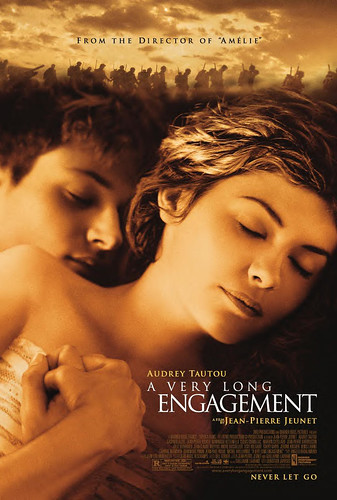
it just can't be a good idea to have "VERY LONG" in your movie's title

I came up with 20 films in all, and AFTER I selected them by title, I looked up their budgets and their box office performance in the U.S. Let's see how good a prognosticator I would have been if betting by title alone.

2003

THE LIFE OF DAVID GALE: budget- $50 million, U.S. gross- $19.7 million
POOLHALL JUNKIES: b. $4 mil, USg. $.56 mil
OWNING MAHOWNY: b. $10 mil, USg. $1 mil


2004

CHASING LIBERTY: b. $23 mil, USg. $12.2 mil
WELCOME TO MOOSEPORT: b. $26 mil, USg. $14.5 mil
THE UNITED STATES OF LELAND: b. ??, USg. $.34 mil
THE CHRONICLES OF RIDDICK: b.$120 mil, USg. $57.7 mil
A HOME AT THE END OF THE WORLD: b. $6.5 mil, USg. $1 mil
SKY CAPTAIN AND THE WORLD OF TOMORROW: b. $70 mil, USg. $37.8
A VERY LONG ENGAGEMENT: b.$55 mil, USg. $6.2 mil


2005

BECAUSE OF WINN-DIXIE: b. $15 million, USg. $32.6
ELIZABETHTOWN: b.$54 million, USg. $26.9


2006

LOOKING FOR COMEDY IN THE MUSLIM WORLD: b. ???, USg. $.89 mil
TRISTRAM SHANDY: A COCK AND BULL STORY: b. $4.7 mil, USg. $1.2
LUCKY NUMBER SLEVIN: b. $27 mil, USg. $22.5
LET’S GO TO PRISON: b. $4 mil, USg. $5.5 million


2007

CODE NAME: THE CLEANER: b. $20 mil, USg. $8.1 mil
I THINK I LOVE MY WIFE: b. $14 mil, USg. $12.5
THE WENDELL BAKER STORY: b. $8 mil, USg. $.13 mil
IN THE VALLEY OF ELAH: b. ??? USg. ???

Slevin? no really, Slevin??

So, without using LELAND and ELAH and MUSLIM in the equation (for lack of available figures) lets see what the numbers add up to for the other 17 films on Mr. Word Player's Terrible Title List™.

COMBINED BUDGET: $511.2 million
COMBINED GROSS: $260.1 million

COMBINED LOSS: $251.1 million

Now here's the question that I have no answer for-- with better titles, would these films have performed appreciably better? Or are titles such an integral part of a film that these were doomed to (collective) box-office failure, having been developed and rewritten for so long with weak titles at the eye of the storm?

I haven't seen any of the movies on the list (with the exception of the first 20 minutes of TRISTRAM), so I can't really comment on how their quality/perceived quality figured into the losses.

What do you think? What IS in a name when it comes to plunking down your hard earned entertainment dollar?

Thursday, September 20, 2007

Blue on Blue

Lately, for a variety of reasons, I've been using more profanity than usual. Just today a minor curse word escaped my lips in conversation with a woman I'd just met, and in a business scenario. She didn't blink at it and we moved on, but inside I was peeved.

Come on Mr. Word Player, you're better than that.

And as I'm sure you know, I'm not the only one. America is cursing up an unprecedented blue streak with no signs of a slowdown, let alone a return to more genteel public discourse.

All of this shit-talking got me wondering a while back how the word "blue" got associated with profanity and risqué business. Mrs. Word Player found an interesting post about it on Snopes.com, where they dispelled the urban myth that American "blue laws" were so-called because they were printed on blue paper.

Picasso's "Blue Period" was fucking awesome

Apparently our 17th century Puritan forefathers and -mothers enacted a series of "blue laws" that regulated people's "moral behavior", especially as concerning the Sabbath day. Variances of these sorts of laws evolved into the 19th and 20th century temperance movements and to some degree explain why you can't buy booze until such-and-such o'clock on Sundays in so many states.

You get an interesting dichotomy of meaning when you look up the word blue, as seen by these two side-by-side definitions found at Merriam Webster's site:

6 : PURITANICAL
7 a : PROFANE, INDECENT b : OFF-COLOR, RISQUE


Huh. Blue means puritanical AND profane (not to mention "low in spirits").

Look it up at the Online Etymology Dictionary, and all you get is:

Blue (adj.) "lewd" is recorded from 1840; the sense connection is unclear, and is opposite to that in blue laws (q.v.)

Pornographic films used to be called "blue movies."

The most popular color for toothbrushes is blue (which is helpful for when you're washing your mouth out after using blue language.)

Warhol's "Blue Period" was less awesome...

And then there's the term "working blue" and/or "blue comedy", which would appear to come from the same (blue?) vein. Mrs. Word Player and I joke with one another about how we love it when the other is working blue (the comment that usually follows an unexpected or particularly filthy outburst of obscenity.

My good friends at Wikipedia had this interesting info about blue comedy:

Blue comedy is comedy that is off-color, risqué, indecent, profane, or obscene[1]. It often contains cursing and/or sexual imagery that shocks and offends many audiences.

The term comes from the music hall comedian Max Miller who kept all his adult jokes in a blue coloured notebook. 'Working blue' refers to the act of performing this type of material.


one can only imagine Mary's X-rated activities

Wow. Can it really be true that "blue comedy" would have been called "orange comedy" if Max Miller had bought a different style of notebook?

I have a faint memory of the first time I heard a reference to blue comedy, naturally attached to the colorful Redd Foxx. I imagine we'll all be cursing a blue streak when the ill-advised feature film adaptation SANFORD AND SON comes to a theater near us.

Under certain circumstances, profanity provides a relief denied even to prayer.
–Mark Twain (1835-1910)

Tuesday, September 18, 2007

Cellular Phronesis

Someone or other once said that "a clear conscience is often a sign of a bad memory." I wonder what that means for the consciences of the near future that will no longer be able to forget a thing with every step of every day recorded in one form or another for later playback or review.

Memory, of course, is a very tricky thing, and I for one am pleased with the way technology allows us to remember things that were prime candidates for slipping through cracks. It has taken me some effort to memorize three phone numbers that I can recite without cheating, yet I can vividly remember the first time I heard Heart's "Magic Man" on the way to Montessori school about 32 years ago and being scared and excited by the lyrics coming out of Mother Word Player's dashboard FM.

terrifying!

I got to thinking of the shortcomings and successes of memory on Sunday reading Jenny Lyn Bader's article "Britney? That's All She Rote" from the Week In Review section of the New York Times. Bader touched on something I've felt for a long time now, that collectively our memories are getting to be just as short as out attention spans. "We are in a culture that devalues our sense of memory" says author and Harvard rhetoric professor James Engell.

I've hoped that the less we have to rely on our memories for day-to-day details (thanks to advances in personal technology) that the more brainpower we would have at our disposal for creative and esoteric thinking. Frankly, it's hard to compare one's memory epochs, especially when you can't remember what the older ones were like anymore.

people often forget about The Disintegration of The Persistence of Memory

The article contained two words I was unfamiliar with that I wanted to write up here, but in the 48+ hours since I first read it something else from it has lodged in my noggin. In talking about the physiology of memory, she notes:

Other body parts may be involved, too, as suggested by stories of transplant patients who acquire memories not their own. Mr. Engall said, "Memory has a kind of bodily presence."

And I thought that notion was strictly the invention of horror screenwriters!

Anyway, here are the two words that are either new to me, or seemed so because I had forgotten learning about them the first time:

1. phronesis: Aristotle distinguishes between two intellectual virtues: sophia and phronesis. Sophia (usually translated "wisdom") is the ability to think well about the nature of the world, and is used in our attempts to discover why the world is the way it is (this is sometimes equated with science); sophia involves deliberation concerning universal truths. Phronesis is the ability to think about how and why we should act in order to change things, and especially to change our lives for the better. Aristotle says that phronesis isn't simply a skill, however, as it involves not only the ability to decide how to achieve a certain end, but also the ability to reflect upon and determine that end (this is, however, denied by some commentators, who argue that Aristotle considers the desired end (eudaimonia) to be given, so that phronesis is simply the ability to achieve that end).

perhaps Aristotle taught Alexander a tad too well?

Gaining phronesis requires time, as one must gain both the habit and understanding of correct deliberation.
(
definition taken from wikipedia)

2. neurobics: a unique new system of brain exercises based on the latest scientific research from leading neurobiology labs around the world - including Dr. Katz' lab at the Dept of Neurobiology in the Dook University Medical Center in Durham, NC. The deceptively simple exercise program is the first and only program scientifically based on the brain's ability to produce natural growth factors called neurotrophins that help fight off the effects of mental aging. Neurobic exercises use your five physical senses and your emotional sense in unexpected ways and encourage you to shake up your everyday routines.
(explanation taken from neurobics.com)

Tuesday, September 11, 2007

In Search Of: Optimism

Six years ago today, a phone call woke me up for the second time that morning. The first time was when Mrs. Word Player got up to go to work, after which I promptly fell back asleep. The phone call was from a close friend who worked at CNN Headline News in Atlanta. She told me that a plane had struck the World Trade Center, that it was apparently no accident, and was asking if we were OK.

By the time I got dressed and ran up to the roof to see, a second plane had struck the towers. Words cannot describe the feeling of shock, how time seemed to slow down, and how scared I was. Mrs. Word Player called from work, and soon would return to our tiny West Village apartment with several of her workmates in tow. We numbly watched the news coverage, drank scotch, and made and fielded phone calls checking on friends and loved ones.

taken from our rooftop at 14 Horatio St. on my 30th birthday, 8/24/01

The acrid smell of smoke and scorched metal would waft up to us later that morning and linger for weeks.

taken from the same rooftop 18 days later

And of course, all of our memories of that morning will linger for the rest our lives. I'm a big fan of milestones and statistics, eras and epochs, and as I've been thinking about today's sixth anniversary of 9/11/01 I've thought about how it demarcated my own life.

From 8/24/71 to 1/28/86 I was an optimist. Until my gym class that day, freshman year of high school, when we were called back to our class and informed that the Space Shuttle Challenger had disintegrated shortly after liftoff, I had no question that the future would be even brighter than I could imagine (and to paraphrase Han Solo, I had imagined quite a bit). I was a sci-fi kid, and I was certain that in my lifetime I'd be visiting Space Stations and Moon Bases. SPACE: 1999 and The Martian Chronicles had been huge favorites of mine, and they weren't set so far into the future that I couldn't believe.

Anyway, from 1/28/86 to 9/11/01 I was a realist, with cynical tendencies. After 9/11, I began skewing more and more pessimist. No need to go into detail, but suffice it to say that I no longer saw a bright future for the people of Earth.

But wait, there's more?

NYC-based artist and graphic designer Reed Seifer (pronounced like "cipher") created his Project Optimism long before 9/11/01, but for me it has taken on a special personal meaning in the months and years since then. He has incorporated the word and the spirit of "optimism" into a variety of media and format, but the one that I thankfully can't seem to stop thinking about is his series of brightly colored buttons with the single word "optimism" emblazoned on them.

optimism!

Life can appear cripplingly complicated to me at times, and the fact that a simple button with one word on it can be so powerfully affecting comes as a great relief.

The Optimism of childhood was a gift, but I've come to realize that the Optimism of adulthood is a choice. It's not whether you see the glass as half full or half empty, it's how hard you work to add just enough to the glass that it's no longer a judgment call.

Thursday, September 6, 2007

Cruising World

In the U.S., English is the native tongue spoken by approximately 82% of the population, and over 140 languages are taught in high schools across the nation in a vain attempt to make Americans bilingual.

Why is it then, I wonder, that it seems like everybody took either Spanish or French in high school?

I'll never forget this poster of Gerard Depardieu that hung above the blackboard

I took French for three years and Latin my senior year (in which I earned my first "F", thankfully after I'd already been admitted to UNC-CH). With some scattered French in middle school and an additional year in college, I learned enough French to order food on a train and ask directions.

But most importantly, to me anyway, I learned enough to speak English with an exaggerated French accent for laughs and to pepper my snappy comebacks with just enough French snippets to sound arrogant at the proper time.

I've come across a couple of unfamiliar French words in articles over the past few days, which made me think of some of my favorite phrases from Madame Rothe's French class in high school that survived my teens and live on to this day:

"passez une bon weekend"= have a good weekend

"qu'est-ce que si passe?" = what's going on? what's happening"

"porquoi? PARCE-QUE!" = why? BECAUSE!

I can safely say this now, nearly 20 years later, without fear of getting Madame Rothe in trouble: she invited some of her favorite students over to her house and GAVE US ALL A GLASS OF WINE as we hung out and talked about France.

Can you IMAGINE such an egregious violation of teacher-student conduct? And at a CATHOLIC school no less!

"French for Robots" is the hot new elective for Fall '07

Madame Rothe was a great teacher- one of the very few from my K-12 years that I ever think about anymore.

Anyway (before I bust out cryin') here are the two Frenchyisms I had to look up earlier this week:

maudit: Definition: (informal adj) - darned, blasted, hateful

Où sont ces maudites clés ? - Where are those darned keys?

Après ce cours, je ne veux plus voir ce maudit livre - After this class, I don't want to see this hateful book any more

(literary adj) - accursed

Related: maudire - to curse; un/e maudit/e - damned soul; le Maudit - the Devil
(thank you french.about.com)

Al apparently prefers Cruis'n Exotica

The word was used in an Indiewire article about the DVD release of the much maligned Al Pacino gay serial killer thriller CRUISING, as follows:

"Paramount's imminent deluxe edition of William Friedkin's 1980 film maudit, CRUISING."

The second was folie à deux, which means "shared madness" or "craziness for two", a mental disorder which occurs simultaneously in two people with a close relationship or association.

This one I read in Newsweek's article about the back-to-back suicides of former "it"couple Theresa Duncan and Jeremy Blake.

Moments tristes...

Thursday, August 30, 2007

Dog Ears #5: Crash

No no, not that CRASH, J.G. Ballard's 1973 novel CRASH. I was drawn to the book to see what longtime fave David Cronenberg was thinking when he adapted Ballard's work for his controversial 1996 film of the same name.

Hitchcock would've loved Deborah Kara Unger

Note to self- it can be dangerous to wonder what David Cronenberg was thinking.

Overall I found the book to be dated, repetitive and sophomoric, and not nearly as hot or disturbing as I expected from a quasi-legendary book of underground erotica. Thankfully it was short, 'cause if I read either of Ballard's favorite words ("glans" and "pubis") one more time I was gonna crash my foot into the book's spine.

After CRASH, I doubt I'll ever read Ballard's EMPIRE OF THE SUN which Spielberg adapted in 1987 (unless I hear good things about it from you of course).

The good news is that the book was chock full of dog-earable words that I'm excited to finally look up, not to mention a turn of phrase or two that aroused my literary side.

p22. "It was not the sexuality of the posture that stayed in my mind, but the stylization of the terrible events that had involved us..."

p39. "At times I had even speculated on the kind of traffic accident in which I would die."*

* I included this quote because it reminded me that during my first stint in Los Angeles (1995-2001) I had a premonition that I would eventually be killed on one of the city's many highways. Thankfully I haven't felt that same foreboding this time around.

p41. buccal |ˈbəkəl| |ˌbəkəl| |ˌbʌk(ə)l|
adjective / technical
of or relating to the mouth : the buccal cavity.
• of or relating to the cheek : the buccal side of the molars.
ORIGIN early 19th cent.: from Latin bucca ‘cheek’ + -al.

p42. "Listening in a bored way, the women patients lay in their beds. Two of them were suspended with their legs in traction, as if involved in the fantasies of a demented gymnast."

p50. autogeddon. I assume this word was the creation of the author... it bugged me every time I read it. As far as neologisms go, though, it's pretty weak salsa.

p54. penumbra |peˈnəmbrə| |pəˌnəmbrə| |pɪˌnʌmbrə|
noun
the partially shaded outer region of the shadow cast by an opaque object.
• Astronomy the shadow cast by the earth or moon over an area experiencing a partial eclipse.
• Astronomy the less dark outer part of a sunspot, surrounding the dark core.
• any area of partial shade.

p57. vitrified > vitrify |ˈvitrəˌfī| |ˌvɪtrəˈfaɪ| |ˌvɪtrɪfʌɪ|
verb ( -fies, -fied) [ trans. ] (often be vitrified)
convert (something) into glass or a glasslike substance, typically by exposure to heat.

i had to vitrify that glass

p65. invigliator > invigilate |inˈvijəˌlāt| |1nˌvɪdʒəˈleɪt| |ɪnˌvɪdʒɪleɪt|
verb [ intrans. ] Brit.
supervise candidates during an examination.
DERIVATIVES
invigilation |-ˌvijəˈlā sh ən| |1nˈvɪdʒəˌleɪʃən| |-ˌleɪʃ(ə)n| noun
invigilator |-ˌlātər| |1nˌvɪdʒəˈleɪdər| noun

p77. "A week after the inquest she was waiting at the taxi rank of the Oceanic* Terminal as I drove away from Catherine's office."
* LOST fans will enjoy the name of Ballard's fictitious airline.

p99. treadle |ˈtredl| |ˌtrɛdl| |ˌtrɛd(ə)l|
noun
a lever worked by the foot that imparts motion to a machine.
• any of a row of metal spikes set on an angle on a spring within a plate laid across the entrance or exit of a parking facility, used to prevent drivers from using the facility without paying.

p144. sulcus |ˈsəlkəs| |ˌsəlkəs| |ˌsʌlkəs|
noun / Anatomy
a groove or furrow, esp. one on the surface of the brain.

p148. anneal |əˈnēl| |əˌni(ə)l| |əˌniːl|
verb [ trans. ]
heat (metal or glass) and allow it to cool slowly, in order to remove internal stresses and toughen it.
• Biochemistry recombine (DNA) in the double-stranded form following separation by heat.

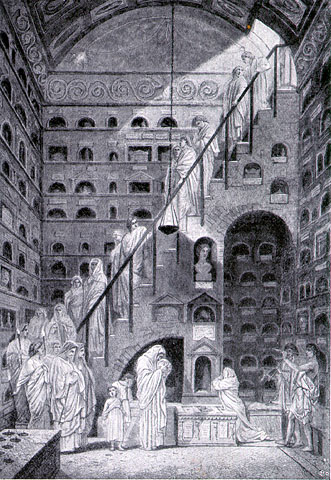
p151. columbarium |ˌkäləmˈbe(ə)rēəm| |ˈkɑləmˌbɛriəm| |ˈkɒl(ə)mˌbɛːrɪəm|
noun ( pl. -baria |-ˈbe(ə)rēə| |ˈkɑləmˌbɛriə|)
a room or building with niches for funeral urns to be stored.
• a niche to hold a funeral urn.
• a stone wall or walk within a garden for burial of funeral urns, esp. attached to a church.
ORIGIN mid 18th cent.: from Latin, literally ‘pigeon house’ .

mummy, where are the pigeons?

p177. invagination |inˌvajəˈnā sh ən| |1nˈvødʒəˌneɪʃən| |ɪnˈvadʒɪˌneɪʃ(ə)n|
noun chiefly Anatomy Biology
the action or process of being turned inside out or folded back on itself to form a cavity or pouch.
• a cavity or pouch so formed.

p205. hypogeum |ˌhīpəˈjēəm| |ˈhaɪpəˌdʒiəm| |ˈhʌɪpə(ʊ)ˌdʒiːəm|
noun ( pl. -gea |-ˈjēə| |ˈhaɪpəˌdʒiə| |-ˌdʒiːə|)
an underground chamber.
ORIGIN mid 17th cent.: from Latin, from Greek hupogeion, neuter of hupogeios ‘underground.’

Monday, August 27, 2007

Death Blog 2000

Yesterday I read a stimulating article in the NY Times about "life lists": lists people make of goals and experiences they want to achieve before they die. I think "death list" has a lot more urgency than "life list", but the point is that writing about these lists has become a cottage industry and I want in.

One of the sources quoted was 43Things.com, a website where you can join "1,217,358" people in making out a list of 43 things you want to do, then see who else shares your aspirations (for instance, 138 people want to learn Hungarian before their ticket is punched).

Instead of writing up a life list, I thought I'd make a blog list of 43 subjects I want to blog about before I expire and/or tire of blogging. So, with no further talk of my inevitable death...

1. The maxims of Nicholas-Sebastien Roch de Chamfort
2. Scrabble
3. Post-structuralism
4. Truisms that aren't true
5. The excuse "Sorry, I've been really busy"
6. Words I hate myself for having to constantly look up
7. "Greatest Hits" from my portfolio of screenplay coverage
8. The importance of a good title to books, movies, TV shows
9. Fantasy Baseball
10. Pascal's Wager
11. Dinosaurs
12. The Inner Game of Tennis

13. Headphones
14. Liner notes
15. Friendship
16. Email etiquette
17. Wishlists
18. Socrates and Plato
19. High school survival stories
20. Ghost stories
21. Solipsism
22. David Cronenberg's DEAD RINGERS
23. Ray Bradbury's THE MARTIAN CHRONICLES

25. Deejaying
26. Brooklyn
27. Nihilism
28. Omelettes
29. Homophones & Homonyms
30. Nightmares
31. Mad Libs
32. LSD
33. Memory vs. History
34. Liars
35. Statistics
37. Writing poetry
38. Bad ideas vs. Good ideas
39. The voices inside our heads
40. Snapshots
41. Context
42. Bermuda

43. Love

Wednesday, August 22, 2007

Meatspace Odyssey

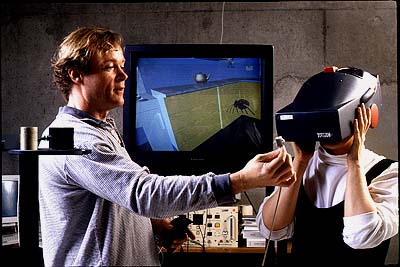
There was a time when Virtual Reality meant putting goggles and sensors on and running through a Tron-esque maze fleeing pterodactyls or walking through the floorplan of a proposed building. Today we have an entire Virtual World in Second Life, an online universe whose existence I only stumbled upon a few days ago. When a client mentioned that a very real world company has set up shop in Second Life, I pretended I knew what she was talking about then bounced to Wikipedia to look it up after the call was over.

didn't I blow your mind this time? didn't I?

There I learned that "residents" of Second Life refer to our traditional, corporeal world as "meatspace", a term that made me laugh and frown. That lead me to an even more interesting word, one that you may be familiar with but was new to me.

Meatspace is an example of a "Dysphemism", which is defined by The Columbia Guide to Standard American English as:

The process and the result of substituting an ugly or otherwise unpleasant locution for one more attractive in sound or meaning are both called dysphemism, of which the World War I sailors’ name for tapioca pudding, fisheye soup, is a graphic and printable example. Dysphemism is an antonym of euphemism.


That's mighty fine fish-eye soup Admiral.

So basically, you use a dysphemism when you want to make a neutral term sound awful or extreme. Instead of saying "I was thrilled when the Angels defeated the Yankees 18-9", I'd say "I was thrilled when the Angels annihilated the Yankees 18-9." That dude is dumb as a box of rocks... this coffin nail is really refreshing... etc etc.

Here's an entertaining read on the concept of the "Dysphemism Treadmill" from Wikipedia:

Similar to the concept of the euphemism treadmill, a complementary “dysphemism treadmill” exists, but is more rarely observed. In these cases, notions of profanity, obscenity and other words once called “offensive” are later described as “objectionable,” then “questionable,” and in some cases, they reach near or outright acceptability.

One modern example is the word “sucks.” “That sucks” began as American slang for “that is very unpleasant,” and is the shortened version of “that sucks cock/dick.” It developed over the late-20th century from being an extremely vulgar phrase to mainstream slang. (The origin of the intransitive usage, “sucks,” is disputed and may derive from more innocuous slang. See the archived discussions of The American Dialect Society. The same may be said of the use of “screw,” often used as slang for sexual intercourse (and a euphemism for “fuck”), in such usages as “to screw up” (to make a major mistake).)

Sometimes a term will go from being a euphemism to being a dysphemism and then go back to being a euphemism. “Queer” and “gay,” for example, both started as euphemisms for “homosexual,” and then got on the euphemism treadmill and became insults—but are now the preferred adjectives amongst the gay community themselves.

If anyone calls me a tub of lard again, I'll put my flipper in their ass.

I imagine that "Dysphemism Treadmill" is a great cocktail party subject. I can almost see a board game...

Anyway, next time you're considering using a played-out euphemism like "Kitty went to live on a farm", know that you can always go the opposite direction and say that "Kitty is worm food now."

Monday, August 13, 2007

Dog Ears #4: From Hell

After thoroughly enjoying Alan Moore's WATCHMEN, the first graphic novel I'd read in a decade, I walked to my local comic shop House of Secrets to see what else Mr. Moore had to offer. I decided on FROM HELL, Moore's epic collaboration with artist Eddie Campbell on the Jack the Ripper murders that was originally published in serial comic book form in 1989. The hefty version I bought includes the entire series, and its nearly 600 page length includes appendices that had been published after the original run up until 1998.

"Will no one help the Widow's son?"

The helpful clerk pointed out that it was imperative for full comprehension to flip to the back and read each chapter's description in the appendix after you've read the chapter. At the time I thought the guy was just nerding out, but I quickly found his advice to be spot on. FROM HELL is a dense, multilayered, and chilling tale, and the inspired leaps of imagination in concert with painstaking research from the writer and illustrator results in one of the most thought-provoking reads I've encountered in some time. Flipping back to the appendix after reading each chapter was not a chore, but a revelatory trip into history and the authors' creative process.

This time, instead of selecting prose and words of interest from the graphic novel itself, I wanted to examine the dog ears of the appendices instead. I think you'll get a good feel for the material this way.

Appendix 1, Page 1 (or 1.1)
ex gratia: as an act of grace; out of one's favor

The Fabian Society: a British socialist intellectual movement, whose purpose is to advance the socialist cause by gradualist and reformist, rather than revolutionary means. It is best known for its initial ground-breaking work beginning in the late 19th century and then up to World War I. The society laid many of the foundations of the Labour Party during this period; subsequently, it affected the policies of newly independent British colonies, especially India, and is still in existence today.

1.2
Jah-Bul-On (or Jahbulon): a word which was used historically in some rituals of Royal Arch Masonry. In addition, according to Francis X. King, the word is used in rituals of the Ordo Templi Orientis, as Aleister Crowley had contact with various clandestine Masonic groups. There has been much debate over the origin and meaning of this word; and there is no consensus even among Masonic researchers as to the meaning of the word. The word's meaning and legitimacy is unclear. One Masonic scholar alleges that the word first appeared in an early 18th Century Royal Arch ritual, as the name of an allegorical explorer searching for the ruins of King Solomon's Temple; while another Masonic scholar believes it is a descriptive name for God in Hebrew; other, non-Masonic, authors have alleged that it is a Masonic name for God, and even the name of a unique "Masonic God". It is this last interpretation that has led to debates about and condemnation of Freemasonry by several religious groups.

was Hogarth satirizing medical cruelty or revealing Masonic ritual?

1.3
Necronaut: The International Necronautical Society is a semi-fictional organisation devoted to exploring the concept of death and spatial analogies, closely modelled on European avant-gardes of the 20th century. It has mounted several events at the Institute of Contemporary Arts. The June 2004 edition of Art Monthly ran a feature on the INS, which claimed that: "The INS models itself on the modernist avant-gardes. It even mimics their ideological disputes; a year ago McCarthy, remembering André Breton, ejected most of the founding members. But it also plays, with its "General Secretary", its "hearings" and "reports", on the terminology and protocol of the Kafkaesque bureaucracy."

Dionysiac Architects: an ancient secret society, its principles and doctrines much like the modern Freemasonic Order. They were an organization of builders bound together by their secret knowledge of the relationship between the earthly and the divine sciences of architectonics. They were supposedly employed by King Solomon in the building of his Temple, although they were not Jews, nor did they worship the God of the Jews, being followers of Bacchus and Dionysos. The Dionysiac Architects erected many of the great monuments of antiquity. They possessed a secret language and a system of marking their stones. They had annual convocations and sacred feasts. The exact nature of their doctrines is unknown.

1.11
corpus callosum: a structure of the mammalian brain in the longitudal fissure that connects the left and right cerebral hemispheres. It is the largest white matter structure in the brain, consisting of 200-250 million contralateral axonal projections. It is a wide, flat bundle of axons beneath the cortex. Much of the inter-hemispheric communication in the brain is conducted across the corpus callosum

1.28
Diabolism n.
1. Dealings with or worship of the devil or demons; sorcery.
2. Devilish conduct or character.

William Blake painted this creature after, he says, it materialized in front of him.

1.30
Theosophism: "any of various philosophies professing to achieve a knowledge of God by spiritual ecstasy, direct intuition, or special individual revelation; esp. a modern movement following Hindu and Buddhist teachings, and seeking universal brotherhood."

1.31
Bavarian Illuminati: The Illuminati is the name used for several groups, both real and fictitious. Most commonly it refers specifically to the Bavarian Illuminati, an Enlightenment secret society founded in the late eighteenth century. However, in modern times it refers to a purported shadowy conspiratorial organization which is reputed to secretly control world affairs, usually a modern incarnation or continuation of the Bavarian Illuminati. In this context, Illuminati is often used in reference to a New World Order (NWO). Many Conspiracy theorists believe the Illuminati (The People of The Light), or illuminated ones, are the masterminds behind events that will lead to a New World Order.

Order of the Golden Dawn
: The Hermetic Order of the Golden Dawn (or, more commonly, the Golden Dawn) was a magical order of the late 19th and early 20th centuries, practicing a form of theurgy and spiritual development. It was probably the single greatest influence on twentieth century western occultism. Concepts of magic and ritual that became core elements of many other traditions, including Wicca,[1][2] Thelema and other forms of magical spirituality popular today, are drawn from the Golden Dawn tradition.

1.41
cthonic (or chthonic)
1. (Greek mythology) Of or pertaining to the underworld.
2. Dwelling within or under the earth.

One final note: never saw the Hughes Brothers film version of FROM HELL starring Johnny Depp and Heather Graham, but remember very mixed reviews. Any thoughts on whether or not its worth my time would be appreciated.

Monday, August 6, 2007

OK Children, What Does It All Mean?

The search for meaning in the art and entertainment we consume can be a frustrating one. Not only are there countless possible interpretations, but there are countless possible misinterpretations too. And the horrible/wonderful thing about it is that none of them can definitively said to be right or wrong. Even if the artist or creator has gone on record speaking in no uncertain terms about what the theme or moral of the story/song/painting is, one has to consider the possibility that revisionist history, self-mythologization, or garden variety ego may be at work.

I find it liberating to accept that you can never really know for sure what you are meant to take away from the experience of consuming (for lack of a better word) someone else's art. More than that, I believe you can never really know for sure what "The One True Interpretation" is of art that you yourself have created.

don't let the glasses fool you- he doesn't know the meaning of THE MEANING OF LIFE.

It should go without saying that all art is not created equal, and the spectrum of possible interpretations varies wildly from the Pretty Damn Obvious to the Pretty Damn Ambiguous, but I said it anyway.

I sometimes miss the spirited and free-form discussions that would sometimes pop up after a trip to the movies back in college. It's not necessarily that any of us knew what we were talking about, but more the "state your thesis and support it" mindset that most of us were in that fostered some lively deconstructions of what films like DO THE RIGHT THING, NAKED LUNCH, MY OWN PRIVATE IDAHO and, shit, even BASIC INSTINCT were really trying to say.

Back then I was more inclined to think in terms of "right" or "wrong" responses and interpretations, but now I've swung into the "there are no wrong answers" camp. There are no wrong answers, because the only message interpretation that matters is the individual's.

even horn-rimmed glasses can't totally be trusted.

As much as we would like to believe that "universal truths" put our minds at ease by erasing those troubling gray areas, there are precious few universal interpretations and zillions of idiosyncratic ones.

This train of thought was boarded after watching TWO FOR THE ROAD (1967), a multifaceted and avant-garde (in the best and worst sense) exploration of marriage directed by Stanley Donen and featuring an Oscar-nominated script by Frederic Raphael.

Without going in to too much detail, the film revolves around a series of road trips made by married couple Audrey Hepburn and Albert Finney. The trips span the time from their first chance meeting to their bitter contemplation of divorce, and are shuffled together in nonlinear fashion à la PULP FICTION to maximize the effect of the reveals from each sequence. Side note: fans of WHEN HARRY MET SALLY will notice more than a few "inspirations" taken from ROAD.

The voice-over on the film's contemporary trailer featured on the DVD touted the couple as two lovers who "made something wonderful out of being alive!", but my interpretation was radically different.

I can't say precisely why, but I'm more inclined to believe sunglass-wearers.

Mrs. Word Player had a third read on the film's themes and messages, and quickly had a fourth when we pulled our yellowing copy of Baseline's MOVIE GUIDE off the shelf. I considered looking up the bios of Donen and Raphael to see if their personal histories would support or detract from my theory, but decided against it.

What the movie "meant" had already registered, and despite my affection for ROTTEN TOMATOES, no canvas of the critical response was going to appreciably change how I felt.

Does TWO FOR THE ROAD have something compelling to say about marriage in general? About marriage in the 1960s? About Frederic Raphael's views on marriage? About the marriage that evolved organically after the creation of these two characters? About what Hollywood thinks about marriage? Would we feel differently about the outcome of the marriage if the wife had been played by Judy Dench instead of Audrey Hepburn? Is it empty of thematic value at all, being just a movie meant strictly to entertain and titillate by any means necessary?

What is the "message" of ROMEO AND JULIET? I would wager that that play has "inspired" or "justified" more suicides than the combined lyrics of all heavy metal and rock songs combined, but would anyone consider adding a warning label to Shakespeare or not teaching the play to kids Romeo's age?

The truth hurts. Life is complicated. Motives are murky.
or
The truth will set you free. Life is simple. Motives are transparent.

It's all relative.

Or is it?