Showing posts with label College. Show all posts

Friday, February 27, 2009

Now Playing: 365 Original Feature Film Titles, Loglines and Taglines

Has a movie ever changed your life?

I can point to one that absolutely, positively, irrevocably altered the direction my life has taken.

In the spring of 1992, as my junior year at UNC-CH was winding down, I went to see the new Robert Altman film THE PLAYER at the Varsity Theater on Franklin Street in Chapel Hill. I was already a big movie nut before seeing the film, but the majority of my knowledge about the movie industry came from SISKEL & EBERT, ENTERTAINMENT TONIGHT and what I heard on the tram of the Universal Studios tour.

I'm not sure what it says about me that I felt a connection to the murderous sleazeball studio exec

THE PLAYER changed all that. I walked out of that movie wishing I could be Griffin Mill, the oily studio exec played so brilliantly by Tim Robbins. My mind reeled that someone's job was sitting at a desk, hearing writers pitch movie ideas and then saying "yea" or "nay." I loved the intrigue of the studio lot and the satiric look at the creative process that so often requires a deal with the devil.

That movie got me thinking about where I was going with my life and what my career path would be (the number one topic of most college juniors methinks). I had chosen my Poli Sci major because it was one of the top pre-law majors, but my feelings about law school had been steadily eroding for some time. I headed to Alaska the summer of '92 experiencing a real crisis of identity and generally feeling the fear.

Me, in Alaska, on the verge of an epiphany (and needing a shave + shower).

Long story short, you have a lot of time to think working the slime line of a salmon cannery, and my mind kept coming back to THE PLAYER. One day I had an epiphany of sorts at my campsite after a particularly long shift: no matter what you do you have to give working in Hollywood a shot. I graduated in '93 and by '95 I was living in Los Angeles and learning how to be a development guy as an intern Wendy Finerman Productions on the Columbia/TriStar (aka Sony) lot in Culver City.

As I was wondering what to do with this here blog, my thoughts came back once again to THE PLAYER, and one particularly funny and prescient scene. Larry Levy (played by Peter Gallagher) is the new hotshot exec at the studio where Griffin Mill works. Larry is bemoaning how expensive screenwriters are to the studio, and wonders aloud if maybe the execs in the room couldn't come up with ideas for features that are just as good....

LARRY LEVY
I'm just saying there's time and money to be saved...
if we came up with these stories on our own.

GRIFFIN MILL
Where are these stories coming from?

LARRY LEVY
Anywhere. It doesn't matter.
The newspaper.
Pick any story.

BONNIE
'Immigrants protest budget cuts
in literacy program.'

LARRY LEVY
Human spirit overcoming human adversity.
Sounds like Horatio Alger in the barrio.
Put Jimmy Smits in it and you've got
a sexy STAND AND DELIVER.

BONNIE
How about 'Mud slide kills hundreds
in slums of Chile'?

LARRY LEVY
That's good. Triumph over tragedy.
Sounds like a John Boorman picture.
Slap a happy ending on it,
the script will write itself.

BONNIE
'Further bond losses
push Dow down.'
(beat)
I see Connery as Bond.

(Thanks to script-o-rama.com for this excerpt, which I edited for clarity.)

This scene, in turn, reminded me of the many, many times I've heard my fellow wanna-be screenwriters worrying about protecting their script ideas from nefarious producers and studios. Always registering, trademarking and speaking in hushed tones about their precious ideas...

In my experience, ideas are cheap... it's the execution that's expensive. The days of the writer selling a feature pitch for millions without the accompanying polished, ultra-tight, already-written screenplay are all but gone, and besides, it's much cheaper for a producer or studio to option or buy a script than to "steal" an idea, develop and write it on their own and risk a lawsuit and bad publicity if the film is a success.

Unfortunately, the days of original screenplays (i.e. not reboots, reimaginings, sequels, adaptations, etc) being made into studio films also seem to be in danger (but I digress).

I am going to put my belief that it should be relatively easy for writers to come up with movie ideas to the test, and write a new one every day for the next twelve months, starting this Sunday March 1.

I am going to hone my abilities to write taglines on these film pitches because I think I would be great at it in "real life" and I want to put that belief to the test.

And finally, I am going to focus on what I believe is the extreme importance of a great title for a film that seeks commercial success. I read the following in the storylink.com "eZine" that I subscribe to a few days ago and I think it hit the nail right on the head:

A spec script must have a strong concept and poster that is "primal" and easy to tell - and a title that "says what it is"!

I am a firm believer in the necessity of a title that, in some essential way, "says what it is." Quick, what was the movie BODY OF LIES about? That film was referenced in an article I was reading and I couldn't for the life of me remember. I had to look it up- it was the Ridley Scott-Russell Crowe-Leonardo DiCaprio flop ($70 million budget, $39 million domestic gross) from just last year. I haven't seen the movie, so I can't make any judgment on whether it was good or not, but I can say that a generic title like BODY OF LIES, that could just as easily be the title of a legal thriller or a woman-in-jeopardy film, did it no help. No one will have trouble remembering what the hell SLUMDOG MILLIONAIRE or THE SIXTH SENSE was about...

One final thought... if, by some chance, a producer or writer or actor or director reads one of my barebones movie pitches and happens to like it, I say "adapt away." As these pitches are my intellectual property, I fully expect a "Story By" credit and all the lucre that comes with it. That said, I fervently hope you take my pitch, spend a few months writing and polishing it and a year or two producing and marketing it, and make us lots and lots of money with it.

But wouldn't it be much simpler to hire ME to write it with you and/or for you?

Thursday, December 4, 2008

A Shift in the Dream Landscape

In the last couple of weeks, something unusual has been happening in my dreams. I've been in control, and they've been remarkably anxiety free. Two of the major dream paradigms of my lifetime have been, essentially, turned on their heads.

The first is the horror movie dream. Since I was in junior high (and maybe even earlier), I've been haunted by the dream where a killer (usually Michael Myers from HALLOWEEN) stands silently in my room while I lie motionless in my bed. I know that if I make even the slightest motion, the killer will know I'm there and stab me to death. These static dreams go on for what feels like hours in my sleep, and I often wake up feeling exhausted by the strain of balancing absolute stillness with petrifying fear.

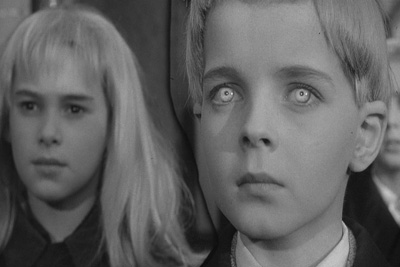
I haven't had this one as often in my 30s, but I felt a strong connection to it the other night when I dreamt I was producing a horror movie out of a cavernous office space with my old colleagues from Civilian Pictures. I felt absolutely in control and excited about finally producing my own feature. The film, which we were shooting in black and white, was a modern interpretation of VILLAGE OF THE DAMNED, and we'd assembled the creepiest looking army of blonde children. They were milling about the set, smiling when off camera and the embodiment of evil when the cameras were rolling (incidentally, feel free to analyze what making this particular movie in my dream has to say about my childless status- I have).

When I woke up I felt empowered and refreshed- now I was calling the shots on the horror in my life.

Who's in control now?

The second major recurring dream theme has been plaguing me steadily through my 20s and 30s. The details of this one change more often that the killer dream, but the essentials are that I've been skipping a college class all semester long, and now I have to return for a big test and face the music. A common wrinkle is that I haven't been to the class in so long that I've forgotten where it's held and/or I've forgotten where the building it's in is located on campus. I ransack my room looking for the list of classes I'm enrolled in that was issued at the beginning of the semester, but I can never find it. I basically wander around the UNC campus (which always looks pristinely beautiful) gnashing my teeth, beating myself up about waiting so long to address the issue and thinking "How did I think I would get away with not going to class all semester!" (Incidentally, I was a big believer in the "if you go to every class, you don't have to study nearly as hard" school of thought, so this dream pattern isn't even really related to any real-life experience that I'm conscious of.)

I wake up feeling exhausted and depressed by these dreams too, and always deeply disappointed in myself (which as you know is one of the least pleasant emotional states).

Last week I had a dream that turned this one upside-down too. I don't recall the details that well, but the gist of it was that I was now on the faculty at UNC. I sat up at the front of the class, serene and confident, and watched the young clueless students file into my class and then hang on my every word.

This one had an even more profound effect on me when I woke up- I could physically feel that a weight had been lifted, that a chain had been broken. Of course, it's too early to say that I won't be having either of the predecessor dreams any more, but it sure doesn't feel like it.

If I had to guess, I'd say that the catalyst for this internal transition was joining Facebook about three weeks ago. I'd fought the notion of Facebook, thinking that it would a big time-waster and filled with uncomfortable small-talky reunions with people you no longer cared about and/or actively wanted to steer clear of. I joined primarily because it's constantly referred to as an outlet or destination for marketing strategies by the people I work with, and I felt like I could no longer pretend to nod my head knowingly about it.

By connecting to dozens and dozens of people who used to occupy a lot of my headspace but have since drifted away for one reason or another, and doing it all at once, I think my unconscious was forced to assess where my own life is now. More than that, I was forced to see something that I already knew but I suppose isn't all that apparent in one's own day-to-day continuum- I've grown up. I really am 37. I really have friends who have teenage children. I really am looking down the barrel at my 20th high school reunion. And so are a lot of other people... it's happening to everybody.

Thankfully, it seems, the producers of my dream life appear to be growing up too.

Friday, September 5, 2008

Midblog Crisis

So, like, how long are blogs supposed to go on? Until death? There's no real way to complete one, as far as I can tell, especially one with an amorphous raison d'ĂȘtre like this one.

I took a month off because I thought the blog was getting stale and gimmicky. I didn't want to dogear the books I was reading any longer, nor did I want to create lists or other excuses to talk about records or movies or whatnot. Most of the issues and ideas that had been rattling around in my head before the blog had now been transcribed, and they weren't replenishing themselves at the kind of rate that would keep me posting a minimum of three times a month (one of the rules I made for myself when I started things off in May of '07).

Another rule I made was no pix of me, but what the hell.
This is from a picture booth strip I took in London for my travel pass
during my brief stint working on B. MONKEY there in May '96

I wanted this blog to be spontaneous, not canned, and the last thing I wanted was to sit at my desk and wonder "Hmm, what should I blog about now?".

I was so hard up for material that I dug up my old journal, curious to see what my writing style and thought processes were like then compared to now.

Let me tell you, if you're interested in humbling yourself real quick, dig up your old journal or diary and give it a spin. "Stupid feeling" galore. That said, it felt really good to see that some of the anxieties and doubts and insecurities that plagued me in my twenties have been dealt with or overcome to some degree.

The journal was a gift from my dad for my 21st birthday, and the first entry is dated September 15, 1992 (shortly after my senior year at UNC began) and the first words are "Hello Cleveland!". The last entry is dated October 28, 1999, and the final words are "I'm going to ask (Mrs. Word Player) to marry me as soon as possible." We were engaged less than a month later, on November 24.

Reading the gory details of the seven years from 1992 to 1999 was very weird. It's not that I'd forgotten the names of some people who were apparently important figures in my life, I'd forgotten they ever existed. It was often a very pleasant jolt to read details about some people who I still think about, but in more fond, hazy ways.

From 8/23/99 entry: "Driving cross-country to move back to Georgia in the spring,
Brett (Kinard) drove too late into the night on a rainy night in Texas.
As was his custom, he wasn't wearing a seatbelt.
No one knows the specifics of his last moments, but in my mind he was singing "My Wild Love" by The Doors wearily, with a Marlboro Red dangling out of the corner of his mouth.
God we had some good times together."


BUT, it was not a treasure trove of quotables that would make for a good blog post. That leaves me with... not much. The blog has been a lot of fun to write, but in many ways I see it as a disappointment. It rarely if ever generated the kind of comment-board discussion that I'd hoped for, and the vast majority of the 14,103 site visits and 21,248 page views came because people Google image-searched some of the pix that I myself had snagged during my Google image searches... which doesn't really get me off that much, to be honest.

Me and Dodger scout Mike Brito from Mr. CFA's trip to LA in August of '95.
Mr. CFA used his Savannah, GA press credentials to wangle us amazing
submerged seats behind home plate to watch Ramon Martinez pitch.
That green Hawaiian shirt is my favorite all-time garment, may it rest in peace.

I have a big personal writing project that I've just embarked upon (writing a novel) and I wonder if the blog is something that I want to keep doing. Maybe I should throw off all the "rules" I've created for it and post only whenever I feel like it, even if that's every three or four months. Maybe I should dream up some blog stunt that I could document without much brainpower (365 Days Without Deodorant!). Maybe I should shutter this one and start fresh elsewhere when I have a stronger central concept to build around.

Honestly, I just don't know. Anyone have any ideas?

Tuesday, July 22, 2008

Bend Me, Shape Me #9: Subliminal Sandwich

Once the volume control is set, do not readjust.
Do not readjust.

As pivotal to the shaping of my taste for funk as The Sound of Funk Vol. 4 was, so the Volume series of compilations was to my taste for beats-driven electronic music.


Volumes 1 and 2 are touchstones on my way here fo' sho.


Volume One CD + bound mini-magazine came out in 1991 on U.K.-based World's End Ltd. In-the-thick-of-it acts like Consolidated and The Orb were there, as were the well-established New Order and Nitzer Ebb, but the standout track on this outstanding comp was "Love Mad" by Meat Beat Manifesto.

If you leave, take me with you.
I want you, I need you.


"They can design future worlds."

I first heard MBM in SP's room in college. He was never afraid to play risky tracks late night in a co-ed situation (rarer than thou'd think), and I always loved it when he played "Drop" from the 1992 MBM album Satyricon. It would either clear the room, or send it into a state, and either way I was there agitating for more volume.

The same is true on a much larger scale with Subliminal Sandwich from 1996, the definitive intersection of all the best parts of MBM.

Listening to Subliminal Sandwich is like tuning into a pirate radio station for a fictional universe, or at least a fictional music scene- the album is so stylistically diverse and daring it's amazing that only one band is behind it all. This is also a rare example of a double album NOT being too much of a good thing. Dancefloor-oriented Side 1 is definitely the more traditional "album side" in terms of track sequencing, but the looser, spacier, more experimental Side 2 is just as essential as the "now, let's go thataway" counterbalance: deep left-field, aggressive ambient (until you get to track 4 "United Nations E. T. C." which rounds back to an even freakier dance-floor style... this is the song that would be playing at midnight on a Saturday if I had my own club.)

Very weird, very exciting stuff. FORBIDDEN PLANET-style space effects, echo chamber dub sensations and angry but mindful lyrics.

MBM deliver unbelievable interplay between their music and visuals when they play live.


It’s a crime,
it’s so sublime.


For me the definitive track is "She’s Unreal":

Give me love,
so that I can kill.
Love me.
Love me.

The buzzing drums coming back in after the sound-collage interlude is an epic break, and the turntable solo in “What’s Your Name?” is one of the best ever. Hyperbole is warranted here, trust me. A helluvan achievement for an operation propelled for over two decades by one guy, Mr. Jack Dangers.

See I believe in the noble, aristocratic art of doing absolutely nothing
and I hope someday I’ll be in a position when I can do even less.

That sentiment, great sample though it is, has very little to do with the incredibly prolific Dangers. This is hard, circuit-driven industrial funk, there for you when yer ready and willing... if this kind of talk turns you on, that is.

**If you're new to the site, the goal of the Bend Me, Shape Me series can be found here.**

Sunday, July 20, 2008

Bend Me, Shape Me #8: Dummy

In the fall of 1994, I returned to UNC for a visit and caught up with my friend MS who was just as into electronic and house music as I was (and probably more). Thanks in part to the wide variety of new music she was bombarded with at her gig late-night deejaying for our college station WXYC, she'd turned me on to a lot of good stuff already.


"Feeling so unholy"

Driving around in her car one night, she said something to the effect of "Have you heard of Portishead?", then when I said I hadn't, "You are gonna love it."

I got goosebumps when I heard the first seconds of "Mysterons", the first track from Portishead's first album Dummy. European-art-film-soundtrack-y guitar layered over chunky old school scratching?

And then those jeep beats?

And then a fucking theramin?

And then, of course, that voice, Beth Gibbons, saying those things.

Inside your pretending
Crimes have been swept aside
Somewhere where they can forget

Did you really want?


So that's how you get a smoky voice


And then the torch song of our generation (am I allowed to say stuff like that?) "Sour Times":

‘Cause nobody loves me,
It's true,
Not like you do.

And it kept going, one amazing track after another that were all indeed directly up my alley. It was one of those records that I immediately had intensely personal feelings about, and yet in a remarkably short time it spread out from the beathead fringe and BOOM everyone I knew loved it too.

One of the last times I can remember feeling optimistic about the state of pop music was following Dummy as it sold millions of copies worldwide, crossing over and over.

Then, like a candle lit at both ends burning brighter, I suddenly couldn't listen to Dummy anymore. In that year or so after I first discovered it, I heard it so many times in so many places that it'd become completely burnt. I never stopped loving it, but I stopped listening to it, and somehow even new material from Portishead hardly resonated with me at all.

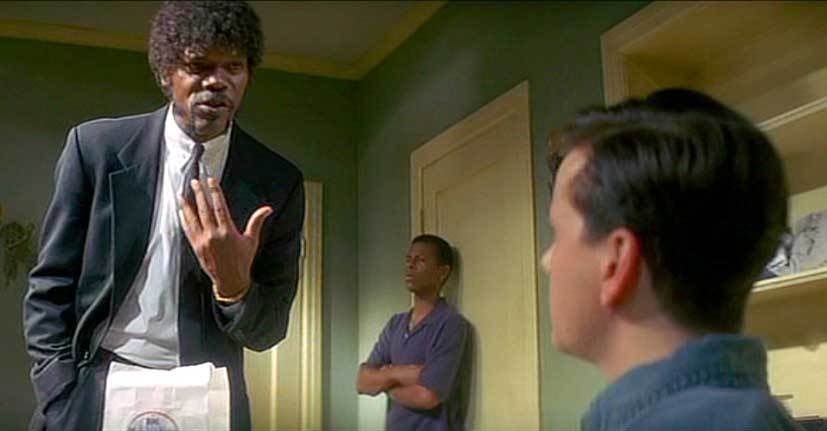
1994-95 also saw me fall in love with and get sick of PULP FICTION

The band took 10 years between their uninspired live album Roseland NYC Live and their third album of new material called, um, Third. I was both excited and wary when I read that Third was about to be released, but my gut said that the long hiatus would be good for both the band and my listening ears.

Well, most everything I've read about Third has been positive, and it scores an 85 at metacritic.com (which translates to "Universal Acclaim"), but after three listenings it just doesn't do anything for me. The weird thing is that I felt like somehow it should, that there was something wrong with me, not the record itself. But the more I think about it, the more I feel that no matter what the new record sounded like, it would fall short for me. Intense Dummy overload may have permanently crossed the wires and made enjoyment of Portishead's future output impossible, but with the passing of the years Dummy thankfully sounds immaculate and wonderfully listenable again.

**If you're new to the site, the goal of the Bend Me, Shape Me series can be found here.**

Friday, July 18, 2008

Bend Me, Shape Me #7: The Sound of Funk 4

Since very few of the cassettes I purchased early on in life are still in my possession, my official career as a music collector began in 1985 when I bought my first three Compact Discs- Yes 90125, U2 The Unforgettable Fire and Van Halen 1984. Since then, an inordinate (to some) amount of my spending money has been utilized to grow that record collection... but there's still never enough.

"Doin' the moonwalk. Talkin' that moon talk"

I would probably buy a lot fewer Compilations if money was no object, but since it is I've found the Compilation (much like the Greatest Hits record, non-score Soundtrack Albums, Insert CDs in music mags like Mixmag and XLR8R, etc) to be a great friend of the music budget. For the price of one record you can often be introduced to a dozen or more new-to-you acts, and quite often a track that strikes a chord can lead you down a path of exploration you may not otherwise have discovered.

By far the best music compilation I've come across is The Sound of Funk 4 on the UK's Rare Groove and Northern Soul reissue label Goldmine Soul Supply. I can't easily find the release date, but I first discovered it in a record store in Brussels.

Royal Crescent Mob at the Cat's Cradle was always a special night

Like many people, I got deepest into exploring new-to-me music during my college years. The (for lack of a better term) white-boy funk of Royal Crescent Mob and Chapel Hill bands Johnny Quest and Sex Police led quickly to golden era funk like The Meters and James Brown.

And thus, the stage was set for that moment in June of 1994 in Brussels, Belgium when I broke off from the pack of dudes I was traveling with to spend some quality time in the local record shop. The selection process details are hazy, but for some reason I decided to spend some Belgian francs taking a chance on The Sound of Funk 4.

To me this is sweet-spot funk, the kind of funk that separates people who shake their ass from people who don't.

Of all the records on this list, The Sound of Funk 4 is the one I evangelize the most. I cannot imagine the house party, backyard barbecue or headphone session that wouldn't be better off with a few of these choice cuts comin' out the speakers.

Where else ya gonna find Bootsy Collins's first solo single "Fun in Your Thang (Part 1)"?

How could music from names like Little Oscar, Burnett Bynam and the Soul Invaders, and Little Joe Cook and the Thrillers be anything other than sublime?

THIS is where you can hear the lip-curling gauntlet-thrower "Funky Funk" by Big Al and the Star Treks!

But we got a thing called the funky funk.
You do what you wanna do!

THIS is where you can hear the all-time greatest theme music for strutting, "Bumping" by Tyrone Chestnut!

When Wee Willie and the Winners implores you to "Get some, before it's all gone", you have no choice but to nod your head in agreement.

One of my three favorite all-time funk songs is "The Funky Buzzard" by Little Oscar.

Funky Buzzard.
Funky Buzzard.
Do your thing.
Funky Buzzard.
Funky Buzzard.
Flap Your Wings.

Wiggle Your Tail Feather

This is the song you want playing in your car when you're on your way somewhere better.

In a final "this is probably only interesting to the blogger himself" note, it just dawned on me that The Sound of Funk 4 has an awesome track from Grady Tate ("Be Black Baby"), the same Grady Tate I singled out for his "opposite end of the musical spectrum" work drumming on the soundtrack to TWIN PEAKS: FIRE WALK WITH ME in the last installment of Bend Me.

Weird.

When you do it once,
You wanna do it some more

Mmm hmmm.

**If you're new to the site, the goal of the Bend Me, Shape Me series can be found here.**

Tuesday, April 15, 2008

Say It's All So, Joe!

Mythology has always floated my boat. Growing up, I loved reading the myths of the Greeks and Romans, as well as mythology from other countries around the world as provided by books like the pivotal (for me anyway) The Crimson Fairy Book. In college, I excitedly read the Joseph Campbell book The Hero with a Thousand Faces after I was tipped off by one of my film professors that Campbell was THE literary influence for George Lucas when he was creating the STAR WARS universe.

Better than CLASH OF THE TITANS!

Confident that I was now familiar enough with Campbell to get by, I didn't touch him again for almost fifteen years until I pulled Hero with a Thousand Faces off the bookshelf when Mrs. Word Player and I were housesitting in Laurel Canyon a while back. Reading him again, especially after focusing so much of my life as a development guy on dissecting the Hero's Journey and three-act narrative structure in screenplays, was eye-opening.

His writing and thinking was far more valuable than merely a guideline for understanding the past and creating fictional narratives, they were critical insights about how to interpret and experience your life's narrative.

Over the past several months we've watched the four-DVD set THE POWER OF MYTH, a series of interviews conducted by journalist (and former White House Press Secretary) Bill Moyers with Joseph Campbell in the last years of Campbell's life. Produced by PBS and originally aired in 1988, MYTH is an awe-inspiring portrait of one man's wisdom, drawn from a lifetime of studying the primal, archetypal stories told by and about our planet known as mythology.

"Spiritual life is the bouquet of natural life, not a supernatural thing imposed upon it."

Campbell, who was in his mid-80s as MYTH was filmed, is a surprisingly mesmerizing screen presence. Shot entirely in medium shots and close-ups, he has such an expressive face and an incredible gift for recall and oratory that you never think for a moment that you're just watching a talking head for an hour. Avuncular, charming, and powerful, Campbell has a similar quality as the Dalai Lama does in interviews I've seen: you simply want to know what they know so you can be the way they are.

His worthy foil is Moyers, no slouch himself in the brains or conversation department. Campbell was an agnostic and Moyers a practicing Christian, and the interplay as they take stabs at interpreting the wonder and meaning of life and death is an amazing thought provoker.

Can you believe it's taken me almost a year to reference STAR WARS in this blog?

I have grown comfortable knowing that I have far more questions than I do answers about why we're here and what (if anything) happens next, and Campbell's quote from the final minutes of the final episode of MYTH is one I can safely adopt as part of my personal philosophy:

“He who says he knows, doesn’t know. He who knows he doesn’t know, knows.”

The DVDs have gone out of print and now list on Amazon for $80 and up, so if you're interested I'd recommend Netflixing them. MYTH is not only a wild ride through history, religion, philosophy, poetry and more, but it's also one of the extremely rare examples of something truly and purely life-affirming. Dig it.

Monday, January 21, 2008

Empathy for the Devil

HEDLEY LAMARR
My mind is a raging torrent, flooded with rivulets of thought
cascading into a waterfall of creative alternatives.

TAGGART
God darnit, Mr. Lamarr, you use your tongue
purtier than a twenty dollar whore.

Too often I find myself thinking like Hedley and speaking like Taggart. Hopefully I write somewhere in between.

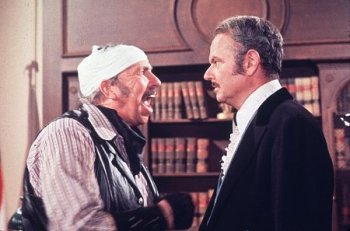
The solution to all life's riddles can be found in BLAZING SADDLES

My mind HAS been flooded with a variety of rivulets lately, and they seem to be begging me to tie them together somehow.

Here they are, separately:

1. A desire to finally write down definitions of classically descriptive terms like "pathos" and "bathos" that I (and many others) seem to misuse and often misunderstand.
2. A desire to finally write down translations of still-in-use Latin phrases that I (and many others) seem to misuse and often misunderstand.
3. A desire to finally write down crib-sheet style descriptions of all the philosophers and thinkers overtly referenced in the character names in LOST in preparation for the premiere next Thursday.

We'll see, I suppose, if there's a connection other than the tenuous one that they were all in play at one time or another as I pursued my BA in Poli-Sci. Hopefully, at the very least, they'll look purty all wrote out in a row.

pathos: Greek for "to suffer".
  1. The aspect of something which gives rise to a sense of pity.
  2. In its rhetorical sense, pathos is a writer's attempt to persuade an audience through appeals involving the use of strong emotions. In this sense, pathos is not strictly limited to pity. In its critical sense, pathos denotes an author's attempt to evoke a feeling of pity or sympathetic sorrow for a character.
  3. In theology and existentialist ethics following Kierkegaard and Heidegger, a deep and abiding commitment of the heart, as in the notion of "finding your passion" as an important aspect of a fully-lived, engaged life.

The urge to make a groan-inducing pun with the word "bathos" is all-but overwhelming

bathos
: Greek for "depth". Used metaphorically from 1638 (Robert Sanderson). First used ironically by Alexander Pope (Bathos, 1727), in contrast to "sublime".
  1. Depth, Bottom.
  2. An abrupt change in style, usually from high to low; an unintended transition of style; an anticlimax.
  3. Triteness; triviality; banality.
  4. Overly sentimental and exaggerated pathos.
pathetic:
1. arousing pity, esp. through vulnerability or sadness : she looked so pathetic that I bent
down to comfort her. See note at moving .
• informal miserably inadequate : his test scores in Chemistry were pathetic.
2. archaic relating to the emotions.

empathy:
1. the intellectual identification of the thoughts, feelings, or state of another person
2. capacity to understand another person's point of view or the result of such understanding

sympathy:
  1. A feeling of pity or sorrow for the suffering or distress of another; compassion.
  2. The ability to share the feelings of another; empathy.
  3. (psychology) A mutual relationship between people such that they are correspondingly affected by any condition.
  4. (physiology) A mutual relationship between organs such that a condition of one part causes an effect in the other.
a priori: deductive reasoning, from cause to effect

a posteriori: inductive reasoning, from effect to cause

factotum: one who does everything

sine qua non: fundamental cause; necessary precondition

flagrante delicto: in the heat of the crime
(I always thought this had a more lurid meaning...)

persona non grata: an unacceptable person

cogito ergo sum: I think, therefore I am (first busted out by ya boy René Descartes in 1637)

amor fati: (this one I've been thinking about a lot lately because of the beautiful Nietzsche quote I stumbled across, so excuse the lengthier wikipedia definition in this already lengthy post)

Amor fati is a Latin phrase that loosely translates to "love of fate" or "love of one's fate". It is used to describe an attitude in which one sees everything that happens in one's life, including suffering and loss, as good. That is, one feels that everything that happens is destiny's way of reaching its ultimate purpose, and so should be considered good. Moreover, it is characterized by an acceptance of the events that occur in one's life.

The phrase is used repeatedly in Nietzsche's writings and is representative of the general outlook on life he articulates in section 276 of The Gay Science, which reads,

I want to learn more and more to see as beautiful what is necessary in things; then I shall be one of those who make things beautiful. Amor fati: let that be my love henceforth! I do not want to wage war against what is ugly. I do not want to accuse; I do not even want to accuse those who accuse. Looking away shall be my only negation. And all in all and on the whole: some day I wish to be only a Yes-sayer.

John Locke is named after John Locke (1632-1704) the Enlightenment philosopher who dealt with the relationship between nature and civilization, later to have great influence on founders of democratic governments. He believed that, in the state of nature, all men had equal rights to punish transgressors; to ensure fair judgment for all, governments were formed to better administer the laws.

Anthony Cooper is John Locke's father. It seems he's based on two Anthony Coopers:
Anthony Ashley-Cooper (1621-1683) was an English politician who was the mentor and patron of real-life philosopher, John Locke.

Anthony Ashley-Cooper (1671-1713) was an eighteenth-century moral philosopher who posited that people are basically good, and that morality is a foundational (if not innate) part of humanity.

"Desmond" David Hume is named after David Hume (1711-1776). Hume was the first great philosopher of the modern era to carve out a thoroughly naturalistic philosophy. This philosophy partly consisted in the rejection of the historically prevalent conception of human minds as being miniature versions of the Divine mind; a notion that has been entitled the ‘Image of God’ doctrine. This doctrine was associated with a trust in the powers of human reason and insight into reality, which powers possessed God’s certification.

Danielle "Rousseau" is named after Jean-Jacques Rousseau (1712-1778), a philosopher and composer of the Enlightenment whose political philosophy influenced the French Revolution, the development of both liberal and socialist theory, and the growth of nationalism. With his Confessions and other writings, he practically invented modern autobiography and encouraged a new focus on the building of subjectivity that would bear fruit in the work of thinkers as diverse as Hegel and Freud. His novel Julie, or the New Heloise was one of the best-selling fictional works of the eighteenth century and was important to the development of romanticism.

I think Alpert's backstory will go a long way in telling us if time travel is in play on LOST

Richard Alpert (the eyebrowish "Other" who recruited Juliet to the island) is named after Dr. Richard Alpert (born April 6, 1931), also known as Baba Ram Dass, is a contemporary spiritual teacher who wrote the 1971 bestseller Be Here Now. He is well-known for his association with Timothy Leary at Harvard University in the early 1960s, both having been dismissed from their professorships for experiments on the effects of psychedelic drugs on human subjects. He is also known for his travels to India and his association with the Hindu guru Neem Karoli Baba.

Mikhail Bakunin (aka "Patchy") is named after Mikhail Bakunin (1814-1876) was a well-known Russian revolutionary and anarchist philosopher. He "rejected governing systems in every name and shape", every authority figure, including God, or a sovereign. Bakunin denied the concept of "free will" and advocated a materialist explanation of natural phenomena. Bakunin believed that the proper form of social organization is that of free association between individuals and between communities. Thus, "The freedom of all is essential to my freedom."

Whew. I feel better now. Thank you to Wikipedia, Wiktionary, Apple's Dictionary, Latin Phrases & Quotations by Richard A. Branyon, and Lostpedia.

Finally, for other LOST fans beginning to loosen up their theory-belts for Season 4, check out this intriguing line of thinking at Lost in Shangri-La.

Thursday, January 17, 2008

Toxic Ontology?

Tell it to me straight- is it the height of vanity to blog about what's going on in one's noggin?

(It's interesting to note that vanity means both "excessive pride in or admiration of one's own appearance or achievements" and "the quality of being worthless or futile", and I think both definitions apply to my question above).


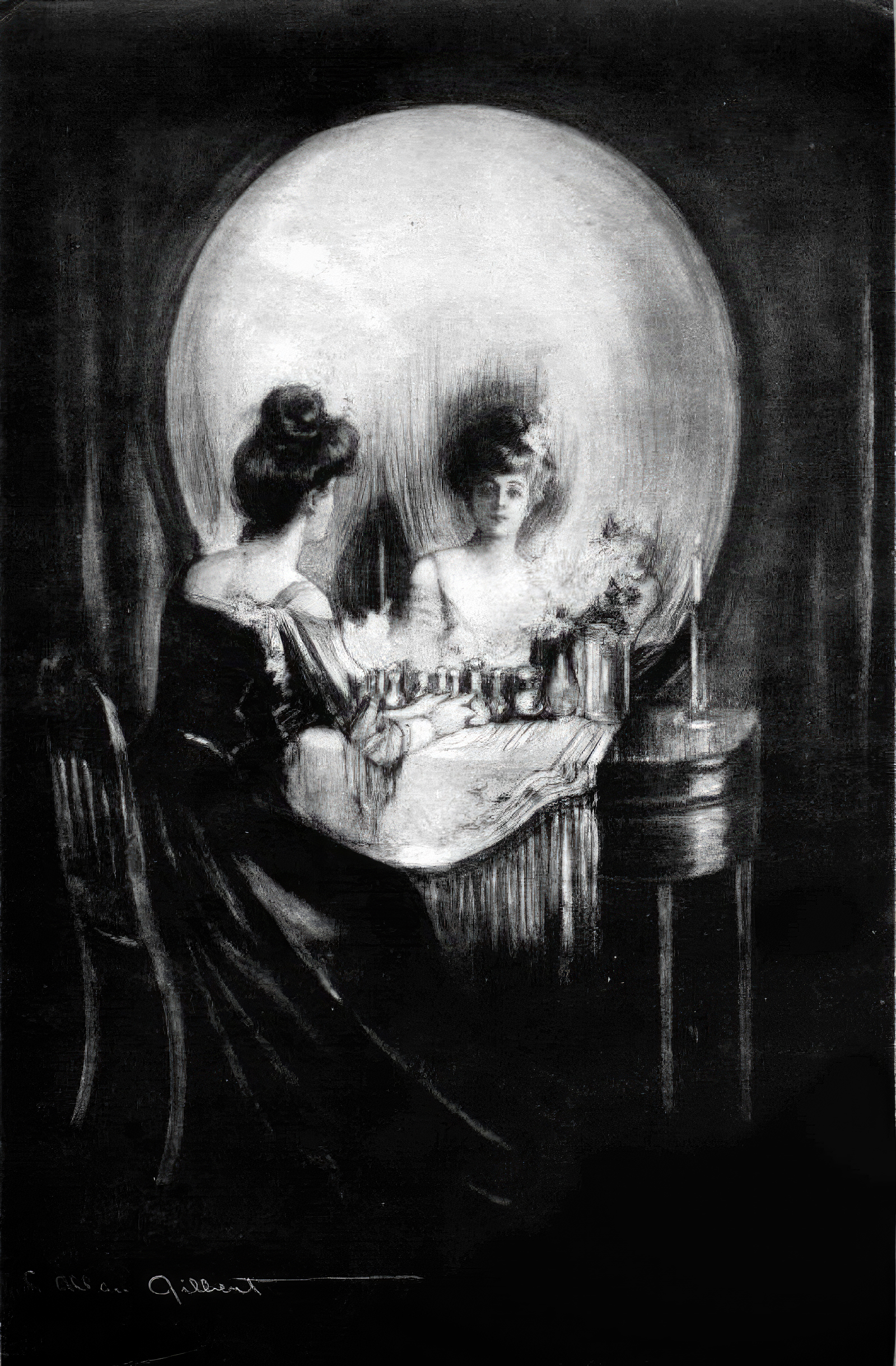
"My own little nasty world"

Was Socrates right when he said "The unexamined life is not worth living", or is the correlation between thinking and happiness that the more you think, the less happy you are?

I do my best to only speak for myself in this forum and in "real" life as well, but when I think I like to think in generalities as well as specifics. I've been running into a word lately in my reading that not only encapsulates a good deal of my free-form thinking, but also some of what I've been doing here. More than a dictionary definition is called for, so allow me this chunk from Wikipedia:

Ontology is a study of conceptions of reality and the nature of being. In philosophy, ontology is the study of being or existence and forms the basic subject matter of metaphysics. It seeks to describe or posit the basic categories and relationships of being or existence to define entities and types of entities within its framework.

Some philosophers, notably of the Platonic school, contend that all nouns refer to entities. Other philosophers contend that some nouns do not name entities but provide a kind of shorthand way of referring to a collection (of either objects or events). In this latter view, mind, instead of referring to an entity, refers to a collection of mental events experienced by a person; society refers to a collection of persons with some shared interactions, and geometry refers to a collection of a specific kind of intellectual activity.

As a philosophical subject, ontology chiefly deals with the precise utilization of words as descriptors of entities or realities. Any ontology must give an account of which words refer to entities, which do not, why, and what categories result. When one applies this process to nouns such as electrons, energy, contract, happiness, time, truth, causality, and God, ontology becomes fundamental to many branches of philosophy.


Shouldn't there be more choices than "red pill" or "blue pill"?

I freely admit to being a novice when it comes to ontology, but I do particularly like the fact that it "chiefly deals with the precise utilization of words as descriptors of entities or realities." I'd like to think my pursuit of better words and more accurate descriptions, and my desire to ask better questions and seek more accurate answers, serves a larger purpose than simple self-improvement. There have to be reasons beyond vanity and self-promotion that millions of people spanning the length of human existence have been compelled to write down the stuff going on in their heads and try their best to circulate it to the widest audience possible, right?

Unfortunately, and quite the opposite from my expectations as a younger man, it seems to me that carrying on discourse of this flavor, at least in in-person conversation, becomes less feasible the older we get. When the Beatles sang "But if you go carrying pictures of chairman Mao, You ain’t gonna make it with anyone anyhow" in 1968's "Revolution 1", I imagine they weren't talking to the Chinese, but to thinkers and theorists raining on the Age of Aquarius's indulgent parade.

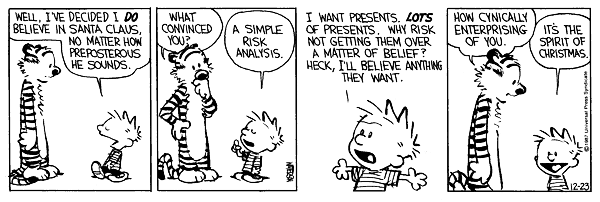
Among other things, college gave me a deeper appreciation of Calvin and Hobbes

I was wholly unprepared for my first taste of serious philosophical discussions when I took a Philosophy course my freshman year in college. I was used to taking tests with hard and firm answers, not teasing out the threads of Pascal's Wager, but the weird energy of that class's discussions has stayed with me even though it has rarely been reproduced.

Maybe I'm living proof of Oscar Wilde's position that "Seriousness is the only refuge of the shallow." Maybe I'm afraid that if I stop reading and writing and searching and questioning and challenging myself, as exhausting and frustrating as it can be, I won't be me any more. Of course, I have to live with the possibility that the new me would be happier than the old me, but that's not a wager I'm willing to take. I remember vividly the day a former friend of mine announced proudly that he, at the age of 29, was never going to read another book again in his life. He felt that he was well-read enough to focus his energies elsewhere, but I felt that I no longer had any idea who this person standing in front of me was. I believe that if you're not moving forward, you're moving backward.

There is no standing still.

Right?

Monday, November 19, 2007

What's the Opposite of Schadenfreude?

I must confess that there have been many occasions when I have taken pleasure in the pain of others. I hate that kind of pleasure, but when it comes, it comes. Right?

The good news is that over the past few weeks I've been feeling quite the opposite, taking great pleasure in the success of others. Three others in particular, all of whom I've known as friends and colleagues for nine years or more and who are enjoying varying degrees of public success at the same time.

It's awkward to say "I'm proud of you" to a non-relative in person, but hell, I AM feeling proud of them and what's wrong with sharing a little of that... blog-style?

This one speaks for itself.

The first is Mr. Sam Stephenson, whose excellent article "Southern Homecoming" about native North Carolinian Thelonious Monk's final string of shows in his home state is the cover story of Oxford American magazine's 2007 Music Issue. Before I first met Sam, at the University of North Carolina-Chapel Hill in 1989, I'd heard tales of Sam. Sam Stephenson can drink a whole keg of beer. Sam Stephenson can throw a baseball 200 yards and hit a moving car. When I did meet him I quickly found out he was a gentle giant (and was laughed at for thinking ANYONE could drink a whole keg... hey I was 18).

Sam is a devoted aficionado, ambassador and archivist for jazz, photography, and specifically jazz photography. His 2003 book Dream Street: W. Eugene Smith's Pittsburgh Project was another highwater mark for Sam, yet I believe it'll one day go down as the prelude to an even greater work on Smith's soon-to-be-infamous Jazz Loft.

Livin La Vida Reilly

The second name I'll drop is Mr. Barry Poltermann, who co-directed (alongside Frank L. Anderson) the concert film/documentary THE LIFE OF REILLY focusing on MATCH GAME fixture (and much, much more) Charles Nelson Reilly. I've known Barry since that day in 1998 that, sight unseen, he hired me over the phone from Milwaukee to be the development guy for his new Venice, CA based film and commercial production company Spoke Film.

Spoke was the launching pad for film financing offshoot Civilian Pictures, which quickly became the focus of both our lives- mine up to the beginning of 2001 and Barry's until... well in a way it still is. Civilian offered ordinary investors the opportunity to buy shares of movies and documentaries in various stages of development, and despite the fact that we raised quite a bit of money and attracted high profile names like Diane Keaton, Keith Gordon and John Sloss, Civilian didn't achieve its ultimate goal of getting Civilian-financed films into theaters... until 2007. First the Wu-Tang Clan doc ROCK THE BELLS made it, and now LIFE OF REILLY makes it two in one year.

I just surfed to civilian.com to insert the link here and discovered that the investor-friendly homepage that's been up for years has recently been replaced by a holding page, so we'll have to see what Barry and the Civilian crew are up to next. Even though I personally had nothing to do with REILLY, I'm still chuffed to see the Civilian logo in the newspaper movie listings.

If I were a betting man, I'd lay $100 on Riley scoring an Oscar nomination (or at the very least a Golden Globe).

Exhibit #3 is Mr. Todd Eckert, who produced the Ian Curtis biopic CONTROL, which is also now in theaters (thanks to the Weinstein Company's acquisition of the film at Cannes). I met Todd in a shuttle van shuttling us from the Salt Lake airport to Park City for Sundance in January of 1999. I wish I could remember what specifically struck our initial conversation up, but I remember for certain it was music (probably Ryuichi Sakamoto, but I can't be sure). We exchanged business cards, met later in the festival for drinks, and have been friends ever since.

Todd is, without question, the most serious music fan I've ever known. He was a music journalist before transitioning into the film finance world and, lately, into film production (among other things- he's a renaissance man in the best sense of the word). Despite a daunting travel, family and work schedule, he still manages to take in (what seems to me) hundreds of shows and movies a year and always drops band names to me that mean nothing to me at the time yet have a tendency to make sense later when the bands explode onto the scene.

Todd relentlessly pursued CONTROL for years, and took quite a few gambles to get it made the way he wanted it to get made including shooting in B&W, hiring a first-time feature director (Anton Corbijn), first-time feature writer (Matt Greenhalgh) and first-time feature actor (Sam Riley) to play the lead. All this from a first time feature producer, yet the film's taken major prizes at Cannes, Edinburgh, Chicago and more and is cruising towards $1 million at the U.S. box office with far more abroad.

Too all three of you major dudes, I extend a heartfelt "I'm proud of you": I'm genuinely happy for your successes.