Showing posts with label Philosophy. Show all posts

Wednesday, January 21, 2009

Previously on LOST

Yesterday Facebook was buzzing with Inauguration Day chatter and commentary. These days, even the most exciting news gets old quickly, so I thought I'd make light of the big day with this post on a thread at a new friend's page.

ME
"now we can focus on the real issue- where did the island go on LOST?"

PERSON I DON'T KNOW
"huh? Ohhhhhhhh....I don't watch T.V. it'll rott your brain"

Don't you just love getting lectured by someone you've never met? I wanted to say something about how LOST, unlike most shows, actually stimulates lively conversation, encourages reading of the classics and exploration of history, etc. but I also didn't want to get into it with a stranger from San Francisco on someone else's page.

Later on down the thread, I did get a kick out of a follow-up post by the same person.

PERSON I DON'T KNOW
I do enjoy the forensic shows though:}

So which is it? "Kill Your television" people who still watch multiple cop shows are kinda like vegans who smoke cigarettes. Which one is it gonna be, because you can't be both and still ride the high horse!

Anyway.

I forgot about that brief exchange until this morning when I was thinking about LOST in the shower. Sorry if that's TMI, but the Season 5 Premiere is tonight.

Maybe my brain is showing signs of "rott" after all...

I was thinking about why the show still holds so much interest to me, and I think it goes beyond the usual razzle-dazzle of the much-discussed mysteries of the Island, the Numbers, the Dharma Initiative, the Hanso family, the Smoke Monster, the Donkey Wheel, etc.

It's about people.

Yes, I know how cheesy that sounds, but bear me out here. I have become a big believer in the importance of reaching a point in one's life where you can no longer point your finger at anyone else for your failings, and you only have to look in the mirror to see the source of your successes. That may be an idealistic state of mind, but it seems to me that even striving for it is extremely beneficial because of the burgeoning awareness gained that you can no sooner change your parents or your genes than you can change your past.


The Dharmacakra, symbolizing the path to enlightenment, is featured prominently on LOST.


But what you can change is the future. That is, unless, you continue to let the unchangeable past dictate who you are today.

Someone close to me has let the phrase "I've had a hard life" enter the conversation a few times lately. Now, it's not up to me to determine the veracity of that statement, and even if I could, those kinds of statements are all relative. But what I feel I can determine is how much the belief that one's life has been "hard" up to now hinders one's ability to create a less "hard" life from this point forward.

What I want to say is "That may be true, but a lot of people's lives have been hard. Would you rather have an excuse ("You've had a hard life") for your present state of unhappiness, or would you rather achieve happiness and use that same statement to signal how it used to be BEFORE YOU TOOK CONTROL OF YOUR LIFE and did what you had to do to make your hard life easier and more enjoyable?"

People win despite being dealt bad hands all the time, and the same is true for people dealt fabulous hands finding a way to lose anyway.

***LOST SPOILERS FROM SEASONS 1-4 AHEAD****

Our characters on LOST all have "daddy issues" that they are being forced, one way or another, to overcome. And isn't that a good thing? I don't recommend literally killing the father figure, as Ben Linus and Kate and Locke and Sawyer have, but isn't some sort of ceremonial dumping of those issues necessary for one to really flower as an adult?

Virtually all of the characters have endured struggles directly related to their socioeconomic status as well. The poorer have either compromised themselves by turning to crime (Sawyer, Kate, Eko) or to status-seeking (Jin, Desmond). The richer have felt it constricting (Sun, Jack), divisive (Boone, Shannon) or downright dangerous (Hurley, Charlie).

On the island, all material things are stripped away so that everyone is playing the same game with the same tools. To borrow the marketing tagline for this season, destiny has called every single one of them, and we will see who answers the call.

This sensation is the primary correlation with my own life and, I think it's fair to say, all of our lives. Destiny is calling every one of us, and we all have the tools inside of us to hear the call and to embark on a life that we make our own.

To me, life is the best possible combination of fate AND free will.

A quick look at the name "Dharma Initiative", the organization that I believe tried to harness the island's power to force people to evolve into a higher state of consciousness, is revealing:

dharma
noun
1 Hinduism: the principle of cosmic order.
• virtue, righteousness, and duty, esp. social and caste duty in accord with the cosmic order.

initiative
noun
1 the ability to assess and initiate things independently :
2 [in sing. ] the power or opportunity to act or take charge before others do :

LOST is so compelling because I believe one of its major underlying themes is that no matter where one is from, every individual must take charge of their own lives in a virtuous way if collectively we are ever going to overcome the suffering of this world.

Well, that and the time travel and cool monsters and stuff.

Thursday, January 8, 2009

The Zen of the Bridesmaid

I don't know about you, but I read in bed almost every night before I go to sleep. So does Mrs. Word Player.

Several years ago, when the wife in a couple we were friends with discovered this about us, she could barely contain her jealousy. I had no idea... I thought every couple read in bed together. It was a strange exchange, in that from that point forward I looked at what I have as lucky rather than just the status quo. In life it's all about perspective, wouldn't you say?

So a few nights ago, MWP leans over and says "read this." I took the book she'd just started, Thoughts Without a Thinker by Mark Epstein, M.D., and read the first sentence in the Forward, which was written by the Dalai Lama.

"The purpose of life is to be happy."

Whoa. The simplicity of that powerful statement packs an incredible wallop. It certainly goes against the Catholic upbringing I received, where suffering and deprivation are lionized and true happiness is deferred to the afterlife.

I bet the Lama is a big LOST fan. Maybe HE is this "Jacob" we keep hearing about...

Lately, my happiness has been yo-yoing quite a bit, but the biggest X factor has been my work life. When work is plentiful, I am practically exuberant. That sensation pervades the rest of my life quickly- I hadn't been happy with my "Development Guy" work in several years, so the 3+ years I've been relying on my copywriting work (which I genuinely enjoy) has been a boon to my overall mood.

I've also been on indefinite hiatus from my screenwriting projects since spring of '07, work that was often as torturous emotionally as it was fulfilling creatively. And I've been OK with that arrangement for a long while now... until recently.

First, work slowed down in December, and it's continued to be slow into January. My mood destabilized. Then, an odd confluence of events suddenly made me revisit my career path and the happiness factor attached to it. It started with LOST. We received Season 4 on DVD for Christmas, and since we already had Seasons 1 and 2, we went out and bought Season 3 to complete the collection. In watching it, for some reason, my eye kept catching on Jeffrey Lieber's name in the credits. He is a co-creator of the show, and someone I used to know. Even though he's had his own issues with LOST, for some reason seeing his name in the credits over and over had a different effect on me than it had in the past.

It wasn't schadenfreude, it was "why him and not me?" I came into (and then lost) contact with Jeffrey long before LOST. I was a newly hired development guy for Civilian (then known as Spoke Film) and I cast my net wide looking for submissions. Naturally, I hated most of the stuff that agents sent me, but when I read Jeff's scripts (one was called "Conspiracy of Weeds" and I can't remember the name of the second) I called and set up a meeting. Nothing ever came of my interest in the scripts ("Conspiracy" was later made with the far less interesting title TANGLED), but I became friends with Jeff and his wife Holly and for a while he even rented office space from Civilian.

Jeff was talented and a very nice guy, and remembering the clever twists and turns in his scripts that I read it's not hard to see how his contributions to LOST earned him a co-creator credit. "But aren't I ALSO a nice and talented guy who has clever twists of my own to share with the world?" that stubborn part of my brain kept saying every time I saw his name on the screen during our LOST-athon.

Try as I might, I couldn't silence that little voice. In fact, a rapid succession of similar events only made it more insufferable. I saw TWILIGHT and, lo and behold, one of the producers is I guy I used to work with at Wendy Finerman Productions. He was a junior development exec then (hey, kinda like I once was!) and LOOK AT HIM NOW. At the grocery store, I saw a girl I went to UNC with and was once friends with who is now producing Adam Sandler movies. We're the same age, and moved out to LA around the same time, but LOOK AT HER NOW. I watch an episode of GOSSIP GIRL and hey, I used to take meetings with the co-creator and occasionally go for drinks with our mutual friend. Damn, what did she have that I don't have?

Yeah, but would dealing with Chuck Bass' problems be any easier?

I know, of course, that it's an enormous oversimplification of the way lives and careers play out to compare myself to them, and I also know that the choices I've made have taken me out of the running for some of the successes that they are now enjoying.

BUT STILL!

Anyway, having all those things happen within a span of a few days really bummed me out for a while. But the more I thought of it, the more my mood improved. I've achieved a pretty damn high level of happiness without the industry success that I'd pursued for over a decade. I've indulged and explored my creative side and expanded and tested my business acumen while developing a personal life that I'm proud of.

And who knows, the best may be yet to come? But the biggest thing that came out of all this for me is the sensation that no matter what happens from this point forward, I was in the game. I played alongside some of the game's top players, even though I never won the big game myself. I've taken the sum of my experiences and spun them into a state of mind that, I feel, is at the very least prepared for any number of challenging paths the future may hold.

Should I happen to find my way back onto the industry path, I'll be ready. And if it doesn't ever "happen" the way I longed for it to? Well, I'll be ready for that too.

Tuesday, April 15, 2008

Say It's All So, Joe!

Mythology has always floated my boat. Growing up, I loved reading the myths of the Greeks and Romans, as well as mythology from other countries around the world as provided by books like the pivotal (for me anyway) The Crimson Fairy Book. In college, I excitedly read the Joseph Campbell book The Hero with a Thousand Faces after I was tipped off by one of my film professors that Campbell was THE literary influence for George Lucas when he was creating the STAR WARS universe.

Better than CLASH OF THE TITANS!

Confident that I was now familiar enough with Campbell to get by, I didn't touch him again for almost fifteen years until I pulled Hero with a Thousand Faces off the bookshelf when Mrs. Word Player and I were housesitting in Laurel Canyon a while back. Reading him again, especially after focusing so much of my life as a development guy on dissecting the Hero's Journey and three-act narrative structure in screenplays, was eye-opening.

His writing and thinking was far more valuable than merely a guideline for understanding the past and creating fictional narratives, they were critical insights about how to interpret and experience your life's narrative.

Over the past several months we've watched the four-DVD set THE POWER OF MYTH, a series of interviews conducted by journalist (and former White House Press Secretary) Bill Moyers with Joseph Campbell in the last years of Campbell's life. Produced by PBS and originally aired in 1988, MYTH is an awe-inspiring portrait of one man's wisdom, drawn from a lifetime of studying the primal, archetypal stories told by and about our planet known as mythology.

"Spiritual life is the bouquet of natural life, not a supernatural thing imposed upon it."

Campbell, who was in his mid-80s as MYTH was filmed, is a surprisingly mesmerizing screen presence. Shot entirely in medium shots and close-ups, he has such an expressive face and an incredible gift for recall and oratory that you never think for a moment that you're just watching a talking head for an hour. Avuncular, charming, and powerful, Campbell has a similar quality as the Dalai Lama does in interviews I've seen: you simply want to know what they know so you can be the way they are.

His worthy foil is Moyers, no slouch himself in the brains or conversation department. Campbell was an agnostic and Moyers a practicing Christian, and the interplay as they take stabs at interpreting the wonder and meaning of life and death is an amazing thought provoker.

Can you believe it's taken me almost a year to reference STAR WARS in this blog?

I have grown comfortable knowing that I have far more questions than I do answers about why we're here and what (if anything) happens next, and Campbell's quote from the final minutes of the final episode of MYTH is one I can safely adopt as part of my personal philosophy:

“He who says he knows, doesn’t know. He who knows he doesn’t know, knows.”

The DVDs have gone out of print and now list on Amazon for $80 and up, so if you're interested I'd recommend Netflixing them. MYTH is not only a wild ride through history, religion, philosophy, poetry and more, but it's also one of the extremely rare examples of something truly and purely life-affirming. Dig it.

Sunday, April 6, 2008

Dog Ears #13: On the Good Life

I had only a faint remembrance of Cicero from my collegiate Political Science syllabus when I read a brief (but funny) passage devoted to knocking him down a peg in Huysman's Against Nature. That book's protag Des Esseintes delighted in calling Cicero "Chick-Pea" (the Latin translation of "Cicero") as he ripped him for his "long-winded style, the redundant metaphors and the rambling digressions" (p28) and much more.

After assassinating Julius Caesar, Brutus asked Cicero "to restore the Republic"

After reading a collection of Cicero's works from the 50s and 40s BC entitled On the Good Life, I'm happy to disagree with Des Esseintes. OK, Cicero was indeed a bit long-winded, but his insights into the core issues of life as he knew it (particularly one's relationships with other people and one's relationship with oneself) are remarkably, even incredibly, spot-on, relevant and and invaluable over 2000 years later.

Rather than fumble around for my own thumbnail description of who Cicero was, allow me to paste from Wikipedia:

Marcus Tullius Cicero (Classical Latin pronounced [ˈkikeroː], usually pronounced /ˈsɪsəroʊ/ in English; January 3, 106 BC – December 7, 43 BC) was a Roman statesman, lawyer, political theorist, and philosopher. Cicero is widely considered one of Rome's greatest orators and prose stylists.
Cicero is generally seen as one of the most versatile minds of Roman culture and his writing the paragon of Classical Latin. He introduced the Romans to the chief schools of Greek philosophy and created a Latin philosophical vocabulary. An impressive orator and successful lawyer, Cicero probably thought his political career his most important achievement. However, today he is appreciated primarily for his humanism and philosophical and political writings.

Yes, that was the right call.

There was just something mesmerizing about the title of this book, and even though I've been looking forward to some "Summer Reading"-type books, I knew I had to see if Cicero knew something about the elusive "Good Life" that I didn't know.

He did. He was plagued by many of the same vexations, frustrations and doubts that I am (and millions upon millions of others too, I'd venture). He placed a much higher premium on friendship than most thinkers I've come across, and as someone who has extremely strong feelings about the successes and failures I've experienced in friendships of my own, I was on the edge of my seat for nearly the whole book.

I highly recommend this book to those of you who often feel betrayed by the depth (or lack thereof) of modern interpersonal relationships and seek the ability to see others more clearly for who they are (and, the real trick, who they will be). This was by far my most dog-eared book to date...

Before his execution, Cicero's last words were said to be "do try to kill me properly"


From "Introduction"

p21 "In converting Classical Greek philosophy into Latin, Cicero "had to create new words. We owe him the terms quality, individual, vacuum, moral, property, induction, element, definition, difference, notion, comprehension, infinity, appetite, instance, science, image, species."

- damn!


p37 "Petrarch also welcomed (Cicero) as the spokesman for civilized, active leisure, and, in his essay On the Solitary Life and elsewhere, quoted him in order to show that the highest aim of leisure is to be busy."

p43 "Cicero's ideals do not dwell in Utopias, but in the real world. His treatises are for people who possess mature and independent minds, who have no desire to follow other minds slavishly, and who are compelled, in the course of their daily existences, to grapple with problems which are complex – rarely admitting of a purely intellectual solution – and which call on all the resources of their humanity."


From "Discussions at Tusculum"

p61 "If, therefore, there exists any man who is capable of regarding all the hazards and accidents of fortune and human life as endurable, a man moreover who is troubled neither by fear nor by distress nor by passion, a man of whom all empty pleasures of whatever kind leave utterly cold – then, if such a person exists, there is every reason why he should be happy."

p86 "For Dionysius was...a tragic poet (how good he may have been is beside the point, for in that art, more than any other, everyone seems entirely satisfied with his own efforts: I have never known a poet – and Aquinas was a friend of mine – who was not absolutely first class in his own eyes: that is how it is: you like your work, I like mine)."

- I think that observation holds true for more pursuits than poetry...


p88 "An acute first-class brain is the finest asset anyone can have – and, if we want to be happy, it is an asset we must exploit to the uttermost."

p104 "And what the contrast demonstrates is that the true satisfaction to be derived from food comes not from repletion, but from appetite – the people who run hardest after pleasure are the least likely to catch what they are after."


From "On Duties"

p122 "If we are trying to achieve mental enjoyment, for example, or relief from trouble, the findings of philosophy are of incomparable value, because the people who practise this study are perpetually searching for the things that produce a good and happy life."


From "On Friendship"

p181 (in discussing the recent death of his great friend Scipio)
"For I do not believe Scipio himself has suffered a misfortune. If anyone has suffered a misfortune, it is myself. But if you let your sorrows at such a happening overwhelm you, this shows how much you love, not your friend, but yourself."

p188 "Friendship, then, both adds a brighter glow to prosperity and relieves adversity by dividing and sharing the burden. And another of its very many remarkable advantages is this. It is unique because of the bright rays of hope it projects into the future: it never allows the spirit to falter or fall. When a man thinks of a true friend, he is looking at himself in the mirror. Even when a friend is absent, he is present all the same."

p193 "When a man shows kindness and generosity, his motive in doing so is not just to exact repayment. We do not hire out our favors, and charge interest for them: we behave kindly because that is the natural thing to do. The reason why we count friendship as a blessing is not because we are hoping for a material return. It is because the union is quite enough profit in itself."

p204 "If people whose lives are just constant wallowings in self-indulgence want to discuss friendship, let us not pay them the slightest attention. They do not understand the subject, either in practice or theory."

p208 "The friends we select ought to be sound and stable and reliable. But such people are distinctly scarce, and, besides, it is extremely difficult to pick them except by practical experience: and the problem is that this experience can only be acquired after the friendship has actually begun. That is to say, the friendship comes first and the material for estimating its desirability only becomes accessible later on; it is impossible to try one's friend out in advance."

- which is really too bad, don't you think?

p213 "Friendships formed before one grows up cannot possibly be stable or permanent. For young people's personalities change, and their tastes change with them – and altered tastes are what bring friendships to an end."

Cicero in younger, happier times...

From "The Dream of Scipio"

p 352 "Instead let Virtue herself, by her own unaided allurements, summon you to a glory that is genuine and real. Feel no concern about what other people may say about you. They will say it in any case."

p353 "'Strive on,' he replied. 'And rest assured that it is only your body that is mortal; your true self is nothing of the kind. For the man you outwardly appear to be is not yourself at all. Your real self is not that corporeal, palpable shape, but the spirit inside. Understand that you are god. You have a god's capacity for aliveness and sensation and memory and foresight; a god's power to rule and govern and direct the body that is your servant..."

Saturday, March 15, 2008

Dog Ears #12: The Third Policeman

To honor my Irish heritage and the arrival once again of St. Patrick's Day, I read The Third Policeman by celebrated Irish author Flann O'Brien (the pen of name Brian Ó Núalláin, who also wrote as Myles na gCopaleen).

The cover art feels poorly illustrated... until you hit page 52 and things begin to fall into place

Wellll... O.K., it's only a coincidence that I'm writing this two days before St. Patrick's Day. The real reason I selected this book is that I'm a big LOST nerd and a few years back one of the writers (Craig Wright) remarked, after the book was seen in Desmond's bunk in The Hatch, that the book "was selected for a reason" and contained key insights into the show.

There were some interesting echoes between the two, but the primary possible connection (which I will discuss in a moment) seems to already have been discounted by LOST honchos Lindelof and Cuse.

*THE THIRD POLICEMAN SPOILERS AHEAD*

I'm not a big fan of spoilers, but in this case I feel I can't avoid talking about them. The reason? The Introduction to The Third Policeman gave away the twist ending.

The Introduction!

p.vii (taken from a 1940 letter from O'Brien to William Saroyan):

When you get to the end of this book you realize my hero or main character (he's a heel and a killer) has been dead throughout the book and that all the queer ghastly things which have been happening to him are happening in a sort of hell which he has earned for the killing.

How can it be OK to divulge this kind of information in the Introduction, especially for a book that isn't widely known and therefore not something that everyone pretty much has heard of before à la what happens at the end of Romeo and Juliet or Of Mice and Men? Or maybe the better question is, are we not supposed to read the Introduction until after we've read the book proper? I'm at a loss here- anyone knowing the proper reading and writing etiquette please chime in.

Since the folks at LOST have repeatedly denied that the scenario we've been watching for four seasons now is a representation of limbo or the afterlife, the "big" connection doesn't resonate. That said, there are some interesting minor connections in the dog-ears to follow.

SEE! Desmond was reading it RIGHT HERE and, and it has to mean something, right?

One more (proper?) nugget from the Intro before we smooth back the dog-ears. This bit of information completely endeared me to the author before ever reading a line of his work:

He could not face the humiliation of telling Dublin that his second novel had been rejected in two continents, so he took a desperate step. He pretended that the sole typescript of the novel had been lost and that he could not write it again. Donagh MacDonagh was the only friend to whom he confided the truth. The book was not published till 1967, a year after O'Brien's death.

O'Brien wrote what is now considered a minor masterpiece in 1939-40, but he lived with feelings of deception and shame about it until his death twenty seven years later... when it was promptly published to great acclaim!

Life's a bitch and then you die and then you get published.

With no further ado, here are my selections from this most unusual, Seussian, frustrating, Escherian, frightening, Carrollian, bicycle- and pancake-obsessed and realistically surrealist novel:

p21 "The softening and degeneration of the human race he* attributes to its progressive predilection for interiors and waning interest in the art of going out and staying there. This in turn he sees as the result of the rise of such pursuits as reading, chess-playing, drinking, marriage and the like, few of which can be conducted in the open."

* the "he" in question is the deep-in-left-field (and fictional) philosopher de Selby, who the unnamed narrator is obsessed with, committing murder to bankroll his pursuit of writing a definitive commentary on de Selby's life. It says a bit about the narrator that some of de Selby's core beliefs are that the world is not round, but "sausage-shaped," and that the dark of night is brought on by an accumulation of "dark air" from "a staining of the atmosphere due to volcanic eruptions too fine to be see." This may also be a good time to point out that the author O'Brien is described as "a natural alcoholic" and writes as though he were crazy in the coconut.

p24 "In the darkest corner of the room near the window a man* was sitting in a chair, eying me with a mild but unwavering interest."

* the description of this man Mathers is eerily reminiscent of LOST's favorite apparition Jacob.


p44 (the one-legged narrator discusses the value of life with the one-legged thief Finnucane):

Is it life? Many a man has spent a hundred years trying to get the dimensions of it and when he understands it at last and entertains the certain pattern of it in his head, by the hokey he takes to his bed and dies! He dies like a poisoned sheepdog.

p47 desideratum | diˌsidəˈrätəm; -ˈrātəm; -ˌzidə-|
noun ( pl. -ta |-tə|)
something that is needed or wanted : integrity was a desideratum.
ORIGIN mid 17th cent.: from Latin, ‘something desired,’ neuter past participle of desiderare (see desiderate ).

p48 factivity/factive |ˈfaktiv|
adjective Linguistics
denoting a verb that assigns the status of an established fact to its object (normally a clausal object), e.g., know, regret, resent.

p50 "Of all the many striking statements made by de Selby, I do not think any of them can rival his assertion that 'a journey is an hallucination'."

De Selby's theory of night bears a strong resemblance to the island's "smoke monster"

p59 "'The first beginnings of wisdom,' he said, 'is to ask questions but never to answer any. You get wisdom from asking and I from not answering.'"

p66 sempiternal |ˌsempəˈtərnl|
adjective
eternal and unchanging; everlasting : his writings have the sempiternal youth of poetry.
DERIVATIVES
sempiternally |ˈˈsɛmpəˈtərnli| adverb
sempiternity |-ˈtərnitē| |ˈsɛmpəˈtərnədi| noun
ORIGIN late Middle English : from Old French sempiternel or late Latin sempiternalis, from Latin sempiternus, from semper ‘always’ + aeternus ‘eternal.’

p72 "It was so faultless and delightful that it reminded me forcibly, strange and foolish as it may seem, of something I did not understand and had never even heard of."

p75 acatalectic |āˌkatlˈektik| Prosody
adjective
(of a line of verse) having the full number of syllables.
noun
a line of verse of such a type.

p83 banjaxed/banjax |ˈbanˌjaks|*
verb [ trans. ] Brit., informal
ruin; incapacitate : he said the scheme was banjaxing the tourist industry.
ORIGIN 1930s: originally Anglo-Irish, of unknown origin.

*"banjax" is offically my new favorite word. Please, don't make me banjax you.

p 105 pari passu |ˌpärē ˈpäˌsoō|
adverb
side by side; at the same rate or on an equal footing : early opera developed pari passu with solo song.
ORIGIN Latin, literally ‘with equal step.’

nolle prosequi |ˌnälē ˈpräsiˌkwē|
noun Law
a formal notice of abandonment by a plaintiff or prosecutor of all or part of a suit or action.
• the entry of this in a court record.
ORIGIN late 17th cent.: Latin, literally ‘be unwilling to pursue.’

p123

'And he lay looking at the map for five years more before he saw that it showed the way to eternity.'
'To eternity?'
'Certainly.'
'Will it be possible for us to come back from there?' I whispered.
'Of course. There is a lift.'


p133

'How big is all this place?'
'It has no size at all,' the Sergeant explained, 'because there is no difference anywhere in it and we have no conception of its unchanging coequality.'


p138 "'But the secret of it all-in-all,' continued the Sergeant, 'is the daily readings*. Attend to your daily readings and your conscience will be as clear as a clean shirt on Sunday morning. I am a great believer in the daily readings.'"

*do you get the sense that Locke was a big fan of the "daily readings" before he screwed the pooch at the end of Season Two?

p158 "'Strange enlightenments are vouchsafed," I murmured, 'to those who seek the higher places.'"

Monday, January 21, 2008

Empathy for the Devil

HEDLEY LAMARR
My mind is a raging torrent, flooded with rivulets of thought
cascading into a waterfall of creative alternatives.

TAGGART
God darnit, Mr. Lamarr, you use your tongue
purtier than a twenty dollar whore.

Too often I find myself thinking like Hedley and speaking like Taggart. Hopefully I write somewhere in between.

The solution to all life's riddles can be found in BLAZING SADDLES

My mind HAS been flooded with a variety of rivulets lately, and they seem to be begging me to tie them together somehow.

Here they are, separately:

1. A desire to finally write down definitions of classically descriptive terms like "pathos" and "bathos" that I (and many others) seem to misuse and often misunderstand.
2. A desire to finally write down translations of still-in-use Latin phrases that I (and many others) seem to misuse and often misunderstand.
3. A desire to finally write down crib-sheet style descriptions of all the philosophers and thinkers overtly referenced in the character names in LOST in preparation for the premiere next Thursday.

We'll see, I suppose, if there's a connection other than the tenuous one that they were all in play at one time or another as I pursued my BA in Poli-Sci. Hopefully, at the very least, they'll look purty all wrote out in a row.

pathos: Greek for "to suffer".
  1. The aspect of something which gives rise to a sense of pity.
  2. In its rhetorical sense, pathos is a writer's attempt to persuade an audience through appeals involving the use of strong emotions. In this sense, pathos is not strictly limited to pity. In its critical sense, pathos denotes an author's attempt to evoke a feeling of pity or sympathetic sorrow for a character.
  3. In theology and existentialist ethics following Kierkegaard and Heidegger, a deep and abiding commitment of the heart, as in the notion of "finding your passion" as an important aspect of a fully-lived, engaged life.

The urge to make a groan-inducing pun with the word "bathos" is all-but overwhelming

bathos
: Greek for "depth". Used metaphorically from 1638 (Robert Sanderson). First used ironically by Alexander Pope (Bathos, 1727), in contrast to "sublime".
  1. Depth, Bottom.
  2. An abrupt change in style, usually from high to low; an unintended transition of style; an anticlimax.
  3. Triteness; triviality; banality.
  4. Overly sentimental and exaggerated pathos.
pathetic:
1. arousing pity, esp. through vulnerability or sadness : she looked so pathetic that I bent
down to comfort her. See note at moving .
• informal miserably inadequate : his test scores in Chemistry were pathetic.
2. archaic relating to the emotions.

empathy:
1. the intellectual identification of the thoughts, feelings, or state of another person
2. capacity to understand another person's point of view or the result of such understanding

sympathy:
  1. A feeling of pity or sorrow for the suffering or distress of another; compassion.
  2. The ability to share the feelings of another; empathy.
  3. (psychology) A mutual relationship between people such that they are correspondingly affected by any condition.
  4. (physiology) A mutual relationship between organs such that a condition of one part causes an effect in the other.
a priori: deductive reasoning, from cause to effect

a posteriori: inductive reasoning, from effect to cause

factotum: one who does everything

sine qua non: fundamental cause; necessary precondition

flagrante delicto: in the heat of the crime
(I always thought this had a more lurid meaning...)

persona non grata: an unacceptable person

cogito ergo sum: I think, therefore I am (first busted out by ya boy René Descartes in 1637)

amor fati: (this one I've been thinking about a lot lately because of the beautiful Nietzsche quote I stumbled across, so excuse the lengthier wikipedia definition in this already lengthy post)

Amor fati is a Latin phrase that loosely translates to "love of fate" or "love of one's fate". It is used to describe an attitude in which one sees everything that happens in one's life, including suffering and loss, as good. That is, one feels that everything that happens is destiny's way of reaching its ultimate purpose, and so should be considered good. Moreover, it is characterized by an acceptance of the events that occur in one's life.

The phrase is used repeatedly in Nietzsche's writings and is representative of the general outlook on life he articulates in section 276 of The Gay Science, which reads,

I want to learn more and more to see as beautiful what is necessary in things; then I shall be one of those who make things beautiful. Amor fati: let that be my love henceforth! I do not want to wage war against what is ugly. I do not want to accuse; I do not even want to accuse those who accuse. Looking away shall be my only negation. And all in all and on the whole: some day I wish to be only a Yes-sayer.

John Locke is named after John Locke (1632-1704) the Enlightenment philosopher who dealt with the relationship between nature and civilization, later to have great influence on founders of democratic governments. He believed that, in the state of nature, all men had equal rights to punish transgressors; to ensure fair judgment for all, governments were formed to better administer the laws.

Anthony Cooper is John Locke's father. It seems he's based on two Anthony Coopers:
Anthony Ashley-Cooper (1621-1683) was an English politician who was the mentor and patron of real-life philosopher, John Locke.

Anthony Ashley-Cooper (1671-1713) was an eighteenth-century moral philosopher who posited that people are basically good, and that morality is a foundational (if not innate) part of humanity.

"Desmond" David Hume is named after David Hume (1711-1776). Hume was the first great philosopher of the modern era to carve out a thoroughly naturalistic philosophy. This philosophy partly consisted in the rejection of the historically prevalent conception of human minds as being miniature versions of the Divine mind; a notion that has been entitled the ‘Image of God’ doctrine. This doctrine was associated with a trust in the powers of human reason and insight into reality, which powers possessed God’s certification.

Danielle "Rousseau" is named after Jean-Jacques Rousseau (1712-1778), a philosopher and composer of the Enlightenment whose political philosophy influenced the French Revolution, the development of both liberal and socialist theory, and the growth of nationalism. With his Confessions and other writings, he practically invented modern autobiography and encouraged a new focus on the building of subjectivity that would bear fruit in the work of thinkers as diverse as Hegel and Freud. His novel Julie, or the New Heloise was one of the best-selling fictional works of the eighteenth century and was important to the development of romanticism.

I think Alpert's backstory will go a long way in telling us if time travel is in play on LOST

Richard Alpert (the eyebrowish "Other" who recruited Juliet to the island) is named after Dr. Richard Alpert (born April 6, 1931), also known as Baba Ram Dass, is a contemporary spiritual teacher who wrote the 1971 bestseller Be Here Now. He is well-known for his association with Timothy Leary at Harvard University in the early 1960s, both having been dismissed from their professorships for experiments on the effects of psychedelic drugs on human subjects. He is also known for his travels to India and his association with the Hindu guru Neem Karoli Baba.

Mikhail Bakunin (aka "Patchy") is named after Mikhail Bakunin (1814-1876) was a well-known Russian revolutionary and anarchist philosopher. He "rejected governing systems in every name and shape", every authority figure, including God, or a sovereign. Bakunin denied the concept of "free will" and advocated a materialist explanation of natural phenomena. Bakunin believed that the proper form of social organization is that of free association between individuals and between communities. Thus, "The freedom of all is essential to my freedom."

Whew. I feel better now. Thank you to Wikipedia, Wiktionary, Apple's Dictionary, Latin Phrases & Quotations by Richard A. Branyon, and Lostpedia.

Finally, for other LOST fans beginning to loosen up their theory-belts for Season 4, check out this intriguing line of thinking at Lost in Shangri-La.

Thursday, January 17, 2008

Toxic Ontology?

Tell it to me straight- is it the height of vanity to blog about what's going on in one's noggin?

(It's interesting to note that vanity means both "excessive pride in or admiration of one's own appearance or achievements" and "the quality of being worthless or futile", and I think both definitions apply to my question above).


"My own little nasty world"

Was Socrates right when he said "The unexamined life is not worth living", or is the correlation between thinking and happiness that the more you think, the less happy you are?

I do my best to only speak for myself in this forum and in "real" life as well, but when I think I like to think in generalities as well as specifics. I've been running into a word lately in my reading that not only encapsulates a good deal of my free-form thinking, but also some of what I've been doing here. More than a dictionary definition is called for, so allow me this chunk from Wikipedia:

Ontology is a study of conceptions of reality and the nature of being. In philosophy, ontology is the study of being or existence and forms the basic subject matter of metaphysics. It seeks to describe or posit the basic categories and relationships of being or existence to define entities and types of entities within its framework.

Some philosophers, notably of the Platonic school, contend that all nouns refer to entities. Other philosophers contend that some nouns do not name entities but provide a kind of shorthand way of referring to a collection (of either objects or events). In this latter view, mind, instead of referring to an entity, refers to a collection of mental events experienced by a person; society refers to a collection of persons with some shared interactions, and geometry refers to a collection of a specific kind of intellectual activity.

As a philosophical subject, ontology chiefly deals with the precise utilization of words as descriptors of entities or realities. Any ontology must give an account of which words refer to entities, which do not, why, and what categories result. When one applies this process to nouns such as electrons, energy, contract, happiness, time, truth, causality, and God, ontology becomes fundamental to many branches of philosophy.


Shouldn't there be more choices than "red pill" or "blue pill"?

I freely admit to being a novice when it comes to ontology, but I do particularly like the fact that it "chiefly deals with the precise utilization of words as descriptors of entities or realities." I'd like to think my pursuit of better words and more accurate descriptions, and my desire to ask better questions and seek more accurate answers, serves a larger purpose than simple self-improvement. There have to be reasons beyond vanity and self-promotion that millions of people spanning the length of human existence have been compelled to write down the stuff going on in their heads and try their best to circulate it to the widest audience possible, right?

Unfortunately, and quite the opposite from my expectations as a younger man, it seems to me that carrying on discourse of this flavor, at least in in-person conversation, becomes less feasible the older we get. When the Beatles sang "But if you go carrying pictures of chairman Mao, You ain’t gonna make it with anyone anyhow" in 1968's "Revolution 1", I imagine they weren't talking to the Chinese, but to thinkers and theorists raining on the Age of Aquarius's indulgent parade.

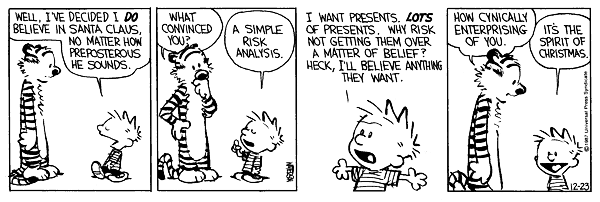
Among other things, college gave me a deeper appreciation of Calvin and Hobbes

I was wholly unprepared for my first taste of serious philosophical discussions when I took a Philosophy course my freshman year in college. I was used to taking tests with hard and firm answers, not teasing out the threads of Pascal's Wager, but the weird energy of that class's discussions has stayed with me even though it has rarely been reproduced.

Maybe I'm living proof of Oscar Wilde's position that "Seriousness is the only refuge of the shallow." Maybe I'm afraid that if I stop reading and writing and searching and questioning and challenging myself, as exhausting and frustrating as it can be, I won't be me any more. Of course, I have to live with the possibility that the new me would be happier than the old me, but that's not a wager I'm willing to take. I remember vividly the day a former friend of mine announced proudly that he, at the age of 29, was never going to read another book again in his life. He felt that he was well-read enough to focus his energies elsewhere, but I felt that I no longer had any idea who this person standing in front of me was. I believe that if you're not moving forward, you're moving backward.

There is no standing still.

Right?