Showing posts with label Creative Process. Show all posts

Friday, February 27, 2009

Now Playing: 365 Original Feature Film Titles, Loglines and Taglines

Has a movie ever changed your life?

I can point to one that absolutely, positively, irrevocably altered the direction my life has taken.

In the spring of 1992, as my junior year at UNC-CH was winding down, I went to see the new Robert Altman film THE PLAYER at the Varsity Theater on Franklin Street in Chapel Hill. I was already a big movie nut before seeing the film, but the majority of my knowledge about the movie industry came from SISKEL & EBERT, ENTERTAINMENT TONIGHT and what I heard on the tram of the Universal Studios tour.

I'm not sure what it says about me that I felt a connection to the murderous sleazeball studio exec

THE PLAYER changed all that. I walked out of that movie wishing I could be Griffin Mill, the oily studio exec played so brilliantly by Tim Robbins. My mind reeled that someone's job was sitting at a desk, hearing writers pitch movie ideas and then saying "yea" or "nay." I loved the intrigue of the studio lot and the satiric look at the creative process that so often requires a deal with the devil.

That movie got me thinking about where I was going with my life and what my career path would be (the number one topic of most college juniors methinks). I had chosen my Poli Sci major because it was one of the top pre-law majors, but my feelings about law school had been steadily eroding for some time. I headed to Alaska the summer of '92 experiencing a real crisis of identity and generally feeling the fear.

Me, in Alaska, on the verge of an epiphany (and needing a shave + shower).

Long story short, you have a lot of time to think working the slime line of a salmon cannery, and my mind kept coming back to THE PLAYER. One day I had an epiphany of sorts at my campsite after a particularly long shift: no matter what you do you have to give working in Hollywood a shot. I graduated in '93 and by '95 I was living in Los Angeles and learning how to be a development guy as an intern Wendy Finerman Productions on the Columbia/TriStar (aka Sony) lot in Culver City.

As I was wondering what to do with this here blog, my thoughts came back once again to THE PLAYER, and one particularly funny and prescient scene. Larry Levy (played by Peter Gallagher) is the new hotshot exec at the studio where Griffin Mill works. Larry is bemoaning how expensive screenwriters are to the studio, and wonders aloud if maybe the execs in the room couldn't come up with ideas for features that are just as good....

LARRY LEVY
I'm just saying there's time and money to be saved...
if we came up with these stories on our own.

GRIFFIN MILL
Where are these stories coming from?

LARRY LEVY
Anywhere. It doesn't matter.
The newspaper.
Pick any story.

BONNIE
'Immigrants protest budget cuts
in literacy program.'

LARRY LEVY
Human spirit overcoming human adversity.
Sounds like Horatio Alger in the barrio.
Put Jimmy Smits in it and you've got
a sexy STAND AND DELIVER.

BONNIE
How about 'Mud slide kills hundreds
in slums of Chile'?

LARRY LEVY
That's good. Triumph over tragedy.
Sounds like a John Boorman picture.
Slap a happy ending on it,
the script will write itself.

BONNIE
'Further bond losses
push Dow down.'
(beat)
I see Connery as Bond.

(Thanks to script-o-rama.com for this excerpt, which I edited for clarity.)

This scene, in turn, reminded me of the many, many times I've heard my fellow wanna-be screenwriters worrying about protecting their script ideas from nefarious producers and studios. Always registering, trademarking and speaking in hushed tones about their precious ideas...

In my experience, ideas are cheap... it's the execution that's expensive. The days of the writer selling a feature pitch for millions without the accompanying polished, ultra-tight, already-written screenplay are all but gone, and besides, it's much cheaper for a producer or studio to option or buy a script than to "steal" an idea, develop and write it on their own and risk a lawsuit and bad publicity if the film is a success.

Unfortunately, the days of original screenplays (i.e. not reboots, reimaginings, sequels, adaptations, etc) being made into studio films also seem to be in danger (but I digress).

I am going to put my belief that it should be relatively easy for writers to come up with movie ideas to the test, and write a new one every day for the next twelve months, starting this Sunday March 1.

I am going to hone my abilities to write taglines on these film pitches because I think I would be great at it in "real life" and I want to put that belief to the test.

And finally, I am going to focus on what I believe is the extreme importance of a great title for a film that seeks commercial success. I read the following in the storylink.com "eZine" that I subscribe to a few days ago and I think it hit the nail right on the head:

A spec script must have a strong concept and poster that is "primal" and easy to tell - and a title that "says what it is"!

I am a firm believer in the necessity of a title that, in some essential way, "says what it is." Quick, what was the movie BODY OF LIES about? That film was referenced in an article I was reading and I couldn't for the life of me remember. I had to look it up- it was the Ridley Scott-Russell Crowe-Leonardo DiCaprio flop ($70 million budget, $39 million domestic gross) from just last year. I haven't seen the movie, so I can't make any judgment on whether it was good or not, but I can say that a generic title like BODY OF LIES, that could just as easily be the title of a legal thriller or a woman-in-jeopardy film, did it no help. No one will have trouble remembering what the hell SLUMDOG MILLIONAIRE or THE SIXTH SENSE was about...

One final thought... if, by some chance, a producer or writer or actor or director reads one of my barebones movie pitches and happens to like it, I say "adapt away." As these pitches are my intellectual property, I fully expect a "Story By" credit and all the lucre that comes with it. That said, I fervently hope you take my pitch, spend a few months writing and polishing it and a year or two producing and marketing it, and make us lots and lots of money with it.

But wouldn't it be much simpler to hire ME to write it with you and/or for you?

Friday, February 20, 2009

Two Reboot Finalists

This is part of my blog reboot process. For the origin of the thought of the motivation of the why and the why now, please click back here.

I've said before that there are a handful of reasons why I'm rebooting and refocusing this blog:

Increase Exposure
Creative Challenge
Showcase My Writing
More Fun for Me, More Entertaining for You

I freely admit that this is all about furthering my career as a professional writer. I would very much like for there to be dollars at the end of this rainbow. It feels important for me to say this up front, as I don't want to be the guy who pretends he's doing something strictly for the art. The art is very important, but I've come to learn that money is also very important too.

Hopefully, art and commerce can co-exist in some meaningful way for me. I know that is a lot to ask of myself, but if you don't ask a lot of yourself then odds are you won't receive a lot from yourself.

Don't you think?

So, with no further ado...

OPTION ONE

A hybrid of the Fiction Writer and the Confessional angles. Here I would fictionalize the present and future of my life in journal form. The journal would begin on March 1, 2009 using my actual, or true past as the backstory.

In other words, I would use the actual raw material of my life to date as the jumping-off point for the adventures of Fictional David Rielly. The changes would be subtle at first; I wouldn't win the lottery on the first day or anything like that. But, over the course of the next year, I would add fictional wrinkles to my real life as a way to... see what I would do.

This option would be a study in wish fulfillment and worst-case scenarios. I would make my relatively uneventful life... eventful. Here I could experiment in meta creative visualization, as the purpose of fictionalizing my life would primarily be to make changes in my real life.

There's something here, methinks, but it might take some digging to find it.

I've always loved this tagline

OPTION TWO

This one falls under the Stunt category. What I propose is to pitch you an original movie idea every day for a year. Each post will include three parts: 1) a title, 2) a logline, and 3) a publicity tagline. Here's an example using an existing film:

1) ALIEN

2) When Ellen Ripley and the crew of the deep space mining ship Nostromo answer a distress call on a distant world, they must do battle with the murderous alien life-form they unwittingly bring back to their ship.

3) "In space, no one can hear you scream."

This option revolves around several areas where I have a great deal of history and interest. I've written thousands of loglines for scripts I covered as a reader. I've brainstormed plenty of movie premises (though nowhere near 365). Perhaps most importantly, I know that there are copywriters out there who are paid to write taglines for the theatrical release of feature films and I'd love nothing more to join their ranks.

What better portfolio piece could there be for that job than this?

I'm going to think about this for a week or so, do some preparatory work and then relaunch The Word Player on March 1, 2009 with the first installment of the new concept.

Thanks in advance for your thoughts and responses. I'll see you on the 1st.

Thursday, February 5, 2009

word player 2.0 > Research

Snapped this John Baldessari at LACMA, where there is still virtually no blog-related art

Yesterday I decided to take a week and attempt to conjure a "reboot" concept for this blog that, when executed, would fulfill me creatively AND reach a wide enough audience to serve as a marketing tool for my services as a professional writer. Now that I've laid out what my goal is, I think it makes sense for me to tackle this assignment as I would any other gig. I've heard from many other creative professionals that just as doctors are often terrible patients, they are their own worst clients. I will try to be levelheaded as I give and receive direction to and from myself, but I am Hollywood-adjacent so there may be obscenity-filled tirades and pandering illogic.

I know that this is a pipe dream, but what the hell: what could really make this process interesting is if you chimed in with thoughts and direction for me to consider along the way. As a work-from-home freelancer since 2001, the thing I miss most about office life is the ease of collaboration, the bouncing back and forth of ideas. The end goal is to create a blog concept that's entertaining and/or thought-provoking enough that you would want to read it regularly, so why not help me sculpt it out of clay?

So, now that I have my creative brief in front of me and I've had some time for contemplation, the next step is a little research. To be honest (I say that a lot , don't I?) I don't read many blogs nor do I read about blogs other than the occasional article in the newspaper. Let's look at the current state of blog affairs and see if we can spot a burgeoning trend or identify an underserved niche that could be helpful.

Technorati, one of the primary search engines designed specifically for combing through blogs, has a "State of the Blogosphere: 2008" post that is as good a place as any to start. Here are some interesting stats:
  • comScore MediaMetrix (August 2008)
    • Blogs: 77.7 million unique visitors in the US
    • Facebook: 41.0 million | MySpace 75.1 million
    • Total internet audience 188.9 million
  • eMarketer (May 2008)
    • 94.1 million US blog readers in 2007 (50% of Internet users)
    • 22.6 million US bloggers in 2007 (12%)
  • Universal McCann (March 2008)
    • 184 million WW have started a blog | 26.4 US
    • 346 million WW read blogs | 60.3 US
    • 77% of active Internet users read blogs
Wow. So I am one of approx. 26.4 million bloggers in the U.S. That's a lot of competition. I'm glad I gave myself a whole week to figure this out. It's good to see that 77% of internet users read blogs. That's encouraging.

My background is in the entertainment industry, and according to MediaMetrix 4 of the top 10 entertainment sites (OMG, TMZ, Asylum and Perez Hilton) are blogs. Good to know.

Other than Jessica Alba (who is currently tagged in an amazing 15,499 blog posts), who and what are people blogging about? Barack Obama is tagged in 223,934 posts, while the iPhone has a whopping 184,991 tags. I could check these numbers all day- it's fascinating to see what people are spending their days talking and writing about.

Here's what people are looking for in blogs, based on the top Technorati searches:
I've never seen an episode of ALIAS- apparently I'm in the minority there. Several of these searches mean little or nothing to me, hmmm.

Here are the top 10 blogs by "authority" (or, how many other blogs have linked to the site in the past six months.)
  1. Breaking News and Opinion on The Huffington Post
  2. Engadget
  3. TechCrunch
  4. Gizmodo, the Gadget Guide
  5. Boing Boing
  6. Official Google Blog
  7. Lifehacker, tips and downloads for getting things done
  8. Daily Kos: State of the Nation
  9. Ars Technica
  10. Smashing Magazine
OK. Two politics/news sites, and eight technology sites. No fear of me going there.


this will still be my command post, so please don't suggest a travel journal
of my experiences at the world's best water parks.


I've chosen not to have advertisements on my blog because I think they look cheesy and I've never approached the kind of traffic numbers that would produce any meaningful income. This, though, is pretty startling:

The majority of bloggers we surveyed currently have advertising on their blogs. Among those with advertising, the mean annual investment in their blog is $1,800, but it’s paying off. The mean annual revenue is $6,000 with $75K+ in revenue for those with 100,000 or more unique visitors per month.

Looks like 100,000 unique visitors per month is a magic number.

Another interesting place to take the current temperature is Blogger's "Blogs of Note," a daily pick by the Blogger staff. Here are the conceits of the last ten Blogs of Note:

Fashion
Expat Journal
Photography
Expat Journal
Art
Travel
Travel/Photography
Knitting
Photography
Tablescaping (the art of, it seems, setting a good looking table.)

OK, a little more room to play with here. Interesting.

I'm now going to return to my paying clients (I'm working for myself on spec), but I feel I've done some good foundation work for the days to come. Plenty of food for thought. Next I will select five different general areas in which to brainstorm a specific angle for the reboot. Then, at the end of the process, I'll give it all some more consideration and announce the "winning" direction.

Tomorrow's blog angle will be "The Curator." See you then.

Wednesday, February 4, 2009

the word player 2.0

This past weekend, a friend said "So, I see you don't post very often on the blog anymore."

This is true. I feel like I'm lacking enough subject matter to post with any regularity, and waiting for inspiration to strike only provides me with sporadic bits and pieces to chew on.

"Inspiration is for amateurs," someone once said about writing. I agree to the extent that you can't rely on it on a day-to-day basis. It is, however, invaluable in creating a keystone around which other pieces of the puzzle can coalesce.

I can't bring myself to write movie or record or book reviews due to the sheer glut of material already out there on the subject. Besides, I want to continue progressing as a professional writer, and the paid critic is a dying breed.

When I started this blog, more than anything it was a new channel for me to funnel and explore my creative impulses after hanging up my screenwriting boots. For over five years straight I'd been constantly working on one script or another, often taking more than a year to "complete" one. I really, really enjoyed the immediacy of completing something short and sweet in one sitting. Blogging not only flexed new writing muscles, but I quickly discovered that it kept me limber in other valuable areas as well.

After a year or so, however, I got the feeling that I was writing only for myself and a small handful of friends. If you'll permit me to speak frankly, I'm at a stage in my writing development where I need to either be writing for an audience or writing for money. Writing for neither is simply unsatisfying (sorry amigos), and gives me the unshakable sensation that my time would be better spent elsewhere.


So here's the crossroads where I find myself today, the fifth Wednesday of 2009. In the four years I've been seriously pursuing copywriting, it has become the first career path in my life where I can genuinely see an intersection of ability, confidence, earning potential and job satisfaction. I love doing the work, I just can't seem to find enough of it on a consistent basis. In the last 10 days, I've had three jobs that I thought were in the bag fall through. Two of them were because the client decided to call in favors with friends of theirs who are writers and try to get the work done for free.

I can't compete with free.

I am promoting myself as a copywriter as best I can using other more traditional channels, but as of this morning (hell, as of this hour) I am determined to exploit this forum more vigorously and inventively. I need to draw more attention to myself in order to reach the pivotal demographic of people who have money to pay writers to write. This is not an easy pill for a mellow introvert to swallow, but them's the breaks.

Now, I realize that blogging about the internal workings of my mind (what I've essentially been doing since the end of the "Bend Me, Shape Me" series) is never going to draw a crowd (and is probably boring as shit to most of you). I also know that I have now reached the end of this post without inspiration striking me with a swell solution to my dilemma (damn).

So, over the next week or two I will brainstorm here "live" for an hour every day I can. I'll see if I can come up with a new central conceit for this blog that will not only engage me creatively, but also have a realistic chance to draw a much larger audience to the site than the one I currently enjoy (an average of 45 page visits/64 page views per day).

I encourage you to chime in. If you've never been here before, a quick glance at the Labels running down the right-hand side should give you an idea of what sort of subject matter I respond to historically.

I market myself as a concept-driven copywriter, so I should damn well be able to come up with a marketable concept for myself.

Right?

We'll see what the process creates. Lacking inspiration (so far), it's time to turn to perspiration.

Thursday, January 8, 2009

The Zen of the Bridesmaid

I don't know about you, but I read in bed almost every night before I go to sleep. So does Mrs. Word Player.

Several years ago, when the wife in a couple we were friends with discovered this about us, she could barely contain her jealousy. I had no idea... I thought every couple read in bed together. It was a strange exchange, in that from that point forward I looked at what I have as lucky rather than just the status quo. In life it's all about perspective, wouldn't you say?

So a few nights ago, MWP leans over and says "read this." I took the book she'd just started, Thoughts Without a Thinker by Mark Epstein, M.D., and read the first sentence in the Forward, which was written by the Dalai Lama.

"The purpose of life is to be happy."

Whoa. The simplicity of that powerful statement packs an incredible wallop. It certainly goes against the Catholic upbringing I received, where suffering and deprivation are lionized and true happiness is deferred to the afterlife.

I bet the Lama is a big LOST fan. Maybe HE is this "Jacob" we keep hearing about...

Lately, my happiness has been yo-yoing quite a bit, but the biggest X factor has been my work life. When work is plentiful, I am practically exuberant. That sensation pervades the rest of my life quickly- I hadn't been happy with my "Development Guy" work in several years, so the 3+ years I've been relying on my copywriting work (which I genuinely enjoy) has been a boon to my overall mood.

I've also been on indefinite hiatus from my screenwriting projects since spring of '07, work that was often as torturous emotionally as it was fulfilling creatively. And I've been OK with that arrangement for a long while now... until recently.

First, work slowed down in December, and it's continued to be slow into January. My mood destabilized. Then, an odd confluence of events suddenly made me revisit my career path and the happiness factor attached to it. It started with LOST. We received Season 4 on DVD for Christmas, and since we already had Seasons 1 and 2, we went out and bought Season 3 to complete the collection. In watching it, for some reason, my eye kept catching on Jeffrey Lieber's name in the credits. He is a co-creator of the show, and someone I used to know. Even though he's had his own issues with LOST, for some reason seeing his name in the credits over and over had a different effect on me than it had in the past.

It wasn't schadenfreude, it was "why him and not me?" I came into (and then lost) contact with Jeffrey long before LOST. I was a newly hired development guy for Civilian (then known as Spoke Film) and I cast my net wide looking for submissions. Naturally, I hated most of the stuff that agents sent me, but when I read Jeff's scripts (one was called "Conspiracy of Weeds" and I can't remember the name of the second) I called and set up a meeting. Nothing ever came of my interest in the scripts ("Conspiracy" was later made with the far less interesting title TANGLED), but I became friends with Jeff and his wife Holly and for a while he even rented office space from Civilian.

Jeff was talented and a very nice guy, and remembering the clever twists and turns in his scripts that I read it's not hard to see how his contributions to LOST earned him a co-creator credit. "But aren't I ALSO a nice and talented guy who has clever twists of my own to share with the world?" that stubborn part of my brain kept saying every time I saw his name on the screen during our LOST-athon.

Try as I might, I couldn't silence that little voice. In fact, a rapid succession of similar events only made it more insufferable. I saw TWILIGHT and, lo and behold, one of the producers is I guy I used to work with at Wendy Finerman Productions. He was a junior development exec then (hey, kinda like I once was!) and LOOK AT HIM NOW. At the grocery store, I saw a girl I went to UNC with and was once friends with who is now producing Adam Sandler movies. We're the same age, and moved out to LA around the same time, but LOOK AT HER NOW. I watch an episode of GOSSIP GIRL and hey, I used to take meetings with the co-creator and occasionally go for drinks with our mutual friend. Damn, what did she have that I don't have?

Yeah, but would dealing with Chuck Bass' problems be any easier?

I know, of course, that it's an enormous oversimplification of the way lives and careers play out to compare myself to them, and I also know that the choices I've made have taken me out of the running for some of the successes that they are now enjoying.

BUT STILL!

Anyway, having all those things happen within a span of a few days really bummed me out for a while. But the more I thought of it, the more my mood improved. I've achieved a pretty damn high level of happiness without the industry success that I'd pursued for over a decade. I've indulged and explored my creative side and expanded and tested my business acumen while developing a personal life that I'm proud of.

And who knows, the best may be yet to come? But the biggest thing that came out of all this for me is the sensation that no matter what happens from this point forward, I was in the game. I played alongside some of the game's top players, even though I never won the big game myself. I've taken the sum of my experiences and spun them into a state of mind that, I feel, is at the very least prepared for any number of challenging paths the future may hold.

Should I happen to find my way back onto the industry path, I'll be ready. And if it doesn't ever "happen" the way I longed for it to? Well, I'll be ready for that too.

Wednesday, December 3, 2008

State of the Nation

Yesterday Mrs. Word Player and I took a walk in the park behind our house. It was about dusk, and there was a thick haze in the air that had been hanging around since I'd referred to it as fog in the morning. The setting sun looked beautiful, the hills mysterious. The horse running circles around its trainer in the Equestrian Center next door kicked up dust of its own, adding to the sense of early evening obfuscation.

I haven't been feeling myself lately. I missed a haircut appointment before going to SF two weekends ago, one that was already overdue, and my hair is too big and curly. I feel fat. I hurt my Achilles tendon playing tennis a month ago, slipping just so on the court after a match delay caused by scattered showers. I've been walking with a limpy hitch in my step ever since, and even though I haven't been on the court since and have stopped my morning walks, it hasn't healed properly. I miss the exercise, especially during the Halloween-Thanksgiving eating season. You make so many forward strides physically by playing tennis two or three times a week for a couple years, and then it feels like you lose it all with a month away.

Work has really slowed down after a pretty terrific year. Whenever this happens, my mood invariably turns darker. I've all but shelved the book, which is what I thought I would work on during the slow "paying work" times. It's not that I lost faith in the idea, it's that I lost faith in the possibility of it ever doing anything other than sitting on my shelf next to my screenplays. At my age, I feel like I need at least a fighting chance of remuneration if I'm going to invest thousands more solitary hours into a passion project.

And so, with all this in mind, we went for a walk.

Walking the labyrinth in St. George, UT

Solvitur Ambulando. "It is solved by walking." We've found this to be as true as any saying is, and yesterday was no exception. MWP is no dummy, and could see that I had little cartoon storm clouds roiling above my head. And off we went.

Just as the election was for the previous twelve months, the economy has now become the jumping off point for practically every conversation. We talked about what the dry period meant for us in the short term, and then the long term. Was it time for me to pursue full-time, on-site employment? I've been a stay-at-home freelancer since the end of 2000, and I've dodged plenty of bullets during that stretch. Maybe now, when I'm sitting relatively pretty and have amassed a decent-sized portfolio, is a good time to jump back into the office job fray? If there were any jobs available in my field these days this may have taken longer to discuss.

But then, we asked ourselves, where will we be in ten years? Let's say that we both have continued, sustained success as freelancers until 2018: will we still be hirable when we're not quite as cute or hip and our rates are exponentially higher than our less experienced but ever more cute and young and hip competition?

Will we ever be able to buy a house when the money we've invested to save for it is shrinking rather than growing?

How could anyone in their right mind start a family right now without a sizable safety net? And what kind of world will they grow up in where only the wealthy can afford to pay for college and masked gunmen roam freely?

F†®ƒ©¨ˆ∆˙©ç%$%#&^***CK!

And then we smiled. My foot was hurting a little, but we'd walked the circumference of the park and were on the road back home. There's never been any way to know what the future holds, and there's little wisdom in making long term plans with any expectations of seeing them play out as diagrammed. Hey, we've made it this far, haven't we? Our operating history; as individuals, as a couple, as wage-earners, as creatives; projects that we will continue to at least be competitive in our field, if not somewhat successful. Right?

Even though the majority of what came out of our mouths could be labeled as pessimistic, or at least moany-groany, the simple act of walking while we were talking took a great deal of the negative power of the words away.

When life gives you lemons, take a walk. Odds are you won't feel nearly as sour afterwards.

Friday, September 5, 2008

Midblog Crisis

So, like, how long are blogs supposed to go on? Until death? There's no real way to complete one, as far as I can tell, especially one with an amorphous raison d'être like this one.

I took a month off because I thought the blog was getting stale and gimmicky. I didn't want to dogear the books I was reading any longer, nor did I want to create lists or other excuses to talk about records or movies or whatnot. Most of the issues and ideas that had been rattling around in my head before the blog had now been transcribed, and they weren't replenishing themselves at the kind of rate that would keep me posting a minimum of three times a month (one of the rules I made for myself when I started things off in May of '07).

Another rule I made was no pix of me, but what the hell.
This is from a picture booth strip I took in London for my travel pass
during my brief stint working on B. MONKEY there in May '96

I wanted this blog to be spontaneous, not canned, and the last thing I wanted was to sit at my desk and wonder "Hmm, what should I blog about now?".

I was so hard up for material that I dug up my old journal, curious to see what my writing style and thought processes were like then compared to now.

Let me tell you, if you're interested in humbling yourself real quick, dig up your old journal or diary and give it a spin. "Stupid feeling" galore. That said, it felt really good to see that some of the anxieties and doubts and insecurities that plagued me in my twenties have been dealt with or overcome to some degree.

The journal was a gift from my dad for my 21st birthday, and the first entry is dated September 15, 1992 (shortly after my senior year at UNC began) and the first words are "Hello Cleveland!". The last entry is dated October 28, 1999, and the final words are "I'm going to ask (Mrs. Word Player) to marry me as soon as possible." We were engaged less than a month later, on November 24.

Reading the gory details of the seven years from 1992 to 1999 was very weird. It's not that I'd forgotten the names of some people who were apparently important figures in my life, I'd forgotten they ever existed. It was often a very pleasant jolt to read details about some people who I still think about, but in more fond, hazy ways.

From 8/23/99 entry: "Driving cross-country to move back to Georgia in the spring,
Brett (Kinard) drove too late into the night on a rainy night in Texas.
As was his custom, he wasn't wearing a seatbelt.
No one knows the specifics of his last moments, but in my mind he was singing "My Wild Love" by The Doors wearily, with a Marlboro Red dangling out of the corner of his mouth.
God we had some good times together."


BUT, it was not a treasure trove of quotables that would make for a good blog post. That leaves me with... not much. The blog has been a lot of fun to write, but in many ways I see it as a disappointment. It rarely if ever generated the kind of comment-board discussion that I'd hoped for, and the vast majority of the 14,103 site visits and 21,248 page views came because people Google image-searched some of the pix that I myself had snagged during my Google image searches... which doesn't really get me off that much, to be honest.

Me and Dodger scout Mike Brito from Mr. CFA's trip to LA in August of '95.
Mr. CFA used his Savannah, GA press credentials to wangle us amazing
submerged seats behind home plate to watch Ramon Martinez pitch.
That green Hawaiian shirt is my favorite all-time garment, may it rest in peace.

I have a big personal writing project that I've just embarked upon (writing a novel) and I wonder if the blog is something that I want to keep doing. Maybe I should throw off all the "rules" I've created for it and post only whenever I feel like it, even if that's every three or four months. Maybe I should dream up some blog stunt that I could document without much brainpower (365 Days Without Deodorant!). Maybe I should shutter this one and start fresh elsewhere when I have a stronger central concept to build around.

Honestly, I just don't know. Anyone have any ideas?

Wednesday, May 7, 2008

Dog Ears #14: On Writing

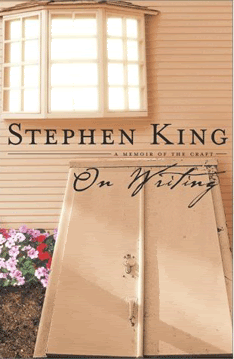
I'd planned to take a break from Dog Ear-ing for a while, and had skipped the last book I read (Chip Kidd's The Learners- good, but not great). The next book on my stack was Stephen King's nonfiction On Writing: A Memoir of the Craft, a book I'd picked from an assortment of giveaways in the basement of AB and UM over the holidays. When I began I wasn't planning on Dog Ear-ing it either, but there were just too many plums I couldn't resist picking... et voila.

It's always a pleasure when Mr. King leads you down into the cellar

Including On Writing I've now read 22 books written by King, far and away the largest number by any one author. In scanning his chronological bibliography, I also realized that I hadn't read any King since 1997's Wizard and Glass, the fourth installment of the frustratingly ambitious Dark Tower series. I'm not sure why I stopped reading King for so long, but my best guess is that he was just so damn prolific that I stopped trying to keep up and, kind of like a favorite band you veer away from after years of faithful devotion, I realized that I needed a break.

Even though On Writing is nonfiction, it's written in King's instantly recognizable voice, and I realized how much I'd missed it after such a long break. The book's more or less broken up into three sections- King's own personal history and evolution as a writer, his advice on how to manage the art and craft of writing itself, and finally a harrowing chapter on his near-fatal encounter with a

BLOGGER'S NOTE

Above, I stopped writing mid-sentence when Mrs. Word Player walked in the door. We decided to go out and grab some lunch, so I walked away from the computer and this post. What I had been about to write was that King, as a pedestrian, was struck by a car in a horrible accident near his home in the middle of writing On Writing, and didn't finish it for months.

In true, eerie King fashion, we got in the car to drive to lunch today and got in a car accident in an intersection not far from our home. We were both shaken up but uninjured and the other driver (also uninjured) was clearly at fault. As I was driving the rental car home after dropping our car off to get fixed the weird synchronicity struck me, and oddly made me feel a little better about the whole thing. At least no one had to be evacuated by helicopter for emergency surgery...

Fortunately, the other driver didn't hiss "Thinner!" at me while exchanging insurance information

That said, I'm a touch freaked out.

Anyway, here are some of the best Dog Ears from On Writing.

p37 "Let's get one thing clear right now, shall we? There is no Idea Dump, no Story Central, no Island of the Buried Bestsellers; good story ideas seem to come quite literally from nowhere, sailing at you right out of the empty sky: two previously unrelated ideas come together and make something new under the sun. Your job isn't to find these ideas but to recognize them when they show up."

p163 "... stories are found things, like fossils in the ground. ... Stories aren't souvenir tee-shirts or GameBoys. Stories are relics, part of an undiscovered pre-existing world. The writer's job is to use the tools in his or her toolbox to get as much of each one out of the ground intact as possible."

p249 logrolling: |ˈlôgˌrōli ng; ˈläg-|
noun
1 informal the practice of exchanging favors, esp. in politics by reciprocal voting for each other's proposed legislation. [ORIGIN: from the phrase you roll my log and I'll roll yours.]
2 a sport in which two contestants stand on a floating log and try to knock each other off by spinning it with their feet.

The boy that launched a million nightmares

Well, it seems that after I cut a few DE's that didn't seem as compelling as I thought they were laying in bed, this installment is a little thin. Let's insert the two DE's I couldn't resist making in The Learners to beef the piece up, yes?

p160 "'Lars once said there are two kinds of people in this world: those who believe there are two kinds of people in this world and everyone else.'"

p175. "Miss Preech: 'Your five o'clock is here. The respondent to the shoe ad. A Mr. Harshbarger.'
'Send him up.' Tip rubbed his hands listlessly. 'Oh, I'm just filled with antisappointment.'
'Pardon?'
'Antisappointment. Anticipation colliding head-on with the certainty of its own doom."

I think we've all experienced our fair share of antisappointment, yes?

One final note- tomorrow is the one year anniversary of this blog. Feel free to take the day off from work and celebrate with me. To borrow once more from Stephen King, thank you Faithful Reader.

Monday, February 11, 2008

Dog Ears #10: Zeroville

Sometimes I hate myself for giving in to the siren song of movies again and again. Part of me thinks that I should know better by now. That I'm looking for something out of films that I can never find again.

Title is taken from Godard's ALPHAVILLE

This nagging gnawing feeling is magnified a thousandfold and distorted into cinematic metafiction in Steve Erickson's Zeroville, a 2007 book that came to my attention from a number of year-end "Best of 2007" lists. The cover art (sucker that I am?) intrigued me even more- why did this bald man have Montgomery Clift and Elizabeth Taylor from A PLACE IN THE SUN tattooed on his head, and what was he gazing at in that empty deep blue space?

Author Erickson is also the film critic for Los Angeles magazine (a good mag that, tellingly, I kept my subscription to during my four years in NYC), and he brings his cynical sense of humor and archivist's passion for films and the film industry to bear on this fictionalized narrative set among "real" Hollywood of the late 1960s, 70s, and early 80s. "Cinéautistic" protag Vikar (the fellow on the cover) either loses or finds his mind with the help of industry friends like John Milius, punk music, and a terrifying recurring dream that doesn't sound all that farfetched to a movie obsessive like me.

Vikar refers to Milius (seen here directing CONAN) as "Viking Man"

The book is frustrating, at times feeling like a self-satisfied collection of obscure film references and trivia held together by the haphazard wanderings of a more-violent Forrest Gump type. But there are stretches where Vikar's quest transcends the limitations of the structure and becomes something unique in its ability to communicate why people who perhaps should know better still look for something (unattainable?) in darkened movie theaters.

p42 "I mean, that's the whole thing about the movies," says the burglar*. "Bigger than the sum of the parts and all that? If the parts are too good, the whole is somehow less. I mean, you can't have, you know, Trane doing the score for Now, Voyager."

* yes, this is the kind of book where burglars wax poetic about the philosophy of cinema.

p119 "When Michael has Fredo killed, it isn't just Cain slaying Abel. It's Abraham sacrificing Isaac, because Michael has assumed the role of the father to his older brother, who has assumed the role of the son. Michael sacrifices the child to the god called Family; he destroys the family in its corruptible human form to preserve the idea of Family that's more divine, and to preserve Michael's love for Family that the older brother has betrayed."

p265 "The thing is, that movie last night* is a completely different movie when you watch it by yourself. Why is that? Movies are supposed to be watched with other people, aren't they? Isn't that the point of movies–you know, one of those social ritual things, with everyone watching? It never occurred to me a movie might be different when you don't watch it with anyone else."

* A PLACE IN THE SUN

p266 "Vikar says, 'Once Cassavetes told me about seeing A Place in the Sun when it came out. He hated it so much that he went back and saw it the next day and then every day for a week, until he realized he loved it. ... So why does that happen?... The movie hasn't changed. It's still the same exact movie, but it's like it sets something in motion, some understanding you didn't know you could understand, it's like a virus that had to get inside you and take hold and maybe you shrug it off–but when you don't, it kills you in a way, not necessarily in a bad way because maybe it kills something that's been holding you down or back, because when you hear a really really great record or see a really great movie, you feel alive in a way you didn't before...'"

Taylor saved a choking Clift's life by pulling two of his teeth out of his throat after he crashed his car in 1956

revolves around Vikar's obsession with two films in particular, George Stevens' A PLACE IN THE SUN (1951) and Carl Theodore Dreyer's THE PASSION OF JOAN OF ARC (1928). Since I hadn't seen either before reading the book, I thought I'd at least check out one and rented A PLACE IN THE SUN. It's not a movie that you can necessarily "enjoy" on a story level, but the technique of the direction, cinematography and editing was certainly far ahead of its time. After seeing PLACE and from what I've gleaned about JOAN OF ARC, I think I understand the connection Vikar felt to these two films in particular. They both feature intimate close-ups that so fill up the screen that the viewer is drawn in deeper than they may be prepared for, and both feature stars (Clift and Maria Falconetti) whose success playing tragic roles on screen somehow translated to lives that became tragedies in reality.

That may be what makes film such a unique medium, not only can it be transcendent and transformative for the audience, but it exerts an even more powerful, and sometimes dangerous, pull on those who create them.


Thursday, January 17, 2008

Toxic Ontology?

Tell it to me straight- is it the height of vanity to blog about what's going on in one's noggin?

(It's interesting to note that vanity means both "excessive pride in or admiration of one's own appearance or achievements" and "the quality of being worthless or futile", and I think both definitions apply to my question above).


"My own little nasty world"

Was Socrates right when he said "The unexamined life is not worth living", or is the correlation between thinking and happiness that the more you think, the less happy you are?

I do my best to only speak for myself in this forum and in "real" life as well, but when I think I like to think in generalities as well as specifics. I've been running into a word lately in my reading that not only encapsulates a good deal of my free-form thinking, but also some of what I've been doing here. More than a dictionary definition is called for, so allow me this chunk from Wikipedia:

Ontology is a study of conceptions of reality and the nature of being. In philosophy, ontology is the study of being or existence and forms the basic subject matter of metaphysics. It seeks to describe or posit the basic categories and relationships of being or existence to define entities and types of entities within its framework.

Some philosophers, notably of the Platonic school, contend that all nouns refer to entities. Other philosophers contend that some nouns do not name entities but provide a kind of shorthand way of referring to a collection (of either objects or events). In this latter view, mind, instead of referring to an entity, refers to a collection of mental events experienced by a person; society refers to a collection of persons with some shared interactions, and geometry refers to a collection of a specific kind of intellectual activity.

As a philosophical subject, ontology chiefly deals with the precise utilization of words as descriptors of entities or realities. Any ontology must give an account of which words refer to entities, which do not, why, and what categories result. When one applies this process to nouns such as electrons, energy, contract, happiness, time, truth, causality, and God, ontology becomes fundamental to many branches of philosophy.


Shouldn't there be more choices than "red pill" or "blue pill"?

I freely admit to being a novice when it comes to ontology, but I do particularly like the fact that it "chiefly deals with the precise utilization of words as descriptors of entities or realities." I'd like to think my pursuit of better words and more accurate descriptions, and my desire to ask better questions and seek more accurate answers, serves a larger purpose than simple self-improvement. There have to be reasons beyond vanity and self-promotion that millions of people spanning the length of human existence have been compelled to write down the stuff going on in their heads and try their best to circulate it to the widest audience possible, right?

Unfortunately, and quite the opposite from my expectations as a younger man, it seems to me that carrying on discourse of this flavor, at least in in-person conversation, becomes less feasible the older we get. When the Beatles sang "But if you go carrying pictures of chairman Mao, You ain’t gonna make it with anyone anyhow" in 1968's "Revolution 1", I imagine they weren't talking to the Chinese, but to thinkers and theorists raining on the Age of Aquarius's indulgent parade.

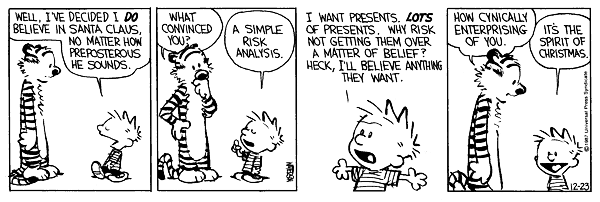
Among other things, college gave me a deeper appreciation of Calvin and Hobbes

I was wholly unprepared for my first taste of serious philosophical discussions when I took a Philosophy course my freshman year in college. I was used to taking tests with hard and firm answers, not teasing out the threads of Pascal's Wager, but the weird energy of that class's discussions has stayed with me even though it has rarely been reproduced.

Maybe I'm living proof of Oscar Wilde's position that "Seriousness is the only refuge of the shallow." Maybe I'm afraid that if I stop reading and writing and searching and questioning and challenging myself, as exhausting and frustrating as it can be, I won't be me any more. Of course, I have to live with the possibility that the new me would be happier than the old me, but that's not a wager I'm willing to take. I remember vividly the day a former friend of mine announced proudly that he, at the age of 29, was never going to read another book again in his life. He felt that he was well-read enough to focus his energies elsewhere, but I felt that I no longer had any idea who this person standing in front of me was. I believe that if you're not moving forward, you're moving backward.

There is no standing still.

Right?

Thursday, December 13, 2007

Dog Ears #8: Backstory 4

There was a time not too long ago when even the thought of reading anything in the Backstory series made me feel all icky inside. The four installments of Backstory are collections of interviews with screenwriters of different eras (1 is "The Golden Age", 2 is 1940s and 1950s, 3 is 1960s, and 4 is 1970s and 1980s) compiled and edited by Marquette film professor Patrick McGilligan. Thanks to my own efforts and the gift-giving prowess of Mrs. Word Player, I now have all four books in the excellent but largely out-of-print series, but after a really rough time writing my fifth screenplay Blood is Thicker (still unfinished after working on it for 11 months of '06 and early '07) I couldn't stomach reading all these success stories for a while.

You can't make this stuff up

Thankfully, time heals wounds of this sort pretty efficiently, so when I peeked into the one volume I hadn't read yet a few weeks ago I was happy to discover that my appetite for intimate conversations with working writers had returned. It's funny how the same words can be exasperating one day and inspiring the next...

The following are anecdotes, insights, self-recriminations and new lingo taken from Backstory 4: Interviews with Screenwriters of the 1970s and 1980s.

ROBERT BENTON
p. 29 "The banalities of married life are, for me, far more interesting and more poignant than the intensity of romance. There's something I find deeply moving about ordinary life."
re: his script for NADINE (1987)

p. 35 "There are two models (of screenplay structure). In one, plot grows out of character. This is the (Howard) Hawks model. In the other, character grows out of plot. This is the [Otto] Preminger model. When I do the architecture on a script of my own, I follow the Hawks approach. I do it so that characters become more complex, and they don't tell you where they're going until they get there."

LARRY COHEN
(Cohen's script for PHONE BOOTH, ultimately made in 2002 with Joel Schumacher at the helm, was once considered by Alfred Hitchcock.)

p. 77 "(Hitchcock) seemed very, very intimidated by Lew Wasserman and the Universal executives, who had more or less undermined his confidence in himself. While making him a very rich man, they'd also destroyed him as an artist. Hitch had severed his ties with [composer] Bernard Herrmann, for example, who had been a close friend and great collaborator, and mainly it was the Universal executives who poisoned his mind against Herrmann and convinced him he needed somebody like Henry Mancini to write songs and a hipper musical score. Which he never got, by the way."

BLAKE EDWARDS
p. 91 tsuris: |ˈtsoŏris; ˈtsər| noun, informal
trouble or woe; aggravation.
ORIGIN early 20th cent.: from Hebrew.

p. 95 "Therefore I consider that slapstick–literally slapstick–is not entirely what I do. Only some of it turns out to be slapstick. Slapstick comes from vaudeville–it comes from what they called "the slap stick" (slapping sound as he demonstrates), which made that sound."

WALTER HILL
p. 106 roustabout: noun
an unskilled or casual laborer.
• a laborer on an oil rig.
• a dock laborer or deckhand.
• a circus laborer.
ORIGIN mid 19th cent.: from the verb roust

"All of this taught me one important thing that carried over to writing. If you are capable of making a living out of your talent and imagination, you are a privileged soul. As to the actual writing, you learn about writing by reading. And then you learn to make use of your own particular attitudes, gifts, and skills by–writing, writing, writing."

p. 113 "I don't pretend to be a scholar about the history and evolution of screenwriting, and I think you have to approach it as a craft rather than an art. But it's the old story; if the craft gets good enough, it is an art."

p. 116 "My clearest impression is that (Michael) Eisner wanted movies to be a kind of pleasantly flavored chewing gum and was almost physically uncomfortable in dealing with anything about the dark side of the human heart."

Remind me to tell you my Harry Dean Stanton story some day

p. 122 (re ALIEN) "I named her "Ripley" (after "Believe It or Not"); later, when she had to have a first name for ID cards, I added "Ellen" (my mother's middle name). I called the ship Nostromo (from Conrad: no particular metaphoric idea, I just thought it sounded good). Some of the characters are named after athletes: Brett was for George Brett, Parker was for Dave Parker of the Pirates, and Lambert was Jack Lambert of the Steelers."

p. 128 "My favorite description of the dilemma of screenwriting comes from David Giler, "Your work is only read by the people who will destroy it."

RUTH PRAWER JHABVALA
p. 151 "What I do realize is that I mustn't have a single word that's not absolutely necessary, no "Oh yes, I see," nothing like that. You have to compress and compress and just give them the essence."

LAWRENCE KASDAN
p. 170 "That's what the STAR WARS saga is about–it's about following those things which are strongest in you and imposing them on the world. Making a career in Hollywood is like that if you want to do your own work. If you want to do what they want you to do, it's easy. You just say yes. But if you want to do what you want to do, you're constantly manipulating the chaos of the system."

p. 176 "That's what all great tragedies are about for me–that in this adherence to a single idea, we sometimes sacrifice everything."
re: his script for BODY HEAT (1981)

ELMORE LEONARD
p. 217 "What's amazing to me when I think about it, is that while Hollywood in general prefers plot-driven stories (they ask, "What's it about?"), thirty-three of my thirty-five books, all character-driven and talky, have either been optioned or bought outright for film."

PAUL MAZURSKY
p. 229 "I'm very sympathetic to those characters. I feel that the middle class is not treated in terms of tragedy. You have to be very rich or very poor to be thought of as a tragic figure."

Thulsa-Thulsa Doom y'all

JOHN MILIUS
p. 296 colloquy: |ˈkäləkwē| noun ( pl. -quies)
1 formal: a conversation : they broke off their colloquy at once | an evening of sophisticated colloquy. See note at conversation .
2 a gathering for discussion of theological questions.
ORIGIN late Middle English : from Latin colloquium ‘conversation.’

p. 299
PM: Was Robert Shaw really as drunk as they say, shooting the scene?
JM: He was totally drunk.

(Shaw had just been busted screwing the nanny by his wife, and kept interjecting his drunken thoughts about the situation into the Indianapolis scene from JAWS, a scene that Milius wrote as a favor to Spielberg. What we see in the final product, of course, has all the nanny bits cut out.)

FREDERIC RAPHAEL
p. 328 (this next bit speaks to questions I had after viewing TWO FOR THE ROAD (1967), written by Raphael)

PM: What was the genesis of the film you did make next, TWO FOR THE ROAD?
FR: (My wife and I) used always to just pack up and travel together. While we were driving down to the south of France from London on one of these trips, I said, "Imagine if we met ourselves as we were ten years ago," and of course the idea revealed itself as a movie.


p. 381 confrere: noun
a fellow member of a profession; a colleague : executives from the four broadcast television networks, along with their cable confreres.
ORIGIN mid 18th cent. : French, from medieval Latin confrater, from con- ‘together with’ + frater ‘brother.’

"The difference between a movie and a novel is that a movie is just the surface of things, and the meanings and emotions can only be implicit."