Showing posts with label A PRAYER FOR OWEN MEANY. Show all posts

Friday, November 23, 2007

Dog Ears #7: A Prayer For Owen Meany

In Dog Ears #6 I listed some of my favorite bits from the first half of John Irving's A Prayer For Owen Meany, but not before expressing my hope that the lull that'd set in about 200 pages into the 617 page novel would end soon.

Sadly, I felt it never did. This was a book that ended with a bang AND a whimper, but mostly with relief that it was finally over.

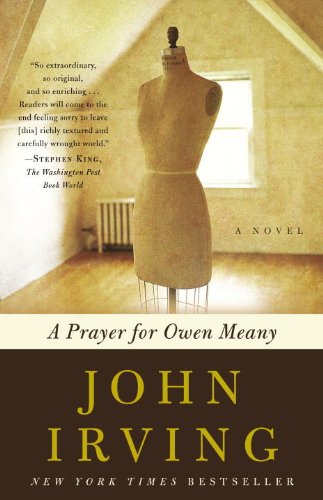
This image is a good match for the book's self-important, unsubtle tone

Soon after the fun of meeting the town of Gravesend for the first time had worn off, and the tragic events that set the story in motion had played out, the book settled into a repetitive loop of heavy-handed foreshadowing and even less novelistic political editorializing. The split arena gambit of telling the story in flashback and in the narrator's Owen-less present backfired severely, and I was sorely tempted to skim any page that took place in the late 80s.

It's one thing to weave in a political theme or point of view, and quite another to hijack what had been a promising tale of predestination vs free will in order to deliver pious shrill rants. This will almost certainly be the last Irving I read.

That said, I did dog-ear quite a few pages in the second half. Let's see how they go down the second time around...

p.372 "She possessed all the up-to-date information that often passes for intelligence among people who make a daily and extensive habit of the New York Times..."
(that one hit a little close to home!)

p.419 peavey: noun ( pl. -veys or -vies)
a lumberjack's cant hook with a spike at the end.
ORIGIN late 19th cent.: from the surname of the inventor.

p. 419 cant dog: noun
another term for cant hook .
(OK... I guess I have to look up cant hook)
cant hook: noun
a hinged metal hook at the end of a long handle, used for gripping and rolling logs.

it's weird to see the word "cant" without an apostrophe

p. 430 "THE COUNTRY WANTS A SAVIOR. THE COUNTRY IS A SUCKER FOR POWERFUL MEN WHO LOOK GOOD. WE THINK THEY'RE MORALISTS AND THEN THEY JUST USE US."

p. 450 macadam: noun
broken stone of even size used in successively compacted layers for surfacing roads and paths, and typically bound with tar or bitumen.
• a stretch of road with such a surface.

They were nuts for macadams

p. 458 "... Canada sold the United States over five hundred million dollars' worth of ammunition and other war supplies... ... by 1970, Canada–"per capita"–was earning more money as an international arms exporter than any other nation in the world..."
(who knew?)

p. 515 addlepated: along with "addleheaded, a synonym for "addlebrained," which means "lacking in common sense; having a muddled mind"

p522 (on discussing the difficulty of teaching students wit)
"It's always description that they miss; I swear, they think it's unimportant. They want dialogue, they want action; but there's so much writing in the description!"

p543 "I will tell you what is my overriding perception of the last twenty years: that we are a civilization careening toward a succession of anticlimaxes–toward an infinity of unsatisfying and disagreeable endings."

Wednesday, October 17, 2007

Dog Ears #6: A Prayer for Owen Meany

His vocal chords had not developed fully, or else his voice had been injured by the rock dust of his family's business. Maybe he had larynx damage, or a destroyed trachea; maybe he'd been hit in the throat by a chunk of granite. To be heard at all, Owen had to shout through his nose.

"It is Owen who made me a believer."

So we hear from narrator John Wheelwright on page 3 of John Irving's 1989 novel A Prayer For Owen Meany. So the reader never forgets this unusual method of speaking, John's best friend Owen's dialogue is IN ALL CAPS FOR THE DURATION OF THE BOOK.

At first I found this authorial choice almost too mannered (even for Irving), but the deeper I push into the book (I'm little more than halfway through on p.350) the more I recognize that it's pivotal to never forget Owen's physical peculiarities as the mystery of his "purpose" is slowly revealed to us through the narrative.

I admit the book has been slow going the last 100 pages or so, but the book's reputation as a classic and my faith that Irving is building to some wonderful fireworks in the Third Act are keeping me going.

That, and the beautiful writing of course.

I'm nervous about how Vietnam will figure into the story of Owen and John

Before I get to some of the many, many dog ears from the first half, I'm wondering if anyone else has noticed a great deal of similarities between Owen Meany and Max Fischer from Wes Anderson's RUSHMORE (1998). I'll have to watch the film again after I finish the book, but off the top of my head Owen and Max both:

1. attend a tony private all-boys school, but only with financial assistance
2. become enraged when Latin is removed from the curriculum
3. suffer from delusions of grandeur
4. feud with the school's headmaster
5. are the central figure at the school's newspaper
6. are central figures in local/school productions of dramatic plays

and I'm sure there are more. I'm also curious to know if the book's quasi-official film adaptation SIMON BIRCH (also 1998) is worth watching. Apparently, John Irving sold the film rights, but only with the stipulation that the title never be used. Irving himself came up with Owen's replacement name "Simon Birch."

Weird.

OK, on with the prose.

p.7 "–but every study of the gods, of everyone's gods, is a revelation of vengeance toward the innocent."

p.34 "Your memory is a monster; you forget–it doesn't. It simply files things away. It keeps things for you, or hides things from you–and summons them to your recall with a will of its own. You think you have a memory; but it has you!"

p.38 "And in addition to being an almost perfect mother, I also know that she was a happy woman–and a truly happy woman drives some men and almost every other woman absolutely crazy."

p.57 "It's a no-win argument–that business of what we're born with and what our environment does to us. And it's a boring argument, because it simplifies the mysteries that attend our birth and our growth."

p.83 red-letter: of special significance
Function: adjective
Etymology: from the practice of marking holy days in red letters in church calendars
Date: 1704

December is chock full of red-letter days

p.111 "... Mr. Merrill was the most appealing because he reassured us that doubt was the essence of faith, and not faith's opposite."

p.128 "Mrs. Hoyt was the first person I remember who said that to criticize a specific American president was not anti-American; that to criticize a specific American policy was not antipatriotic; and that to disapprove of our involvement in a particular war against the communists was not the same as taking the communists' side. But these distinctions were lost on most of the citizens of Gravesend; they are lost on many of my former fellow Americans today."

p.292 "And Hester was committed to irreverence..."
(what an outstanding commitment! Hester the Molester, I salute you!)

p.309 "Don't ask for proof–that was Mr. Merrill's routine message.
'BUT EVERYBODY NEEDS A LITTLE PROOF,' said Owen Meany.
'Faith itself is a miracle, Owen,' said Pastor Merrill. 'The first miracle that I believe in is my own faith itself.'"

p341 "'IT JUST TAKES A LITTLE MORE FAITH.'
'It takes more practice,' I told him irritably.
'FAITH TAKES PRACTICE,' said Owen Meany.