Thursday, August 30, 2007

Dog Ears #5: Crash

No no, not that CRASH, J.G. Ballard's 1973 novel CRASH. I was drawn to the book to see what longtime fave David Cronenberg was thinking when he adapted Ballard's work for his controversial 1996 film of the same name.

Hitchcock would've loved Deborah Kara Unger

Note to self- it can be dangerous to wonder what David Cronenberg was thinking.

Overall I found the book to be dated, repetitive and sophomoric, and not nearly as hot or disturbing as I expected from a quasi-legendary book of underground erotica. Thankfully it was short, 'cause if I read either of Ballard's favorite words ("glans" and "pubis") one more time I was gonna crash my foot into the book's spine.

After CRASH, I doubt I'll ever read Ballard's EMPIRE OF THE SUN which Spielberg adapted in 1987 (unless I hear good things about it from you of course).

The good news is that the book was chock full of dog-earable words that I'm excited to finally look up, not to mention a turn of phrase or two that aroused my literary side.

p22. "It was not the sexuality of the posture that stayed in my mind, but the stylization of the terrible events that had involved us..."

p39. "At times I had even speculated on the kind of traffic accident in which I would die."*

* I included this quote because it reminded me that during my first stint in Los Angeles (1995-2001) I had a premonition that I would eventually be killed on one of the city's many highways. Thankfully I haven't felt that same foreboding this time around.

p41. buccal |ˈbəkəl| |ˌbəkəl| |ˌbʌk(ə)l|
adjective / technical
of or relating to the mouth : the buccal cavity.
• of or relating to the cheek : the buccal side of the molars.
ORIGIN early 19th cent.: from Latin bucca ‘cheek’ + -al.

p42. "Listening in a bored way, the women patients lay in their beds. Two of them were suspended with their legs in traction, as if involved in the fantasies of a demented gymnast."

p50. autogeddon. I assume this word was the creation of the author... it bugged me every time I read it. As far as neologisms go, though, it's pretty weak salsa.

p54. penumbra |peˈnəmbrə| |pəˌnəmbrə| |pɪˌnʌmbrə|
noun
the partially shaded outer region of the shadow cast by an opaque object.
• Astronomy the shadow cast by the earth or moon over an area experiencing a partial eclipse.
• Astronomy the less dark outer part of a sunspot, surrounding the dark core.
• any area of partial shade.

p57. vitrified > vitrify |ˈvitrəˌfī| |ˌvɪtrəˈfaɪ| |ˌvɪtrɪfʌɪ|
verb ( -fies, -fied) [ trans. ] (often be vitrified)
convert (something) into glass or a glasslike substance, typically by exposure to heat.

i had to vitrify that glass

p65. invigliator > invigilate |inˈvijəˌlāt| |1nˌvɪdʒəˈleɪt| |ɪnˌvɪdʒɪleɪt|
verb [ intrans. ] Brit.
supervise candidates during an examination.
DERIVATIVES
invigilation |-ˌvijəˈlā sh ən| |1nˈvɪdʒəˌleɪʃən| |-ˌleɪʃ(ə)n| noun
invigilator |-ˌlātər| |1nˌvɪdʒəˈleɪdər| noun

p77. "A week after the inquest she was waiting at the taxi rank of the Oceanic* Terminal as I drove away from Catherine's office."
* LOST fans will enjoy the name of Ballard's fictitious airline.

p99. treadle |ˈtredl| |ˌtrɛdl| |ˌtrɛd(ə)l|
noun
a lever worked by the foot that imparts motion to a machine.
• any of a row of metal spikes set on an angle on a spring within a plate laid across the entrance or exit of a parking facility, used to prevent drivers from using the facility without paying.

p144. sulcus |ˈsəlkəs| |ˌsəlkəs| |ˌsʌlkəs|
noun / Anatomy
a groove or furrow, esp. one on the surface of the brain.

p148. anneal |əˈnēl| |əˌni(ə)l| |əˌniːl|
verb [ trans. ]
heat (metal or glass) and allow it to cool slowly, in order to remove internal stresses and toughen it.
• Biochemistry recombine (DNA) in the double-stranded form following separation by heat.

p151. columbarium |ˌkäləmˈbe(ə)rēəm| |ˈkɑləmˌbɛriəm| |ˈkɒl(ə)mˌbɛːrɪəm|
noun ( pl. -baria |-ˈbe(ə)rēə| |ˈkɑləmˌbɛriə|)
a room or building with niches for funeral urns to be stored.
• a niche to hold a funeral urn.
• a stone wall or walk within a garden for burial of funeral urns, esp. attached to a church.
ORIGIN mid 18th cent.: from Latin, literally ‘pigeon house’ .
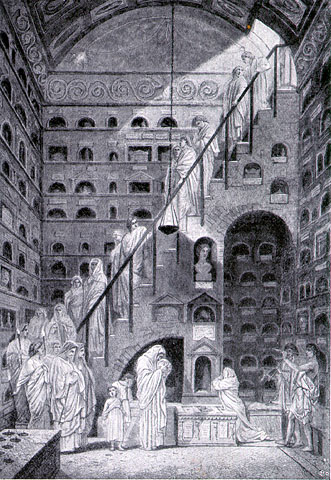
mummy, where are the pigeons?

p177. invagination |inˌvajəˈnā sh ən| |1nˈvødʒəˌneɪʃən| |ɪnˈvadʒɪˌneɪʃ(ə)n|
noun chiefly Anatomy Biology
the action or process of being turned inside out or folded back on itself to form a cavity or pouch.
• a cavity or pouch so formed.

p205. hypogeum |ˌhīpəˈjēəm| |ˈhaɪpəˌdʒiəm| |ˈhʌɪpə(ʊ)ˌdʒiːəm|
noun ( pl. -gea |-ˈjēə| |ˈhaɪpəˌdʒiə| |-ˌdʒiːə|)
an underground chamber.
ORIGIN mid 17th cent.: from Latin, from Greek hupogeion, neuter of hupogeios ‘underground.’

Monday, August 27, 2007

Death Blog 2000

Yesterday I read a stimulating article in the NY Times about "life lists": lists people make of goals and experiences they want to achieve before they die. I think "death list" has a lot more urgency than "life list", but the point is that writing about these lists has become a cottage industry and I want in.

One of the sources quoted was 43Things.com, a website where you can join "1,217,358" people in making out a list of 43 things you want to do, then see who else shares your aspirations (for instance, 138 people want to learn Hungarian before their ticket is punched).

Instead of writing up a life list, I thought I'd make a blog list of 43 subjects I want to blog about before I expire and/or tire of blogging. So, with no further talk of my inevitable death...

1. The maxims of Nicholas-Sebastien Roch de Chamfort
2. Scrabble
3. Post-structuralism
4. Truisms that aren't true
5. The excuse "Sorry, I've been really busy"
6. Words I hate myself for having to constantly look up
7. "Greatest Hits" from my portfolio of screenplay coverage
8. The importance of a good title to books, movies, TV shows
9. Fantasy Baseball
10. Pascal's Wager
11. Dinosaurs
12. The Inner Game of Tennis

13. Headphones
14. Liner notes
15. Friendship
16. Email etiquette
17. Wishlists
18. Socrates and Plato
19. High school survival stories
20. Ghost stories
21. Solipsism
22. David Cronenberg's DEAD RINGERS
23. Ray Bradbury's THE MARTIAN CHRONICLES

25. Deejaying
26. Brooklyn
27. Nihilism
28. Omelettes
29. Homophones & Homonyms
30. Nightmares
31. Mad Libs
32. LSD
33. Memory vs. History
34. Liars
35. Statistics
37. Writing poetry
38. Bad ideas vs. Good ideas
39. The voices inside our heads
40. Snapshots
41. Context
42. Bermuda

43. Love

Wednesday, August 22, 2007

Meatspace Odyssey

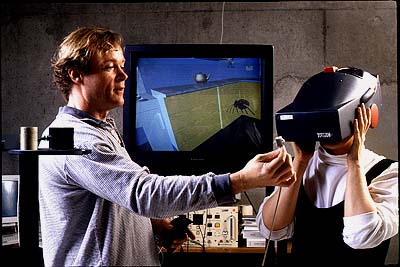
There was a time when Virtual Reality meant putting goggles and sensors on and running through a Tron-esque maze fleeing pterodactyls or walking through the floorplan of a proposed building. Today we have an entire Virtual World in Second Life, an online universe whose existence I only stumbled upon a few days ago. When a client mentioned that a very real world company has set up shop in Second Life, I pretended I knew what she was talking about then bounced to Wikipedia to look it up after the call was over.

didn't I blow your mind this time? didn't I?

There I learned that "residents" of Second Life refer to our traditional, corporeal world as "meatspace", a term that made me laugh and frown. That lead me to an even more interesting word, one that you may be familiar with but was new to me.

Meatspace is an example of a "Dysphemism", which is defined by The Columbia Guide to Standard American English as:

The process and the result of substituting an ugly or otherwise unpleasant locution for one more attractive in sound or meaning are both called dysphemism, of which the World War I sailors’ name for tapioca pudding, fisheye soup, is a graphic and printable example. Dysphemism is an antonym of euphemism.


That's mighty fine fish-eye soup Admiral.

So basically, you use a dysphemism when you want to make a neutral term sound awful or extreme. Instead of saying "I was thrilled when the Angels defeated the Yankees 18-9", I'd say "I was thrilled when the Angels annihilated the Yankees 18-9." That dude is dumb as a box of rocks... this coffin nail is really refreshing... etc etc.

Here's an entertaining read on the concept of the "Dysphemism Treadmill" from Wikipedia:

Similar to the concept of the euphemism treadmill, a complementary “dysphemism treadmill” exists, but is more rarely observed. In these cases, notions of profanity, obscenity and other words once called “offensive” are later described as “objectionable,” then “questionable,” and in some cases, they reach near or outright acceptability.

One modern example is the word “sucks.” “That sucks” began as American slang for “that is very unpleasant,” and is the shortened version of “that sucks cock/dick.” It developed over the late-20th century from being an extremely vulgar phrase to mainstream slang. (The origin of the intransitive usage, “sucks,” is disputed and may derive from more innocuous slang. See the archived discussions of The American Dialect Society. The same may be said of the use of “screw,” often used as slang for sexual intercourse (and a euphemism for “fuck”), in such usages as “to screw up” (to make a major mistake).)

Sometimes a term will go from being a euphemism to being a dysphemism and then go back to being a euphemism. “Queer” and “gay,” for example, both started as euphemisms for “homosexual,” and then got on the euphemism treadmill and became insults—but are now the preferred adjectives amongst the gay community themselves.

If anyone calls me a tub of lard again, I'll put my flipper in their ass.

I imagine that "Dysphemism Treadmill" is a great cocktail party subject. I can almost see a board game...

Anyway, next time you're considering using a played-out euphemism like "Kitty went to live on a farm", know that you can always go the opposite direction and say that "Kitty is worm food now."

Monday, August 13, 2007

Dog Ears #4: From Hell

After thoroughly enjoying Alan Moore's WATCHMEN, the first graphic novel I'd read in a decade, I walked to my local comic shop House of Secrets to see what else Mr. Moore had to offer. I decided on FROM HELL, Moore's epic collaboration with artist Eddie Campbell on the Jack the Ripper murders that was originally published in serial comic book form in 1989. The hefty version I bought includes the entire series, and its nearly 600 page length includes appendices that had been published after the original run up until 1998.

"Will no one help the Widow's son?"

The helpful clerk pointed out that it was imperative for full comprehension to flip to the back and read each chapter's description in the appendix after you've read the chapter. At the time I thought the guy was just nerding out, but I quickly found his advice to be spot on. FROM HELL is a dense, multilayered, and chilling tale, and the inspired leaps of imagination in concert with painstaking research from the writer and illustrator results in one of the most thought-provoking reads I've encountered in some time. Flipping back to the appendix after reading each chapter was not a chore, but a revelatory trip into history and the authors' creative process.

This time, instead of selecting prose and words of interest from the graphic novel itself, I wanted to examine the dog ears of the appendices instead. I think you'll get a good feel for the material this way.

Appendix 1, Page 1 (or 1.1)
ex gratia: as an act of grace; out of one's favor

The Fabian Society: a British socialist intellectual movement, whose purpose is to advance the socialist cause by gradualist and reformist, rather than revolutionary means. It is best known for its initial ground-breaking work beginning in the late 19th century and then up to World War I. The society laid many of the foundations of the Labour Party during this period; subsequently, it affected the policies of newly independent British colonies, especially India, and is still in existence today.

1.2
Jah-Bul-On (or Jahbulon): a word which was used historically in some rituals of Royal Arch Masonry. In addition, according to Francis X. King, the word is used in rituals of the Ordo Templi Orientis, as Aleister Crowley had contact with various clandestine Masonic groups. There has been much debate over the origin and meaning of this word; and there is no consensus even among Masonic researchers as to the meaning of the word. The word's meaning and legitimacy is unclear. One Masonic scholar alleges that the word first appeared in an early 18th Century Royal Arch ritual, as the name of an allegorical explorer searching for the ruins of King Solomon's Temple; while another Masonic scholar believes it is a descriptive name for God in Hebrew; other, non-Masonic, authors have alleged that it is a Masonic name for God, and even the name of a unique "Masonic God". It is this last interpretation that has led to debates about and condemnation of Freemasonry by several religious groups.

was Hogarth satirizing medical cruelty or revealing Masonic ritual?

1.3
Necronaut: The International Necronautical Society is a semi-fictional organisation devoted to exploring the concept of death and spatial analogies, closely modelled on European avant-gardes of the 20th century. It has mounted several events at the Institute of Contemporary Arts. The June 2004 edition of Art Monthly ran a feature on the INS, which claimed that: "The INS models itself on the modernist avant-gardes. It even mimics their ideological disputes; a year ago McCarthy, remembering André Breton, ejected most of the founding members. But it also plays, with its "General Secretary", its "hearings" and "reports", on the terminology and protocol of the Kafkaesque bureaucracy."

Dionysiac Architects: an ancient secret society, its principles and doctrines much like the modern Freemasonic Order. They were an organization of builders bound together by their secret knowledge of the relationship between the earthly and the divine sciences of architectonics. They were supposedly employed by King Solomon in the building of his Temple, although they were not Jews, nor did they worship the God of the Jews, being followers of Bacchus and Dionysos. The Dionysiac Architects erected many of the great monuments of antiquity. They possessed a secret language and a system of marking their stones. They had annual convocations and sacred feasts. The exact nature of their doctrines is unknown.

1.11
corpus callosum: a structure of the mammalian brain in the longitudal fissure that connects the left and right cerebral hemispheres. It is the largest white matter structure in the brain, consisting of 200-250 million contralateral axonal projections. It is a wide, flat bundle of axons beneath the cortex. Much of the inter-hemispheric communication in the brain is conducted across the corpus callosum

1.28
Diabolism n.
1. Dealings with or worship of the devil or demons; sorcery.
2. Devilish conduct or character.

William Blake painted this creature after, he says, it materialized in front of him.

1.30
Theosophism: "any of various philosophies professing to achieve a knowledge of God by spiritual ecstasy, direct intuition, or special individual revelation; esp. a modern movement following Hindu and Buddhist teachings, and seeking universal brotherhood."

1.31
Bavarian Illuminati: The Illuminati is the name used for several groups, both real and fictitious. Most commonly it refers specifically to the Bavarian Illuminati, an Enlightenment secret society founded in the late eighteenth century. However, in modern times it refers to a purported shadowy conspiratorial organization which is reputed to secretly control world affairs, usually a modern incarnation or continuation of the Bavarian Illuminati. In this context, Illuminati is often used in reference to a New World Order (NWO). Many Conspiracy theorists believe the Illuminati (The People of The Light), or illuminated ones, are the masterminds behind events that will lead to a New World Order.

Order of the Golden Dawn
: The Hermetic Order of the Golden Dawn (or, more commonly, the Golden Dawn) was a magical order of the late 19th and early 20th centuries, practicing a form of theurgy and spiritual development. It was probably the single greatest influence on twentieth century western occultism. Concepts of magic and ritual that became core elements of many other traditions, including Wicca,[1][2] Thelema and other forms of magical spirituality popular today, are drawn from the Golden Dawn tradition.

1.41
cthonic (or chthonic)
1. (Greek mythology) Of or pertaining to the underworld.
2. Dwelling within or under the earth.

One final note: never saw the Hughes Brothers film version of FROM HELL starring Johnny Depp and Heather Graham, but remember very mixed reviews. Any thoughts on whether or not its worth my time would be appreciated.

Monday, August 6, 2007

OK Children, What Does It All Mean?

The search for meaning in the art and entertainment we consume can be a frustrating one. Not only are there countless possible interpretations, but there are countless possible misinterpretations too. And the horrible/wonderful thing about it is that none of them can definitively said to be right or wrong. Even if the artist or creator has gone on record speaking in no uncertain terms about what the theme or moral of the story/song/painting is, one has to consider the possibility that revisionist history, self-mythologization, or garden variety ego may be at work.

I find it liberating to accept that you can never really know for sure what you are meant to take away from the experience of consuming (for lack of a better word) someone else's art. More than that, I believe you can never really know for sure what "The One True Interpretation" is of art that you yourself have created.

don't let the glasses fool you- he doesn't know the meaning of THE MEANING OF LIFE.

It should go without saying that all art is not created equal, and the spectrum of possible interpretations varies wildly from the Pretty Damn Obvious to the Pretty Damn Ambiguous, but I said it anyway.

I sometimes miss the spirited and free-form discussions that would sometimes pop up after a trip to the movies back in college. It's not necessarily that any of us knew what we were talking about, but more the "state your thesis and support it" mindset that most of us were in that fostered some lively deconstructions of what films like DO THE RIGHT THING, NAKED LUNCH, MY OWN PRIVATE IDAHO and, shit, even BASIC INSTINCT were really trying to say.

Back then I was more inclined to think in terms of "right" or "wrong" responses and interpretations, but now I've swung into the "there are no wrong answers" camp. There are no wrong answers, because the only message interpretation that matters is the individual's.

even horn-rimmed glasses can't totally be trusted.

As much as we would like to believe that "universal truths" put our minds at ease by erasing those troubling gray areas, there are precious few universal interpretations and zillions of idiosyncratic ones.

This train of thought was boarded after watching TWO FOR THE ROAD (1967), a multifaceted and avant-garde (in the best and worst sense) exploration of marriage directed by Stanley Donen and featuring an Oscar-nominated script by Frederic Raphael.

Without going in to too much detail, the film revolves around a series of road trips made by married couple Audrey Hepburn and Albert Finney. The trips span the time from their first chance meeting to their bitter contemplation of divorce, and are shuffled together in nonlinear fashion à la PULP FICTION to maximize the effect of the reveals from each sequence. Side note: fans of WHEN HARRY MET SALLY will notice more than a few "inspirations" taken from ROAD.

The voice-over on the film's contemporary trailer featured on the DVD touted the couple as two lovers who "made something wonderful out of being alive!", but my interpretation was radically different.

I can't say precisely why, but I'm more inclined to believe sunglass-wearers.

Mrs. Word Player had a third read on the film's themes and messages, and quickly had a fourth when we pulled our yellowing copy of Baseline's MOVIE GUIDE off the shelf. I considered looking up the bios of Donen and Raphael to see if their personal histories would support or detract from my theory, but decided against it.

What the movie "meant" had already registered, and despite my affection for ROTTEN TOMATOES, no canvas of the critical response was going to appreciably change how I felt.

Does TWO FOR THE ROAD have something compelling to say about marriage in general? About marriage in the 1960s? About Frederic Raphael's views on marriage? About the marriage that evolved organically after the creation of these two characters? About what Hollywood thinks about marriage? Would we feel differently about the outcome of the marriage if the wife had been played by Judy Dench instead of Audrey Hepburn? Is it empty of thematic value at all, being just a movie meant strictly to entertain and titillate by any means necessary?

What is the "message" of ROMEO AND JULIET? I would wager that that play has "inspired" or "justified" more suicides than the combined lyrics of all heavy metal and rock songs combined, but would anyone consider adding a warning label to Shakespeare or not teaching the play to kids Romeo's age?

The truth hurts. Life is complicated. Motives are murky.
or
The truth will set you free. Life is simple. Motives are transparent.

It's all relative.

Or is it?

Friday, August 3, 2007

Blind Spot Faith

I strongly disagree with the maxim that one "can never be too rich or too thin", but I'm on the fence about whether you can become too well-read, too musically well-listened or too cinematically well-viewed. On one hand, there's only so many hours in a life, and the more "completist" one becomes in any one category of audio/visual consumption seemingly has to mean neglect of the others (not to mention its impact on human relationships).

But on the other, can't the quixotic* impulse to read all the great books or listen to all the great music or see all the great movies be an enormously productive and propulsive inclination to give in to?

I've never heard of anyone dedicated to somehow working all the great jobs the world has to offer, and really, aren't we spending such an inordinate amount of our life working to ensure that we'll always be able to afford the relative sliver spent reading, watching movies or listening to music?

why are people always better looking in b&w?

All of this began bouncing 'round my coconut while reading "An Appreciation" of recently deceased Italian director Michelangeo Antonioni in the Calendar section of today's LA TIMES. As Death would have it, the 94 year-old Antonioni died July 30, a single day after the death of 89 year-old Swedish director Ingmar Bergman, another giant of world cinema.

When the I-have-no-say-in-this-free-association ball stopped bouncing, I was surprised to be thinking of Austrian director Fred Zinneman.

Way back in 1996, I was working as the development and personal assistant to British director Michael Radford. It was a very mercurial job: BEFORE the Nominations for the 68th Academy Awards were announced, Radford was "the guy who directed the 80's version of 1984". AFTER that very early morning in January, when Miramax wrung an amazing five Oscar nominations (including one for Best Director) out of Radford's Italian-language film IL POSTINO, Radford became a far different entity altogether.

Harvey and Bob spun gold out of Troisi's tragic death.

Perhaps I'll go into detail about working for Radford some other day, but for now it was our exchange about Fred Zinneman that's important.

OSCAR NOMINEE RADFORD
I went to a screening last night of HIGH NOON. Have you ever seen High Noon?

YOUNG MR. WORD PLAYER
Ah, actually, no. I've read a lot about it and--

ONR
Do you even know who Fred Zinneman is?

YMWP
Well, to be honest, no. Should I?

Saying that was a HUGE tactical error.

ONR
Are you SERIOUS? I can't believe it!
What are they teaching you over here?
Fred Zinneman is only the most...


Needless to say, I was wishing I hadn't picked a ninth viewing of HOLY GRAIL or BLAZING SADDLES** over renting the 1952 Western starring Gary Cooper.

But as my face turned redder and he had his fun scoffing my ignorance, I got to thinking about all the great films in the canon I HAD seen. And then I wondered how many if-you-haven't-seen-it-you're-clearly-a-dilettante-poseur films a twentysomething assistant was SUPPOSED to have seen.

And that feeling has stuck with me over the years.

Because I loathe it when someone gives me the exaggerated "I'm SHOCKED and DISAPPOINTED!" eye bulge when they hear I haven't read this or I'm not familiar with that, I pledged to cut the people I encounter a little slack when I discover they've gone their entire lives without experiencing first-hand a record or film that I hold dear.

As you may know, that approach ain't always easy.

Steering this behemoth back towards the point, the above decade-old conversation resurfaced because as I read Antonioni's obit, I realized that I'd only seen two of the movies he'd directed in his 60 years behind the camera- L'AVVENTURA (1960) and BLOW UP (1966). Bergman? Only one, 1957's THE SEVENTH SEAL.

"Mongo is but pawn in game of life."

Does this reveal mean I should be stripped of my Movie Buff status? Or should I be glad that I have virtually the entire filmography of two master directors yet to explore and (perhaps) enjoy?

I vote for the latter. Maybe someone admitting (under duress or otherwise) that blind spots exist in their personal experience of ANY medium should be seen as a happy occasion to turn someone on to the shit they NEED to see, toute de suite.

After all, we've all got 'em. Imagine the shattering despondence someone (a vampire?) might feel when they turned the final page of the last really good book on Earth that they hadn't read. The confession of a Blind Spot is a good indicator that someone's still alive.

After all, they easily could have lied about it to you and changed the subject.

*Full disclosure: I haven't even read Cervates' DON QUIXOTE, even though "quixotic" is one of my favorite words.

** When I finally did see
HIGH NOON, I was stunned to discover that Mel Brooks copied its structure almost scene for scene for BLAZING SADDLES. So there.

Sunday, July 29, 2007

Up the Voltage

This may come as shock and surprise, but occasionally I allow the things people say and write to get under my skin. I do my best to "live and let live" (write and let write?), but occasionally that philosophy requires a nonchalant stroll to a quiet back room to barf in disgust at the preposterous things I hear and read.

One trend in particular has reached the boiling point for me of late, and that is the way people casually toss around the word GENIUS, particularly in describing someone that they/we know, à la "My boyfriend is a genius" or "My daughter is a genius."

Nobody in the game of football should be called a genius. A genius is somebody like Norman Einstein.
- Joe Theismann, Quarterback

Before we go any further, let's be FRIENDS!


"Genius is born, not paid."

Sorry, what I meant to say was, before we go any further let's get a definition of the word GENIUS on the table for reference. From Webster's Revised Unabridged Dictionary (emphasis mine):

Genius implies high and peculiar gifts of nature, impelling the mind to certain favorite kinds of mental effort, and producing new combinations of ideas, imagery, etc. Talent supposes general strength of intellect, with a peculiar aptitude for being molded and directed to specific employments and valuable ends and purposes. Genius is connected more or less with the exercise of imagination, and reaches its ends by a kind of intuitive power. Talent depends more on high mental training, and a perfect command of all the faculties, memory, judgment, sagacity, etc. Hence we speak of a genius for poetry, painting. etc., and a talent for business or diplomacy.

also

Distinguished mental superiority; uncommon intellectual power; especially, superior power of invention or origination of any kind, or of forming new combinations.

Now, because I'm no genius, here's some anecdotal evidence as to what actual geniuses and those that are pretty smart have to say about it:

The first and last thing required of genius is the love of truth.
- Johann Wolfgang von Goethe

Talent hits a target no one else can hit; Genius hits a target no one else can see.
- Arthur Schopenhauer

No great genius has ever existed without some touch of madness.
- Aristotle

I mean, we obviously have nothing in common. I'm a genius, you're all fucking wankers.
- Martin Hannett (in 24 HOUR PARTY PEOPLE)

Over at Mensa, they are very specific about the kind of people they consider for membership: potential members must score within the top 2% (above the 98th percentile) of any approved standardized intelligence test and, in America at least, pay the $52 a year membership fee. That said, they don't use the word "genius" in any of their literature.

So who is a genius?

I'm sorry to say that your grandfather JUST missed out

Here's more from Catharine Morris Cox's 1926 dissertation on geniuses:

In 1916, Stanford University psychologist Lewis M. Terman, Ph.D., classified an IQ score of 140 or higher as "genius or near genius", a classification that is no longer used. Ironically, one of the first practical applications of IQ tests was to identify children who were mentally handicapped, not gifted. Alfred Binet, the French psychologist who developed The Binet-Simon Intelligence Scale in 1905, which Terman would later revise and use to identify gifted children, was dismayed by this subsequent application of his test. Today, not only have high IQ scores become used to identify children for gifted programs, but in popular parlance have become equated with genius. This is very unfortunate since, as we shall see, the relationship between high IQ scores and genius is not always apparent. In fact, history is full of geniuses who more than likely had ordinary IQs.

It's been said that "a sense of timing is the mark of genius", and if that is even close to true, then the so-called geniuses whose paths have crossed with mine have failed the genius test on that criteria alone.

Does genius fade? Can REAL genius fade? I drank what?

Are you, your boyfriend or your daughter contemplating something so new and heady that it's fair to say the people of Earth have never contemplated it before?

If the noodling in question doesn't fit the GENIUS bill, yet what they're up to is nonetheless pretty compelling, then why not fawn over their TALENT or IMPRESSIVE WORK instead of busting out the G word? Talent is still pretty damn impressive, believe you me, and rarer than you might think.

There's no shame in "only" possessing talent.

In the end, genius is a subjective term; no sure-fire process exists that separates the genius from the enormously talented, and one man's genius is another man's hack. As with pornography, most of us think we know genius when we see it. All I ask is that the next time you're tempted to describe someone as a genius, take a moment and make sure that's REALLY what you mean.

Wednesday, July 25, 2007

Sophistry's Choice

I'm as big a fan of the grand statement or the sweeping generalization as the next person, but lately I've picked up on a journalistic trend that crosses the line from informed objectivity into subjective dark-stabbery.

These statements roughly fit the following equation:

"Without the trailblazing of (X) there would never have been a (Y) or (Z)."
Without The Andy Williams Show, Sly and the Family Stone wouldn't have this pic of themselves.

Here's an example from the otherwise excellent August Vanity Fair article "Sly Stone's Higher Power" written by David Kamp (p.175):

"... his December 1969 single "Thank You (Falettinme Be Mice Elf Agin)," which, with its chanted unison vocals and slap bass, effectively invented 1970's funk–without it, no Parliament Funkadelic, no Ohio Players, no Earth, Wind & Fire..."

I have no issue with the statement about 1970's funk, as Family Stone bassist Larry Graham's new "Thumpin' and Pluckin'" technique marked a sea change in funky rhythm sections. What seems preposterous is the "without that song, no P-Funk, Ohio Players, etc" assertion. There's a huge difference between "influenced by" and "would never have existed without," no?

without Larry Graham, there would have been no Graham Central Station.

Especially when you look at the facts. George Clinton formed The Parliaments in 1956, and his first album as leader of Funkadelic was recorded in 1969 and released in 1970. The Ohio Players were playing under different names as early as 1959. Earth Wind & Fire was founded in 1969.

Even if Kamp was trying to say (as I think he was) that those bands wouldn't have existed as we know them today, his reasoning still has logic and history holes in it.

This summer's Wimbledon saw Roger Federer equal Bjorn Borg's record of winning five consecutive titles. Borg himself was in the stands watching the semis and finals, which gave rise to repeated comments from the announcers along the lines of "without Borg, there would be no Federer." Huh?

This year Major League Baseball celebrated the 60th anniversary of Jackie Robinson's breaking of the color barrier when he was called up to the Brooklyn Dodgers in 1947. In a pre-game special on Robinson, the host said (and I'm paraphrasing from memory here), "not only would there be no Barry Bonds without Jackie Robinson, but there wouldn't have been a Rosa Parks either."

we have only Jackie Robinson to blame for this.

I think I can safely say, with no disrespect to Robinson's amazing and hugely important legacy, that if it wasn't him, it would certainly have been someone else. Sure, Larry Doby or whoever else it would have been might not have handled it with the stoicism and grace under pressure that Robinson did, but history (including Ms. Parks' act of definace eight years later) would ultimately have played out in similar fashion.

If you think of it, let me know if you've heard other examples of the "if not for the genius of (X) there never would have been a (Y)" argument.

And you writers out there, let's try and keep the WHAT IF?-style alternate universe hyperbole to a minumum.

Sunday, July 22, 2007

Dog Ears #3: Watchmen

As it's now been established that I'm a Newsweek reader, I had no idea that Time Magazine had published a list of "the 100 best English-language Novels from 1923-Present" in 2005 until I read the back jacket copy of my newly purchased graphic novel WATCHMEN.

There's a good reason they all look so glum.

WATCHMEN, written by Alan Moore (creator of the underrated V FOR VENDETTA), illustrated/lettered by Dave Gibbons, and originally published in serial form by DC Comics in 1986-87, was the only graphic novel named to the Time 100. I picked it up because Damon Lindelof, the co-creator of ABC's LOST, has dropped the occasional hint that some of the show's inspirations were derived from the apparently hugely influential WATCHMEN. I couldn't resist the challenge to see if I could glean some new insights into my favorite still-running show (where have you gone SAXONDALE!?), and other than a couple of Frank Miller graphic novels I hadn't read any comics since the Marvel-ocentric heyday of my youth.


WHAT IF? was more than a comic, it was a pre-teen mantra.

WATCHMEN quickly overcame my skepticism about its placement on the list (I've now read 24 of the Time 100 and am eager to read one more to get that nice round percentage) and continued my recent trend of reading books that really delivered the goods down the home stretch. As with TCOMC, I was struck by a number of exceptionally written (or just plain fun to read) passages and took note of words that were either unfamiliar or needed a look-up to refresh my memory.

If there seem to be some long quotes for a graphic novel, it bears noting that at the end of each chapter there are a variety of "inserts" in the form of articles, book excerpts, interviews, etc. taken from the world of the Watchmen.

OK, with no further ado...

Chapter 3, Page 31
nepenthes |nəˈpenθēz| noun 1 (also nepenthe) |-θē| poetic/literary, a drug described in Homer's Odyssey as banishing grief or trouble from a person's mind. • any drug or potion bringing welcome forgetfulness. ORIGIN: via Latin from Greek nēpenthēs ‘dispelling pain,’ from nē- ‘not’ + penthos ‘grief.’

The view from the aptly-named restaurant Nepenthe's deck in Big Sur.

Chapter 3, Page 31
The new breed of villains... weren't as much fun to fight. All the cases I ended up investigating during the 50's seemed sordid and depressing and quite often blood-chillingly horrible. I don't know what it was... there just seemed to be a sort of bleak, uneasy feeling in the air. It was as if some essential element of our lives, of all our lives, was vanishing before we knew entirely what it was."

Chapter 9, Page 6

"There is no future. There is no past. Do you see? Time is simultaneous, an intricately structured jewel that humans insist on viewing one edge at a time, when the whole design is visible in every facet."

Chapter 11, Page 23
... and from the decks above a cheer went up, both gross and black, its stench affronting heaven.

Chapter 11, Page 32
"Oh, and I've heard some interesting new music from Jamaica... a sort of hybrid between electronic music and reggae. It's a fascinating study in the new musical forms generated when a largely pre-technological culture is given access to modern recording techniques without the technological preconceptions that we've allowed to accumulate, limiting our vision. It's called dub music. You'd like it, I'm sure."

Chapter 12, Page 7
tachyon |ˈtakēˌän| noun, Physics, a hypothetical particle that travels faster than light. ORIGIN 1960s: from tachy- [swift] + -on .


Ah, NOW i understand what a tachyon is.

Chapter 12, Page 27

I did the right thing, didn't I? It all worked out in the end.

"In the end"? Nothing ends, Adrian. Nothing ever ends.

This last quote really affected me, in the same way that laying on the beach and staring up at the night sky does.

Thursday, July 19, 2007

ESPN Zones Out

There's a great line in an old KING OF THE HILL episode where Connie stays with the Hills while her parents go to Maui on business. When Hank takes a look at the stack of reading material Connie brings with her, he says "Newsweek? Not in this house."


"Win-GO that Danica Patrick is Hot!"
"Shut up Dale."

Well, even Time reader and ardent sports fan Hank Hill would have to agree with Newsweek's recent evisceration of SportsCenter's "Who's Now" faux bracket-style competition, the latest evidence of ESPN's fall from glory.

"Everything about the segment is so artificial, from concept to execution, that watching it is like chewing Styrofoam."

Sad, but true. The departure from ESPN of longtime, arguably definitive SportsCenter anchor Dan Patrick further highlights the fact that slowly but very surely ESPN's focus has shifted away from cheeky-yet-highbrow sports reporting and killer highlights and inexorably towards populist celebutainment and tabloid pap.

How else to explain 25 year-old actress/Maxim girl Jessica Biel determining who is more "Now": Tiger Woods or Dwayne Wade?

Before we go any further, is there any doubt in anyone's mind that Tiger Woods is gonna "win"? Oh, right, nobody cares, because "Who's Now" is a meaningless and silly title determined by questionable arbiters of the zeitgeist like Biel, the ubiquitous Shaun White, and former Now-boy Keyshawn Johnson.

The guys at the barbershop are always wondering who would win between these two.

Maybe it's unfair to target ESPN for its overreliance on puff pieces, interminable tearjerker and image rehabilitation segments, and New York Post-style blowharding about off-the-field troubles with the law and/or spousal fidelity. Do we (or more to the point, should we) care more about what Brewers ace Ben Sheets' trip to the DL means to the NL Central pennant race or what Pacman Jones is alleged to have done outside a strip club two months ago? Is ESPN tarnishing it's golden goose by focusing so much time and effort on the sordid personal lives of these sports stars, or is it creating and stoking audience demand to find out what these Neanderthals have gotten themselves into this week?

That's an E-6 for ESPN if you're scoring at home... or if you're by yourself.

I guess I remember a time when ESPN doubters were uncomfortable with the perception that SportsCenter anchors like Keith Olbermann, Kenny Mayne and Craig Kilborn were stealing the spotlight away from the games they covered and onto themselves by incorporating their unique brand of humor into the telecasts. Isn't that preferable to both the increasingly interchangeable anchors and the games themselves taking a backseat to the soap-opera of what the athletes' off-field lives and Q ratings are like "Now"?

Monday, July 9, 2007

Word Salad Surgery

I used to love hip-hop, and I still have a great deal of fondness for the decade 1985-1994 when hip-hop albums still ran the gamut from cheeky party music (Slick Rick, Biz Markie (whom we also have to thank for the exclamation "Oh Snap!")) to philosophizin' booty-shakers (Public Enemy, De La Soul) to simply the illest (Paris, Eric B & Rakim). For an already-devoted reader, obsessive music fan, and fledgling writer, that period's liner notes provided a wealth of lyrical inspiration... a new album could take the whole afternoon to listen to properly.

"steadily the melody plays"

People have been frontin' that they're hard and/or down for as long as hip-hop has existed, and though I never (OK, rarely) perpetrated that I was from the mean streets, I did adopt many words into my personal lexicon taken from the lyrics and worldview of my preferred era of hip-hop.

A personal favorite that I still use today (and may or may not earn me snickers behind my back) is "word". Word is such a malleable word, and with the proper inflection it can be used in many situations when belaboring the point just isn't the right call.

Here's a decent definition stitched together from multiple entries at urbandictionary.com.

A versatile declaration, originating (more or less) in hip-hop culture. "Word" has no single meaning, but is used to convey a casual sense of affirmation, acknowledgement, agreement, or to indicate that something has impressed you favorably. "Word" is the shortened form of the phrase: "my word is my bond" which was originated by inmates in U.S. prisons. The longer phrase was shortened to "word is bond" before becoming "word," which is most commonly used. It basically means "truth." Or "to speak the truth." Can also be used as a question, meaning "really?"

Word.

I'm down with Cameo, but I prefer dropping the "up"

Word can also be a surprisingly evocative modifier, as these medical terminology uses attest:

word salad : noun : a confused or unintelligible mixture of seemingly random words and phrases, specifically • (in psychiatry) as a form of speech indicative of advanced schizophrenia. • as a means of bypassing a spam filter for e-mail.

word blindness : noun : less technical term for alexia , or (less accurately) for dyslexia .

word deafness : noun : an inability to identify spoken words, resulting from a brain defect such as Wernicke's aphasia.

Here's one you don't hear often but that I nominate for reconsideration:

wordage: noun : words collectively • quantity or amount of words • verbiage, wordiness

please don't get me this for my birthday

Which of course makes us appreciate the awkward (awkword?) word "wordiness" and makes me start humming Tom Tom Club's oft-sampled 1981 namechecker "Wordy Rappinghood".

You know what I like about blogging? Stream of consciousness writing. Faulkner would have been a helluva blogger.

The list of phrases that word is used in is too long to even consider playing favorites with, but if I must I'd pick "have a word with". Has anything pleasant ever resulted in a conversation that opens with "Can I have a word with you?"

I'm just trying to keep the "Word" in The Word Player. Knowhaimsayin'?

My Grandfather "Big Bill" was a veritable fountain of words to the wise, and one of my favorites was what he called "The Three B's of Public Speaking":

"Be Brief, Baby."

It doesn't get much briefer than "Word".

Monday, July 2, 2007

Litterati

I have not yet joined the YouTube generation, although I have dipped my toe in the water. I've watched the odd clip recommended to me and used it as a reference tool a couple of times, but overall the hundreds of millions of "short form" clips available for viewing just don't call out to me.

Someday I'll sit down and watch every video The Fixx ever made, but I hope I'm wearing black socks with sandals in my retirement community when I do it.

I copied this artwork in high school art class, poorly

Lately it seems that I'm more and more in the minority when it comes to short form and its newer companion "long form on tiny screen." I declined the V CAST option on my new LG cellphone because I couldn't imagine ever wanting to watch movie trailers, Comedy Central, or... YouTube diversions on my 2" display.

But ho, now the marketing wizards at Apple have introduced the iPhone with its luxurious 3.5" display! Won't the latest YouTube sensations or an entry in the PIRATES OF THE CARIBBEAN trilogy look nearly twice as good here? Yes, but nearly twice as good as "unwatchably small" still doesn't excite me.

Doesn't it seem to anybody else that we've already rejected the Sony Watchman once before?


"the next big thing" victim #106783

I kid. This isn't a rant against YouTube or the iPhone. I'm not a Luddite, and I believe most of these technological advances are damn cool and extremely valuable in the right context.

I guess I've just been cringing a lot lately at the thought of what this is going to mean to the generation growing up with audio and video streaming into every orifice.

Will they know how to read English as we know it, or will Pidgin Textlish be the preferred form of written communication (presumably employed when one's video messaging function is on the fritz)?

I was shocked to see the full-page ad in Sunday's New York Times announcing "NYTIMES.COM/VIDEO" with this enormous headline:

WHEN WORDS AREN'T ENOUGH.

So The New York Times is trying to compete with YouTube by offering "Exclusive Short Videos On Everything From World Affairs and Scientific Innovations to Weddings and Diversions"???

Even after Mrs. Word Player reminded me that the iPhone campaign frequently uses footage of a user surfing NYTIMES.COM as a selling point I still couldn't shake one question:

With theoretically unlimited bandwidth and storage space, does "all the news that's fit to stream" mean that the Times will be far less picky about what they present as news online than they are in the print edition?

Is "When Words Aren't Enough" a tacit admission by "old media" that they just cannot compete with "new media"?


"All the Vows That's Paid to Post"

Should it bother me that whenever I go to my local library it feels like the vast majority of people are there to use computers and free Wi-Fi or check out free videos and DVDs instead of reading books or periodicals?

Is it laughable or terrifying that the new book Cinema for Managers preaches that "executives learn little from books" and that "high-quality films, though, can offer lessons about problem-solving and teamwork as well as focusing on issues such as globalisation and diversity."

What more convincing sign of the Fall of Western Civilization can you imagine than a multinational CEO making decisions based on multiple viewings of THE TERMINAL?

Sunday, July 1, 2007

Dog Ears #2: The Count of Monte Cristo

Damn the last 484 pages of TCOMC were sweet.

I'd be lying if I said I were sad to finish the book, as I've spent chunks of the last five months reading it and I have a dent in my chest from propping it up in bed, but it ended with a magnificent and heartbreaking crescendo that I won't soon forget. Overall the most impressive book I've ever read, and Dumas' insights into human nature are still uncomfortably spot-on in 2007.

I enjoyed jotting down unusual or archaic words and particularly incandescent bits of prose from the first two thirds in Dog Ears #1, so I thought I'd complete the process now.

p1024. "Really, my dear count, you seem to throw a sort of magic influence over all in which you are concerned; when listening to you, existence no longer seems reality, but a waking dream."

p1036. "cartouche" |kärˈtoō sh | noun. a carved tablet or drawing representing a scroll with rolled-up ends, used ornamentally or bearing an inscription. • Archaeology an oval or oblong enclosing a group of Egyptian hieroglyphs, typically representing the name and title of a monarch.

p1056.
"With whom are you going to fight?"
"With Beauchamp."
"Is he one of your friends?"
"Of course; it is always with friends that one fights"

(sad but true...)


p1093 "fruiteress" \Fruit"er*ess\, n. A woman who sells fruit. [1913 Webster]

(hard to believe this essential word has fallen out of favor)

p1095 "pilchard" |ˈpil ch ərd| noun a small, edible, commercially valuable marine fish of the herring family. • Sardinops and other genera, family Clupeidae: several species, including the European Sardina pilchardus. See also sardine.

mmm... crunchy

p1197 "I know the world is a drawing-room, from which we must retreat politely and honestly; that is, with a bow, and all debts of honor paid."

p1204 "nothing induces serious duels so much as a fruitless one."

p1231
"...is someone dead in his house?"
"The general has just blown his brains out," replied Monte Cristo, with great coolness."

(who knew that the phrase "blowing your brains out" has existed for over 160 years?)

p1270 "britska" a long carriage with a calash or movable top, and constructed to afford space for reclining on a journey. Source: W. H. De Puy The People's Cyclopedia (New York: Phillips & Hunt: 1881)

if you're not reclining on your journeys, you're not really journeying

1287 "lazaretto" |ˌlazəˈretō| noun ( pl. -tos) chiefly historical– an isolation hospital for people with infectious diseases, esp. leprosy or plague. • a building (or ship) used for quarantine. • a military or prison hospital.

p1359 "But the excitement had calmed down, and they felt themselves obliged to descend from dreams to reality; after having exhausted the ideal, they found they must talk of the actual."

(I think we've all been there... every rush must eventually be slowed, right?)

p1424 "... who immediately entered into conversation with two or three of those industrious idlers, who are always to be found in Rome at the doors of banking-houses, churches, museums, or theatres."

(I just love the idea of the "industrious idler"... could be to the 'aughts what the term "slacker" was to the '90s)

p1435 "As I was saying last night, they intend me to be ransomed. Holla! here is my watch! Let me see what time it is."

(and I thought "blowing your brains out" seemed anachronistic!)

And finally, my favorite sentiment in the book. Those who haven't already read TCOMC may want to click away now, as these lines represent (IMHO) the culmination of the entire experience and journey of the book...


a view from a cell in the actual Chateau d'If (where Edmond spent 14 long years)

p1461 "There is neither happiness nor misery in the world; there is only the the comparison of one state with another, nothing more. He who has felt the deepest grief is best able to experience supreme happiness. We must have felt what it is to die, Morrel, that we may appreciate the enjoyments of life."

Truer words have never been written.