Monday, March 3, 2008

Life Hyphens

I was reading an article ("Sleepy Eyed Writer, Wandering Byzantium" by Charles McGrath) on the novelist and screenwriter in the New York Times Arts & Leisure section yesterday when two things jumped out at me.

Price also wrote the video for "Bad", directed by Martin Scorsese

The first was Price's reference to Byzantium. Speaking about the Lower East Side today, he said "This place is like Byzantium. It's tomorrow, yesterday – anyplace but today." For a city that's been renamed not once (Constantinople) but twice (Istanbul), Byzantium seems to have been bouncing around in the consciousness lately. My best guess as to why is that the book/film NO COUNTRY FOR OLD MEN took its title from the 1928 poem "Sailing to Byzantium" by William Butler Yeats, and there's been no shortage of ink spilled on NO COUNTRY of late.

This second quote from Price, who was Oscar nominated for his 1986 script for THE COLOR OF MONEY, is the one that really grabbed my attention.

Discussing Eric Cash, the protagonist of his new novel Lush Life:

He's modeled partly on himself, Mr. Price said. "He's me if what has been hadn't been. I've always been interested in when the hyphen disappears – you know, actor-waiter, cabdriver-writer – and you have to settle for who you are."


Fabio celebrating his win for "Best Actor/Model"

This thought really touched on something that I've thought about quite a bit over the years. As a resident of either New York City or Los Angeles since 1995, I have encountered and befriended hundreds of hyphenates or "slashies". In fact, I've been one myself (screenwriter/development guy), but as of right this moment my hyphen has disappeared.

It may not last, but I have come to terms with and laid to rest my aspirations of being a successful screenwriter, and the time since 4/21/07 (the last time I modified the file of my last script) has been marked by an increased sense of well-being and peace with where I am on my lifetime career trajectory. When I think about it, the part of the decision that's the most meaningful to me is that I came to it on my own and in my own time. There was no final rejection, there was no self-imposed time limit that was reached, and there were no external forces forcing me to "give up the dream" before I was ready.

There was just the sense that I'd given it my best shot, that continuing to try was a study in diminishing returns, and that I could only continue to ignore the writing on the wall at my own peril.

I have reached the age where the hyphen is starting to disappear for more and more of my contemporaries (some, I'm happy to say, have dropped the "day job" side of the hyphenate for full time exploration of the dream side), but there are still quite a few who still toil in an unsatisfying gig primarily to provide the means to pursue the long-shot.

I think its fair to say that the odds get longer that long shots will come in the older we get, but does that mean that everyone should "do the math" and put the dream on the shelf at some point?

No one can answer that but oneself, and fortunately many people can balance the pursuit of the elusive dream with a meaningful and fulfilling pursuit of the reality until the day they die.

But what of the people who cannot find peace and fulfillment unless they achieve the fullest realization of the dream side of the hyphenate? I simultaneously root for and worry about many who occupy this category, and after some deliberation I have two tidbits to pass on from my experience that may be helpful.

1) Periodically, reexamine the nuts and bolts of what your dream career is and where you assess your chances currently stand of realizing it.

Will success as a singer or actor or novelist mean the same thing to you if it happens next year compared with how you imagined it happening at age 18 or 21 or 29? Will not achieving success in the same devastate you now as much now as you thought it would then, especially factoring in up-to-date placement of points on a graph representing your personal confluence of luck, hard work, connections, and talent?

2) Do everything in your power to find work on both sides of your hyphenate that is fulfilling in ways beyond the strictly utilitarian/monetary. No matter who you are, the day job has a decent chance of becoming the lifetime career, so maneuver as best you can to make that day job something that improves you and/or your chances for long-term fulfillment.

If you haven't already done so, Netflix FREAKS AND GEEKS

This line of thinking often brings up memories of a particularly thought-provoking episode of Judd Apatow's late and lamented FREAKS AND GEEKS. Rebellious A-student Lindsay Weir was dating spastic stoner Nick Andopolis, and as she came to the realization she didn't have the same feelings for him that he had for her, she also saw that his wide-eyed commitment to becoming a drummer in a rock band (damn the torpedoes of grades and parents) didn't come close to matching the talent level he possessed, which was minimal.

Her quandary was a difficult one: should she tell someone that she genuinely cares for that he should abandon his long-shot creative dreams in hopes of refocusing him on more attainable goals, or should she encourage him to pursue the dream that means so very much to him despite knowing in her heart that he has no realistic chance of it ever coming true?

Tuesday, February 26, 2008

Hello Denali!

Every year in the days running up to the Academy Awards, Mrs. Word Player and I scramble to watch the nominated films in order to better fill out our Oscar picks. In an oddly timed juxtaposition, we watched Sean Penn's INTO THE WILD, an adaptation of Jon Krakauer's 1996 non-fiction bestseller of the same name, the day after I wrote about Huysman's Against Nature.

"For Nature" vs. Against Nature, I thought as I watched the film, with both lives-as-arguments taken to unhealthy extremes.

"Happiness is only real when shared"

I'd read Krakauer's Into Thin Air (1997) and the revelatory Under the Banner of Heaven (2003), but somehow missed Into the Wild. I enjoyed the evocative movie version, especially Penn's direction and Emile Hirsch's vital portrayal of Krakauer's doomed subject Christopher McCandless, and seeing all the beautiful Alaska locations really sent me back in time to my trip to Alaska.

It was only during the final scenes of the film that I put 2 and 2 together and realized that I had been in Alaska at exactly the same time McCandless was, the Summer of 1992, and had come within a few dozen miles of his "Magic Bus" on the Stampede Trail near Denali (aka Mt. McKinley).

I took this pic of Denali moments before being swarmed by millions of mosquitos

It was an unexpectedly eerie realization, not that I might have met him, but that I certainly ran into quite a few people like him during that summer. In fact, the wispy beard and unkempt curls I came home with looked quite a bit like Hirsch/McCandless's.

The trip began in North Carolina, and had an auspicious first stop in Memphis, TN where we heard then-Senator Al Gore speak about the environment and his newly published book Earth in the Balance. Because Gore was a family friend of our close friend and host for the night Mr. JG, we also came away with the inscription below (which instantly became much cooler a month later when Gore was named Bill Clinton's running mate).


My traveling companion Mr. MW and I weren't quite as hardcore (or anti-capitalist) as McCandless, and decided to target work in the salmon canneries of Kenai after hearing one too many horror story of people losing fingers (or worse) working the more lucrative fishing boats in Bristol Bay or the Gulf of Alaska. We wanted to return to UNC with cash in pocket, stories to tell, and all twenty fingers and toes.

I've always considered myself a city boy, and very much needed MW's nose for the outdoors to survive and thrive that summer, but I'll never forget the sensation of sleeping in a tent every night, hitchhiking across Alaska carrying all my possessions on my back, cooking salmon on an open campfire, and smelling really really bad after coming home from an eighteen hour shift on the "slime line".

The ability to read by the midnight sun was a huge perk

Alaska is just so enormous, so unspoiled, so beautiful, so awe-inspiring, so natural, that it's easy for me to understand how McCandless became so intoxicated by it that he thought he could harness its power all by himself.

Tuesday, February 19, 2008

Dog Ears #11: Against Nature (A Rebours)

Coincidentally, the protagonist of Zeroville, the last book I read, was obsessed with making a film based on Là-Bas, which was written by Joris-Karl Huysmans, the author of the next book in my to-read stack Against Nature (A Rebours). Against Nature was published in 1884 and caused a major stir in the literary community for its break with Naturalism, glorifying of Decadence, general blasphemy and controversial explosion/expansion of the scope of a novel.

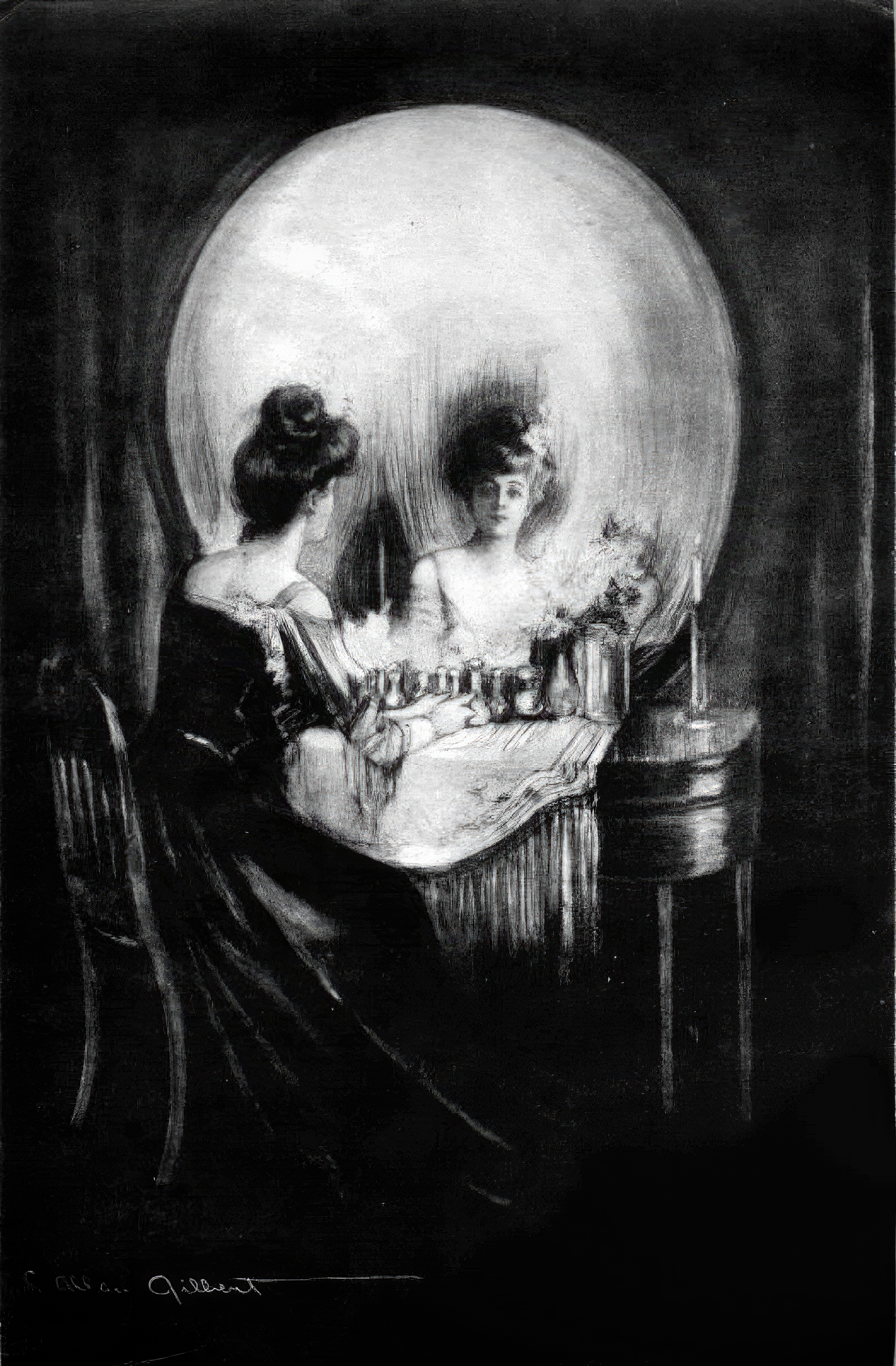
Haven't we all known guys like this?

Huysman's fin de siècle novel has only one character, virtually no narrative storyline, and exists primarily to catalogue the scathing musings of its misanthropic protagonist, the solipsistic and effete aesthete Des Esseintes, who is a barely-fictionalized version of Huysmans himself.

In other words Against Nature is Huysman's blog, his forum for hating on the unworthy and loving on his faves and generally saying "look at how clever I am!" Fortunately for Huysmans, he was an enormously talented (and tormented, and viciously funny) writer and Against Nature holds up as a mammoth treatise on life, misery and the pursuit of the unattainable. Any fan of Oscar Wilde's The Picture of Dorian Gray should read Against Nature, the "poisonous French novel" that sends Dorian down the path of debauchery and madness.

One final note, this book is the inspiration for Steely Dan's 2000 album Two Against Nature, and I imagine any Dan fans who've read up about the personal lives of Mssrs Becker and Fagan and/or listened closely to their lyrics will agree it's an inspired choice.

From the Introduction by Patrick McGuinness

p xvi "Perhaps the belief that there was nothing new was itself a necessary prelude to creating the new."

p xxxiii "How could a novel so ending-obsessed, plotless and gridlocked by description be seen as liberating? In certain respects, it was a version of Flaubert's dream of a book 'about nothing'."
- perhaps Jerry and Larry were fans of Against Nature too?

From Against Nature

p21 higgledy-piggledy|ˈhigəldē ˈpigəldē|
adverb & adjective
in confusion or disorder : [as adv. ] bits of paper hanging higgledy-piggledy on the furniture and walls | [as adj. ] a higgledy-piggledy mountain of newspapers.
ORIGIN late 16th cent.: rhyming jingle, probably with reference to the irregular herding together of pigs.

p22 "Nature, he used to say, has had her day; she has finally and utterly exhausted the patience of sensitive observers by the revolting uniformity of her landscapes and skyscapes."

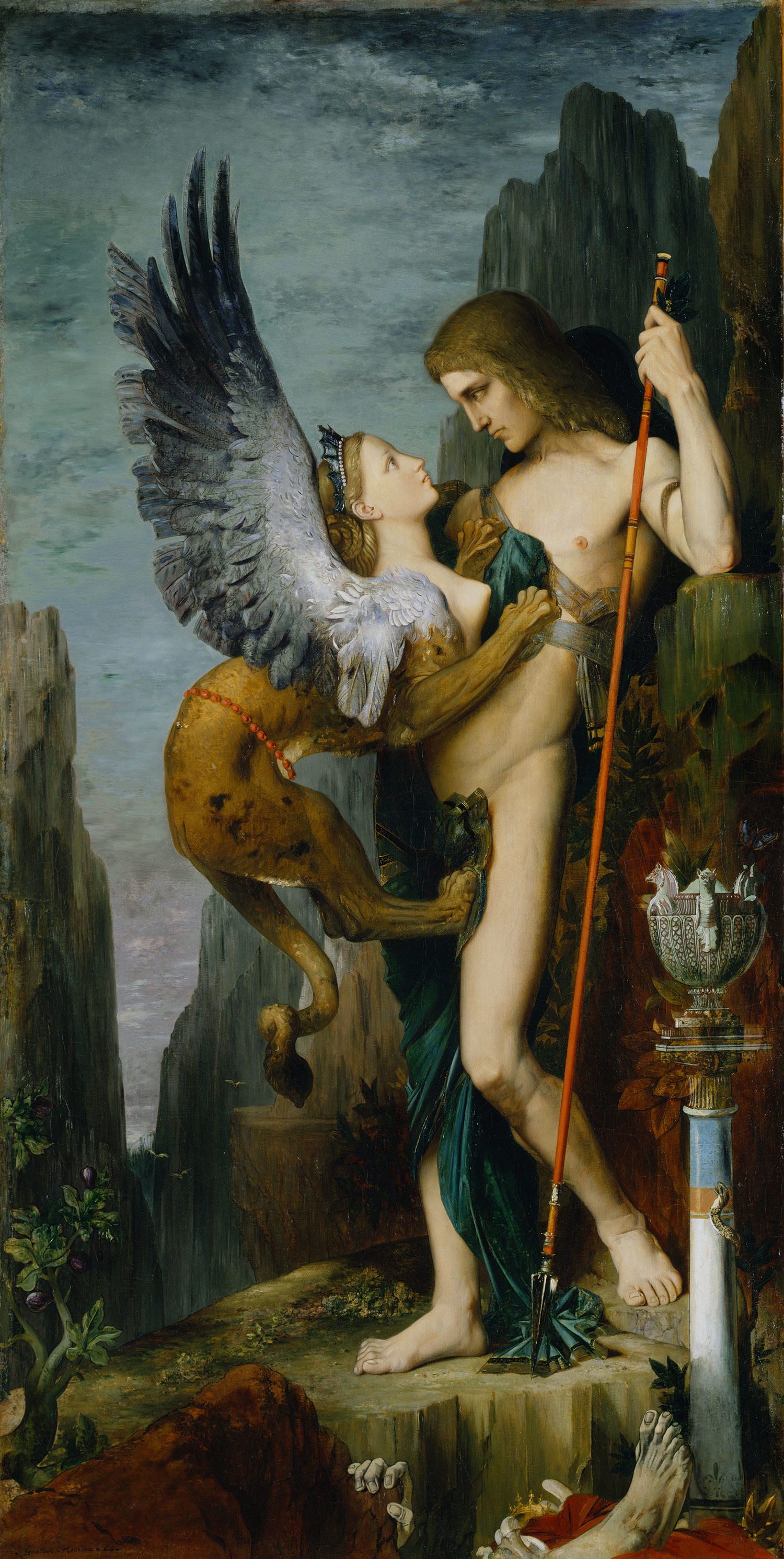
Don't get Des Esseintes started on Gustave Moreau...

p28 caesura |siˈ zh oŏrə; -ˈzoŏrə|
noun
(in Greek and Latin verse) a break between words within a metrical foot.
• (in modern verse) a pause near the middle of a line.
• any interruption or break : an unaccountable caesura: no deaths were reported in the newspapers.
ORIGIN mid 16th cent.: from Latin, from caes- ‘cut, hewn,’ from the verb caedere.

prosody |ˈpräsədē|
noun
the patterns of rhythm and sound used in poetry : the translator is not obliged to reproduce the prosody of the original.
• the theory or study of these patterns, or the rules governing them.
• the patterns of stress and intonation in a language : the salience of prosody in child language acquisition | early English prosodies.

p56 aquarelle |ˌäkwəˈrel; ˌak-|
noun
a style of painting using thin, typically transparent, watercolors.
• a painting in such a style.
ORIGIN mid 19th cent.: from French, from Italian acquarella ‘watercolor,’ diminutive of acqua, from Latin aqua ‘water.’

p75 casuist |ˈka zh oōist|
noun
a person who uses clever but unsound reasoning, esp. in relation to moral questions; a sophist.
• a person who resolves moral problems by the application of theoretical rules to particular instances.

p76 "For several days in succession, his brain was a seething mass of paradoxes and sophisms, a tangle of split hairs, a maze of rules as complicated as the clauses of law, open to every conceivable interpretation and every kind of quibble, and leading up to a system of celestial jurisprudence of positively baroque subtlety."

an illustration by Arthur Zaidenberg from the 1931 Illustrated Editions issue of A Rebours

p94 "... and it is of course true that, just as the loveliest melody in the world becomes unbearably vulgar once the public start humming it and the barrel-organs playing it, so the work of art that appeals to charlatans, endears itself to fools, and is not content ti arouse the enthusiasm of a few connoisseurs, is thereby polluted in the eyes of the initiate and becomes commonplace, almost repulsive."

p110 ritornel/ritornello |ˌritərˈnelō|
noun ( pl. -nellos or -nelli |-ˈnelē|) Music
a short instrumental refrain or interlude in a vocal work.
• a recurring tutti section in a concerto.
ORIGIN Italian, diminutive of ritorno ‘return.’

p118 "Once again, he told himself, the solitude he had longed for so ardently and finally obtained had resulted in appalling unhappiness, while the silence which he had once regarded as well-merited compensation for the nonsense he had listened to for years now weighed unbearably upon him."

p125 trencherwoman/trencherman |ˈtren ch ərmən|
noun ( pl. -men) [usu. with adj. ] humorous
a person who eats in a specified manner, typically heartily : he is a hearty trencherman, as befits a man of his girth.

p141 panegyrist/panegyrize |ˈpanəjəˌrīz|
verb [ trans. ] archaic
speak or write in praise of; eulogize.

p145 purblind |ˈpərˌblīnd|
adjective
having impaired or defective vision.
• figurative slow or unable to understand; dim-witted.

p161 "Yet, the staff of a tavern were every bit as stupid and mercenary, as base and depraved, as the staff of a brothel. Like the latter, they drank without being thirsty, laughed without being amused, drooled over the caresses of the filthiest workman and went for each other hammer and tongs at the slightest provocation."
- I hereby promise to try and start working "go at it hammer and tongs" into conversation

p170 sudorific |ˌsoōdəˈrifik| Medicine
adjective
relating to or causing sweating.
noun
a drug that induces sweating.
ORIGIN early 17th cent.: from modern Latin sudorificus, from Latin sudor ‘sweat.’

p183 hieratic |ˌhī(ə)ˈratik|
adjective
of or concerning priests : he raised both his arms in an outlandish hieratic gesture.
• of or in the ancient Egyptian writing of abridged hieroglyphics used by priests. Compare with demotic .
• of or concerning Egyptian or Greek styles of art adhering to early methods as laid down by religious tradition.

p193 Des Esseintes, while fantasizing about never eating again while receiving all of his nourishment in the form of "peptone enemas", mutters:

"What an absolute release from the boredom that invariably results from the necessarily limited choice of dishes! What a vigorous protest against the vile sin of gluttony! And last but not least, what a slap in the face of Mother Nature, whose monotonous demands would be permanently silenced!"

From Appendix II

p222 alembicated/alembic |əˈlembik|
noun
a distilling apparatus, now obsolete, consisting of a rounded, necked flask and a cap with a long beak for condensing and conveying the products to a receiver.

p223 (from Emile Goudeau's 1884 review of Against Nature):

M. Huysmans, with a remarkable talent and stupefying erudition, has put together in his book Against Nature all the elements of human despair. He has solidly spat on every pleasure, and kept for himself the terrible joy of abolishing human joy. An unhealthy book, but artistically very beautiful, perfectly crafted and skillfully wrought.

Monday, February 11, 2008

Dog Ears #10: Zeroville

Sometimes I hate myself for giving in to the siren song of movies again and again. Part of me thinks that I should know better by now. That I'm looking for something out of films that I can never find again.

Title is taken from Godard's ALPHAVILLE

This nagging gnawing feeling is magnified a thousandfold and distorted into cinematic metafiction in Steve Erickson's Zeroville, a 2007 book that came to my attention from a number of year-end "Best of 2007" lists. The cover art (sucker that I am?) intrigued me even more- why did this bald man have Montgomery Clift and Elizabeth Taylor from A PLACE IN THE SUN tattooed on his head, and what was he gazing at in that empty deep blue space?

Author Erickson is also the film critic for Los Angeles magazine (a good mag that, tellingly, I kept my subscription to during my four years in NYC), and he brings his cynical sense of humor and archivist's passion for films and the film industry to bear on this fictionalized narrative set among "real" Hollywood of the late 1960s, 70s, and early 80s. "Cinéautistic" protag Vikar (the fellow on the cover) either loses or finds his mind with the help of industry friends like John Milius, punk music, and a terrifying recurring dream that doesn't sound all that farfetched to a movie obsessive like me.

Vikar refers to Milius (seen here directing CONAN) as "Viking Man"

The book is frustrating, at times feeling like a self-satisfied collection of obscure film references and trivia held together by the haphazard wanderings of a more-violent Forrest Gump type. But there are stretches where Vikar's quest transcends the limitations of the structure and becomes something unique in its ability to communicate why people who perhaps should know better still look for something (unattainable?) in darkened movie theaters.

p42 "I mean, that's the whole thing about the movies," says the burglar*. "Bigger than the sum of the parts and all that? If the parts are too good, the whole is somehow less. I mean, you can't have, you know, Trane doing the score for Now, Voyager."

* yes, this is the kind of book where burglars wax poetic about the philosophy of cinema.

p119 "When Michael has Fredo killed, it isn't just Cain slaying Abel. It's Abraham sacrificing Isaac, because Michael has assumed the role of the father to his older brother, who has assumed the role of the son. Michael sacrifices the child to the god called Family; he destroys the family in its corruptible human form to preserve the idea of Family that's more divine, and to preserve Michael's love for Family that the older brother has betrayed."

p265 "The thing is, that movie last night* is a completely different movie when you watch it by yourself. Why is that? Movies are supposed to be watched with other people, aren't they? Isn't that the point of movies–you know, one of those social ritual things, with everyone watching? It never occurred to me a movie might be different when you don't watch it with anyone else."

* A PLACE IN THE SUN

p266 "Vikar says, 'Once Cassavetes told me about seeing A Place in the Sun when it came out. He hated it so much that he went back and saw it the next day and then every day for a week, until he realized he loved it. ... So why does that happen?... The movie hasn't changed. It's still the same exact movie, but it's like it sets something in motion, some understanding you didn't know you could understand, it's like a virus that had to get inside you and take hold and maybe you shrug it off–but when you don't, it kills you in a way, not necessarily in a bad way because maybe it kills something that's been holding you down or back, because when you hear a really really great record or see a really great movie, you feel alive in a way you didn't before...'"

Taylor saved a choking Clift's life by pulling two of his teeth out of his throat after he crashed his car in 1956

revolves around Vikar's obsession with two films in particular, George Stevens' A PLACE IN THE SUN (1951) and Carl Theodore Dreyer's THE PASSION OF JOAN OF ARC (1928). Since I hadn't seen either before reading the book, I thought I'd at least check out one and rented A PLACE IN THE SUN. It's not a movie that you can necessarily "enjoy" on a story level, but the technique of the direction, cinematography and editing was certainly far ahead of its time. After seeing PLACE and from what I've gleaned about JOAN OF ARC, I think I understand the connection Vikar felt to these two films in particular. They both feature intimate close-ups that so fill up the screen that the viewer is drawn in deeper than they may be prepared for, and both feature stars (Clift and Maria Falconetti) whose success playing tragic roles on screen somehow translated to lives that became tragedies in reality.

That may be what makes film such a unique medium, not only can it be transcendent and transformative for the audience, but it exerts an even more powerful, and sometimes dangerous, pull on those who create them.


Monday, January 28, 2008

Tunnel Vision

Mrs. Word Player and I took in an afternoon showing of CLOVERFIELD yesterday. Good flick, smartly executed. I actually found myself biting my nails at one point. A lot has been made in the reviews that scenes of destruction in the film echo the footage permanently etched in our minds from 9/11, but I found myself flashing back to my experiences from another traumatic day in New York.

The subway is a very good setting for a monster movie scene...

August 14, 2003. The great Northeast Blackout that knocked out power for 50 million people in the U.S and Canada.

There's a scene in where the survivors decide to flee the streets and walk the darkened, abandoned subway tunnels uptown. Aside from the monster part, I knew exactly how they felt.

By this time MWP and I had moved to Brooklyn, and I'd just landed a job reading scripts for A&E Networks three weeks prior. I got a call from my contact person Mr. RH that he had some scripts for me to pick up, so I hopped on the 4 Express Train at Nevins Street. The evening rush had already begun, and the train became progressively more crowded with sweaty people (the temperature that day was in the low 90s) as we made our way towards my final destination of Grand Central/42nd Street, just a few blocks from A&E's office on 45th.

The train goes express all the way from 14th to 42nd street, so I wasn't quite sure where we were when the train suddenly ground to a halt. At first, nobody batted an eye. Subways make unscheduled stops all the time, usually because another train up ahead is running behind schedule.

But rarely for five minutes. And never for ten minutes. The lights remained on in the car, but the air conditioning did not, and it got very hot very quickly. The conductor soon came over the PA system and told us that the subway system was out of commission, and that they were working on a fix as quickly as possible. People, myself included, were getting antsy. About twenty minutes in, we were told that the entire city was without power. That's when the crying began.

It was like Central Casting had handpicked my fellow mass transiters. A very pregnant woman. Some very old people. About fifteen or twenty 8 to 10-year-old kids, all wearing the same brightly colored t-shirts, on their way to or from camp. I kept waiting for Leslie Nielson to walk into the car and tells us there's no reason to be alarmed. As we were still less than two years removed from 9/11, everyone was speculating about whether the blackout was caused by a terrorist strike. This didn't help the people who were beginning to freak out. I tried to stare straight ahead and be very aware if someone needed my help and/or if someone was going to lose their cool in a violent way (a frequent thought of subway riders even when things are running smoothly).

At some point, the conductor assured us that the blackout was not terror-related and that a crew with flashlights was coming down the tunnel towards us and that we were all going to have to walk through the subway tunnel to Grand Central.

It was the first and only time I've been rescued.

Seventy minutes we were in there.

We were led out the front of the train, where we crawled out one of the front windows, down a ladder and onto the track. We walked single file towards 42nd street from about 37th or 38th. About every 200 yards or so was someone with a flashlight, but other than that it was almost pitch dark.

Yes, you could hear the rats running alongside you. Thankfully, couldn't see 'em. When we made it to 42nd, we were treated to the spectacularly eerie sight of Grand Central Station completely empty, lit by a few emergency lights and, as we walked further out, by the sun coming through the windows. It was one of the most exhilarating feelings I can remember when I finally walked outside onto the street and took a deep gulp of fresh air.

The streets were chaotic with hordes of people walking seemingly in every direction. Nobody's cell phones were working, so after a call to North Carolina on a payphone to let my parents know I was OK and to see if they'd heard from Mrs. Word Player (they hadn't), I decided to walk to MWP's office at 38th and 8th, about six avenue blocks west and four south. When I got there, the buzzers weren't working, so I walked up 15 flights to see if she was still at the office.

Nope, everyone was gone and the doors were locked.

photos ©mrs.word player 2003

Back down the 15 floors, the whole time thinking that the only thing I could do now was not worry about MWP and start walking the 40-50 blocks to the Brooklyn Bridge. My feet hurt and I was drenched in sweat, but by the time I got to the Bridge I started to get a sense of how bizarre this day really was.


it's not every day that cops give out drinks of water

The foot traffic was so thick you could feel the Bridge swaying gently. A look back and you could see the Manhattan skyline in the fading daylight, not a single light on in the thousands of windows. A look ahead and you saw Brooklyn Mayor Marty Markowitz shouting "Welcome Home!" on a bullhorn. Twenty five blocks later and I was home. Thankfully, MWP and her friend and workmate Mz. Art Designer had made it home long before me, snapping the pix I've posted here along the way.

By the next morning, the power was back on, but there was still one more bizarro moment to come. Our good friend Mrs. CFA was working at CNN Headline News back then, and asked Mrs. Word Player to be interviewed live on the air, via telephone, as the pictures she took during the Blackout scrolled across the screen. I sat in the other room, watching the interview live, just one closed door away from the interviewee.

Strange days indeed... most peculiar, mama!

Saturday, January 26, 2008

The Race Car

I don't profess
To be no teacher
But these are my latest outlooks
- "Licking Stick-Licking Stick"
by James Brown

For many years now, I've been receiving a subscription to National Geographic as a Christmas present from my parents. Regardless of whether I give an issue the full read or just flip through to check out the photography, time spent with the venerable mag (and being reminded what an enormous and complicated and beautiful planet we live on) is usually a bright spot in the day.

When the February 2008 issue arrived, however, I wasn't sure what to make of the cover when I first saw it. The feature article is titled "The Black Pharaohs: Conquerors of Ancient Egypt," and my first reaction was "Race issues seem to be almost inescapable lately." Of course, I quickly remembered that February is Black History Month and that the timing of this article has absolutely nothing to do with the ongoing Kelly Tilghman "Lynch (Tiger Woods) in a back alley" imbroglio that has dominated the airwaves of late.

I read the article and found it fascinating and thought provoking in all the best ways. The article basically tells the story of a period beginning in 750 B.C. when Piye, the ruler of Nubia, invaded Egypt to expel the ruling warlords who had abandoned the "true pharoanic customs" and spirtual traditions. For 75 years, Piye, and then his son Taharqua, restored Egypt to its former glory, all under the rule of the dark-skinned Nubians.

Some good trivia for you- Sudan has more pyramids than Egypt.

I had never really known specifically where (or when) "Nubia" was (despite listening to a fair amount of Brand Nubian in college).

Nubia (or "Kush," as it was called in the Bible) was the name for the region to the south of Egypt, along the Nile and in what is now northern Sudan. Most of Nubia was situated in Sudan with about a quarter of its territory in Egypt. Around 350 AD the area was invaded by the Ethiopian kingdom of Aksum and the kingdom collapsed. (culled from wikipedia)

This quote from the article (written by Robert Draper and photographed by Kenneth Garrett) jumped off the page at me:

The ancient world was devoid of racism. At the time of Piye’s historic conquest, the fact that his skin was dark was irrelevant. Artwork from ancient Egypt, Greece, and Rome shows a clear awareness of racial features and skin tone, but there is little evidence that darker skin was seen as a sign of inferiority. Only after the European powers colonized Africa in the 19th century did Western scholars pay attention to the color of the Nubians’ skin, to uncharitable effect.

The stark way that opening sentence reads just blew me away. Can that REALLY be true? And if it's a historical fact, as it appears to be, why isn't it common knowledge?

More interesting words on the topic from an unlikely source- the new, souped up version of Dictionary found in Mac OSX's Leopard, found when looking up the word "race":

Although ideas of race are centuries old, it was not until the 19th century that attempts to systematize racial divisions were made. Ideas of supposed racial superiority and social Darwinism reached their culmination in Nazi ideology of the 1930s and gave pseudoscientific justification to policies and attitudes of discrimination, exploitation, slavery, and extermination. Theories of race asserting a link between racial type and intelligence are now discredited. Scientifically it is accepted as obvious that there are subdivisions of the human species, but it is also clear that genetic variation between individuals of the same race can be as great as that between members of different races

Once we know there was a time when racism was simply not an issue, does it give us hope that one day we can recapture that collective state of mind?


This record came out 40 years ago: are race relations better or worse now?

I would love to feel that hope, but based on the evidence all around me it sure ain't looking good. I see so many people perpetually preoccupied with matters of race, often to the point that it appears to become debilitating. Not because of racism applied by exterior forces, but by the inner turmoil caused when stoking the fires of anger and resentment no longer seems to be a conscious choice. It is certainly not my place to tell anyone how to feel, but still I sometimes wish that it was possible to let those fires burn out instead of constantly adding new fuel.

In surfing around reading about Nubia, I came across this page describing an episode from the 1990s PBS series "Wonders of the African World." This pullquote from the end says some of the things I've been feeling more eloqently than I can:

It is to be hoped that in the new millennium all Americans will come to grasp -- what neither Reisner and his contemporaries, on the one hand, understood nor the modern Afrocentrists, on the other, understand -- that proper study of the past is not attainable unless we can identify and transcend our own biases. At some point we will all need to recognize that "the race to which we belong" -- to use Bayard Taylor's phrase -- is neither black nor white, but simply human, with all its extraordinary creative abilities and all its eternal failings.

it seems the only way to win is not to race at all

It's interesting to me that the word race means "a group of people sharing the same culture, history, language, etc.; an ethnic group," but it also describes a type of competition. As we all know, in competitions there must be a winner and a loser, and in many races, no matter who wins or loses, everyone eventually ends up at the starting line where they began because the race has been conducted by running in circles.

Eliminating racism is a daunting goal, but it would seem than an excellent place to start is eliminating the competition between races over who is right and who is wrong. The unwinnable competition over the moral high ground only serves to bring everybody down.

Tuesday, January 22, 2008

Balancing the Ledger

The first movie I ever took the future Mrs. Word Player to starred Lindsay Lohan.

That may sound like a sure recipe for dating disaster now, but back in August of 1998 (a handful of days after we first met) it was the G-rated Disney remake THE PARENT TRAP title that was the draw, and I'd never heard the name Lindsay Lohan before in my life. I was eager to impress upon my date that we could have G-rated fun together too, and every memory I have from that night is sensational. Thankfully the movie was great, and not at all the "isn't this fun?" (oh-no-we're-exchanging-polite-smiles!?!) bore I feared it could be.

That memory and, for all intents and purposes, that alone is what kept me rooting for Lohan to survive her marathon of death- and logic- and rationality-defying series of arrests, hospitalizations, and rehab stints. Frankly, I didn't/don't want that memory tainted by yet another senseless fatality story.

I think we'll all be looking away from THE DARK KNIGHT posters for a while

Of course, thoughts like this are dredged up by today's news that Australian actor was found dead of an apparent drug overdose at the age of 28. Here's the twist, for me at least: I've been in a funk the whole day about his death, and (surprisingly to me) I've only seen one of the films he's been in.

Why should his death affect me like this? And, how will I feel about it tomorrow?

I can barely remember seeing MONSTER'S BALL in 2001, and even less can I cobble together a handful of words about Ledger's supporting performance in the film. All I know is that I was/am very excited to see his interpretation of The Joker in the upcoming BATMAN: THE DARK KNIGHT, and I was bummed to hear last year that the was splitting up with DAWSON'S CREEK's Michelle Williams, his then-fiancee and mother of their child.

That's it. Yet, I still feel something strong tugging at me now that he's gone. I wonder why it was as strong as it was, and I wonder why it wasn't stronger than it was.

Ultimately, we hadn't formed any memories together yet. Ledger's passing didn't immediately affect me in the same way as the following three shocking, completely unsuspected deaths because (unbeknownst to them in life, as virtually all our bonds with celebs are) I'd internalized enough memories about them (in the same vein as me and Li-Lo) that proved (so far) to be far more difficult to shake.

We all knew eventually this blog would feature glamour shots of me.

So, in chronological order...

JOHN LENNON >>> murdered 12/8/1980 >>> his age: 40, my age: 9

I burst into tears when I heard that John Lennon had died. As near as I can remember, his is the first non-family death I can recall. I grew up listening to The Beatles at home on Father Word Player's Teac reel-to-reel, as he'd recorded his collection of vinyl albums to tape and then given them all away. I was allowed to listen to the stereo by myself on Dad's big-ass grey-brown '70s headphones growing up, and The Beatles were extremely important to me and my musical education as a child. No amount of explaining in the world could explain to a nine year-old why someone would shoot and kill someone like John Lennon.


He looks like he could still be alive, doesn't he?

RIVER PHOENIX >>> fatal overdose 10/31/1993 >>> his age:23, my age: 22

I'd thought it cool, during his life, that River Phoenix was exactly one year and one day older than me. Stupid things like that create a superficial kinship between people like him and people like me. I was a HUGE Steven King fan growing up, and after I saw STAND BY ME in 1986 (adapted from King's novella "The Body" from his collection Different Seasons), I'd become a HUGE River Phoenix fan as well. Toss in his we're-grooming-him-for-a-prequel-or-two role in INDIANA JONES AND THE LAST CRUSADE (and, yes, fine, a desire to have my short curly dark hair look anything like his long straight blonde hair), and his shocking death hit me like a kick to the sternum.

Several years later, I was living in L.A. and went to the Viper Room to see a friend's band play.

The place still had bad ju-ju out the yin-yang.

Incidentally (and something I just now discovered) River's middle name is Jude, named after The Beatles song "Hey Jude" which was written by Paul to comfort Julian Lennon during John and Cynthia's divorce. There's something comforting about a comfort song, no?

"I move for a bad court thingy"

PHIL HARTMAN >>> murdered 5/28/1998 >>> his age:49, my age:26

Still less than 10 years ago, this is the one I remember the most vividly and the one that still hurts the most when the wind blows just so. Hartman's contribution to the comedy and pop-culture scene was vast, including major roles in PEE-WEE'S PLAYHOUSE, THE SIMPSONS, and SNL. His sensibilities were just so dead-on, and you could count on him to be funny whenever he turned up (which was very, very often) in a show or movie. I guess because he was a company player and supporting actor, most of us didn't talk about him too much before he died (for, after all, it really felt like it was the character Lionel Hutz who immortally referred to bourbon as "the brownest of the brown liquors".)

I was in the office of my new job at a production company in Venice, CA, and my bosses were in Milwaukee when I heard the news of Hartman's murder over KCRW. Alone, I once again found myself weeping over the death of someone I never knew.

Hartman, like Lennon and Phoenix, had touched my life in a way I clearly would never forget. Only time will tell how my feelings towards Ledger will evolve, based mostly, I guess, on how many stars I give his to-be-rented back catalog on Netflix combined with how I felt today.

I'm certain this will come out inelegantly, but doesn't it always feel strange when someone who was just alive is now dead forever?

Monday, January 21, 2008

Empathy for the Devil

HEDLEY LAMARR
My mind is a raging torrent, flooded with rivulets of thought
cascading into a waterfall of creative alternatives.

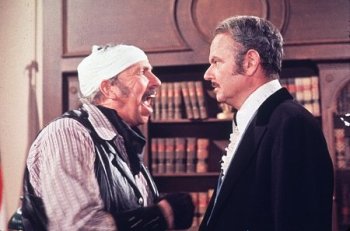
TAGGART
God darnit, Mr. Lamarr, you use your tongue
purtier than a twenty dollar whore.

Too often I find myself thinking like Hedley and speaking like Taggart. Hopefully I write somewhere in between.

The solution to all life's riddles can be found in BLAZING SADDLES

My mind HAS been flooded with a variety of rivulets lately, and they seem to be begging me to tie them together somehow.

Here they are, separately:

1. A desire to finally write down definitions of classically descriptive terms like "pathos" and "bathos" that I (and many others) seem to misuse and often misunderstand.
2. A desire to finally write down translations of still-in-use Latin phrases that I (and many others) seem to misuse and often misunderstand.
3. A desire to finally write down crib-sheet style descriptions of all the philosophers and thinkers overtly referenced in the character names in LOST in preparation for the premiere next Thursday.

We'll see, I suppose, if there's a connection other than the tenuous one that they were all in play at one time or another as I pursued my BA in Poli-Sci. Hopefully, at the very least, they'll look purty all wrote out in a row.

pathos: Greek for "to suffer".
  1. The aspect of something which gives rise to a sense of pity.
  2. In its rhetorical sense, pathos is a writer's attempt to persuade an audience through appeals involving the use of strong emotions. In this sense, pathos is not strictly limited to pity. In its critical sense, pathos denotes an author's attempt to evoke a feeling of pity or sympathetic sorrow for a character.
  3. In theology and existentialist ethics following Kierkegaard and Heidegger, a deep and abiding commitment of the heart, as in the notion of "finding your passion" as an important aspect of a fully-lived, engaged life.

The urge to make a groan-inducing pun with the word "bathos" is all-but overwhelming

bathos
: Greek for "depth". Used metaphorically from 1638 (Robert Sanderson). First used ironically by Alexander Pope (Bathos, 1727), in contrast to "sublime".
  1. Depth, Bottom.
  2. An abrupt change in style, usually from high to low; an unintended transition of style; an anticlimax.
  3. Triteness; triviality; banality.
  4. Overly sentimental and exaggerated pathos.
pathetic:
1. arousing pity, esp. through vulnerability or sadness : she looked so pathetic that I bent
down to comfort her. See note at moving .
• informal miserably inadequate : his test scores in Chemistry were pathetic.
2. archaic relating to the emotions.

empathy:
1. the intellectual identification of the thoughts, feelings, or state of another person
2. capacity to understand another person's point of view or the result of such understanding

sympathy:
  1. A feeling of pity or sorrow for the suffering or distress of another; compassion.
  2. The ability to share the feelings of another; empathy.
  3. (psychology) A mutual relationship between people such that they are correspondingly affected by any condition.
  4. (physiology) A mutual relationship between organs such that a condition of one part causes an effect in the other.
a priori: deductive reasoning, from cause to effect

a posteriori: inductive reasoning, from effect to cause

factotum: one who does everything

sine qua non: fundamental cause; necessary precondition

flagrante delicto: in the heat of the crime
(I always thought this had a more lurid meaning...)

persona non grata: an unacceptable person

cogito ergo sum: I think, therefore I am (first busted out by ya boy René Descartes in 1637)

amor fati: (this one I've been thinking about a lot lately because of the beautiful Nietzsche quote I stumbled across, so excuse the lengthier wikipedia definition in this already lengthy post)

Amor fati is a Latin phrase that loosely translates to "love of fate" or "love of one's fate". It is used to describe an attitude in which one sees everything that happens in one's life, including suffering and loss, as good. That is, one feels that everything that happens is destiny's way of reaching its ultimate purpose, and so should be considered good. Moreover, it is characterized by an acceptance of the events that occur in one's life.

The phrase is used repeatedly in Nietzsche's writings and is representative of the general outlook on life he articulates in section 276 of The Gay Science, which reads,

I want to learn more and more to see as beautiful what is necessary in things; then I shall be one of those who make things beautiful. Amor fati: let that be my love henceforth! I do not want to wage war against what is ugly. I do not want to accuse; I do not even want to accuse those who accuse. Looking away shall be my only negation. And all in all and on the whole: some day I wish to be only a Yes-sayer.

John Locke is named after John Locke (1632-1704) the Enlightenment philosopher who dealt with the relationship between nature and civilization, later to have great influence on founders of democratic governments. He believed that, in the state of nature, all men had equal rights to punish transgressors; to ensure fair judgment for all, governments were formed to better administer the laws.

Anthony Cooper is John Locke's father. It seems he's based on two Anthony Coopers:
Anthony Ashley-Cooper (1621-1683) was an English politician who was the mentor and patron of real-life philosopher, John Locke.

Anthony Ashley-Cooper (1671-1713) was an eighteenth-century moral philosopher who posited that people are basically good, and that morality is a foundational (if not innate) part of humanity.

"Desmond" David Hume is named after David Hume (1711-1776). Hume was the first great philosopher of the modern era to carve out a thoroughly naturalistic philosophy. This philosophy partly consisted in the rejection of the historically prevalent conception of human minds as being miniature versions of the Divine mind; a notion that has been entitled the ‘Image of God’ doctrine. This doctrine was associated with a trust in the powers of human reason and insight into reality, which powers possessed God’s certification.

Danielle "Rousseau" is named after Jean-Jacques Rousseau (1712-1778), a philosopher and composer of the Enlightenment whose political philosophy influenced the French Revolution, the development of both liberal and socialist theory, and the growth of nationalism. With his Confessions and other writings, he practically invented modern autobiography and encouraged a new focus on the building of subjectivity that would bear fruit in the work of thinkers as diverse as Hegel and Freud. His novel Julie, or the New Heloise was one of the best-selling fictional works of the eighteenth century and was important to the development of romanticism.

I think Alpert's backstory will go a long way in telling us if time travel is in play on LOST

Richard Alpert (the eyebrowish "Other" who recruited Juliet to the island) is named after Dr. Richard Alpert (born April 6, 1931), also known as Baba Ram Dass, is a contemporary spiritual teacher who wrote the 1971 bestseller Be Here Now. He is well-known for his association with Timothy Leary at Harvard University in the early 1960s, both having been dismissed from their professorships for experiments on the effects of psychedelic drugs on human subjects. He is also known for his travels to India and his association with the Hindu guru Neem Karoli Baba.

Mikhail Bakunin (aka "Patchy") is named after Mikhail Bakunin (1814-1876) was a well-known Russian revolutionary and anarchist philosopher. He "rejected governing systems in every name and shape", every authority figure, including God, or a sovereign. Bakunin denied the concept of "free will" and advocated a materialist explanation of natural phenomena. Bakunin believed that the proper form of social organization is that of free association between individuals and between communities. Thus, "The freedom of all is essential to my freedom."

Whew. I feel better now. Thank you to Wikipedia, Wiktionary, Apple's Dictionary, Latin Phrases & Quotations by Richard A. Branyon, and Lostpedia.

Finally, for other LOST fans beginning to loosen up their theory-belts for Season 4, check out this intriguing line of thinking at Lost in Shangri-La.

Thursday, January 17, 2008

Toxic Ontology?

Tell it to me straight- is it the height of vanity to blog about what's going on in one's noggin?

(It's interesting to note that vanity means both "excessive pride in or admiration of one's own appearance or achievements" and "the quality of being worthless or futile", and I think both definitions apply to my question above).


"My own little nasty world"

Was Socrates right when he said "The unexamined life is not worth living", or is the correlation between thinking and happiness that the more you think, the less happy you are?

I do my best to only speak for myself in this forum and in "real" life as well, but when I think I like to think in generalities as well as specifics. I've been running into a word lately in my reading that not only encapsulates a good deal of my free-form thinking, but also some of what I've been doing here. More than a dictionary definition is called for, so allow me this chunk from Wikipedia:

Ontology is a study of conceptions of reality and the nature of being. In philosophy, ontology is the study of being or existence and forms the basic subject matter of metaphysics. It seeks to describe or posit the basic categories and relationships of being or existence to define entities and types of entities within its framework.

Some philosophers, notably of the Platonic school, contend that all nouns refer to entities. Other philosophers contend that some nouns do not name entities but provide a kind of shorthand way of referring to a collection (of either objects or events). In this latter view, mind, instead of referring to an entity, refers to a collection of mental events experienced by a person; society refers to a collection of persons with some shared interactions, and geometry refers to a collection of a specific kind of intellectual activity.

As a philosophical subject, ontology chiefly deals with the precise utilization of words as descriptors of entities or realities. Any ontology must give an account of which words refer to entities, which do not, why, and what categories result. When one applies this process to nouns such as electrons, energy, contract, happiness, time, truth, causality, and God, ontology becomes fundamental to many branches of philosophy.


Shouldn't there be more choices than "red pill" or "blue pill"?

I freely admit to being a novice when it comes to ontology, but I do particularly like the fact that it "chiefly deals with the precise utilization of words as descriptors of entities or realities." I'd like to think my pursuit of better words and more accurate descriptions, and my desire to ask better questions and seek more accurate answers, serves a larger purpose than simple self-improvement. There have to be reasons beyond vanity and self-promotion that millions of people spanning the length of human existence have been compelled to write down the stuff going on in their heads and try their best to circulate it to the widest audience possible, right?

Unfortunately, and quite the opposite from my expectations as a younger man, it seems to me that carrying on discourse of this flavor, at least in in-person conversation, becomes less feasible the older we get. When the Beatles sang "But if you go carrying pictures of chairman Mao, You ain’t gonna make it with anyone anyhow" in 1968's "Revolution 1", I imagine they weren't talking to the Chinese, but to thinkers and theorists raining on the Age of Aquarius's indulgent parade.

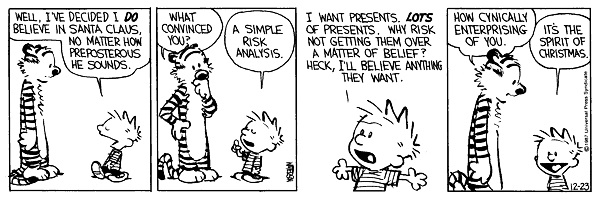
Among other things, college gave me a deeper appreciation of Calvin and Hobbes

I was wholly unprepared for my first taste of serious philosophical discussions when I took a Philosophy course my freshman year in college. I was used to taking tests with hard and firm answers, not teasing out the threads of Pascal's Wager, but the weird energy of that class's discussions has stayed with me even though it has rarely been reproduced.

Maybe I'm living proof of Oscar Wilde's position that "Seriousness is the only refuge of the shallow." Maybe I'm afraid that if I stop reading and writing and searching and questioning and challenging myself, as exhausting and frustrating as it can be, I won't be me any more. Of course, I have to live with the possibility that the new me would be happier than the old me, but that's not a wager I'm willing to take. I remember vividly the day a former friend of mine announced proudly that he, at the age of 29, was never going to read another book again in his life. He felt that he was well-read enough to focus his energies elsewhere, but I felt that I no longer had any idea who this person standing in front of me was. I believe that if you're not moving forward, you're moving backward.

There is no standing still.

Right?

Monday, January 14, 2008

My Salon at Marienbad

Despite growing up in the often less-than-progressive Queen cities of Cincinnati and Charlotte, I became fascinated with surrealism at a very young age thanks in large part to my grandfather Big Bill's collection of Serriers. Parisian surrealist painter Jean-Pierre Serrier (1934-1989) never became a household name alongside contemporaries (and strong influences) like Dali and Magritte, but his work has always had a firm grip on my imagination.

"Now go out and do my bidding!" I would think.

Big Bill not only collected Serriers, but commissioned the artist to create corporate art for his apparel company Velva Sheen. My impressionable mind (then and now) was extremely impressed that my Dad and Grandfather worked for a company represented on canvas by a horde of levitating men in bowler hats with vacant black eyesockets.

Serrier led me to a lifelong love of Magritte and, I suppose, explains to some extent the explosive reaction I had in college the first time I saw director Alain Resnais and screenwriter Alain Robbe-Grillet's 1961 masterpiece LAST YEAR AT MARIENBAD. Long story short, I saw in MARIENBAD all my beloved cold, fascinating, inward-looking surrealist images sprung to life.

Well, sort of. "Frozen in death" may (or may not) be more accurate than "sprung to life" from my point of view, but you can (hopefully) see what I'm trying to say.


Only the shadows know

Because my VHS copy of the film is now collecting spiderwebs with the rest of my remaining tapes, I hadn't thought of the film in a while until yesterday's New York Times article "Marienbad Returns, Unsettling as Ever" written by Mark Harris. The article not only sheds some light on Marienbad's controversial, contentious and surprisingly successful initial run in New York, but also made a personal connection that was so obvious that I never once considered it.

But the movie’s nightmarishly looping, repetitive semi-narrative, drenched in incantatory voice-over and toxically discordant organ music, is as disturbing as ever and retains its power to frustrate anybody who hopes to shake loose some answers after 93 minutes. The people who walked out (literally) of “Inland Empire,” David Lynch’s “Marienbad”-influenced 2006 film, saying “What was that all about?” will find similar though more elegantly concise cause for discomfort here.

The nonlinear, schizophrenic dream-logic elements in Lynch's work (particularly TWIN PEAKS, LOST HIGHWAY, MULHOLLAND DRIVE and INLAND EMPIRE) that I find so wonderfully unsettling are a direct descendant of MARIENBAD's haunted, unsolvable psychotropic puzzle.

This flyer for a 2001 deejay gig of mine "borrowed" from Mr. Magritte

As virtually anyone who stayed up late with me at one of my 1990s bachelor pads will attest, one of my favorite audio-visual background combinations was whatever beat- and loop-driven electronic music I was into and a muted MARIENBAD playing on the set.

How I wished I could spend some time wandering the grounds and playing the matchstick game at Marienbad.

Good times...

POSTSCRIPT: In surfing around and sampling the plethora of online discussions of MARIENBAD (yes, work was slow today), I came across one from author Thomas Beltzer that was particularly excellent here. This pullquote speaks to me suh-in' fierce:

In the dark of the theater all of our wishes are fulfilled. However, despite our materiality and the ephemeral flickering of illusion before us, there in the dark we feel ourselves to be mere ghosts, lesser beings in the presence of screen grandeur. We know we matter less as real brings than the fictional beings before us.

Thursday, January 10, 2008

Dog Ears #9: Blood Meridian, or, The Evening Redness in the West

Sad but true: it often takes having a major writer's work adapted into a feature film in order to get me off my duff and into his canon. Sometimes even more than one film.

I imagine this is the look on Cormac McCarthy's face while he's writing

Such was the case with and the Coen Brothers' 2007 adaptation of his 2005 novel No Country For Old Men. For many years I've heard McCarthy's praises sung by people I liked and/or respected, but fair or unfair I decided to steer clear of him after Billy Bob Thornton's 2000 adaptation of his All The Pretty Horses, on the basis that I thought All The Pretty Horses was an atrocious title and the movie (which I've still never seen) looked lame.

Despite my misgivings about the title of his latest adaptation, I took the plunge, saw NO COUNTRY, and liked the first two-thirds enough to buy the paperback of what I understood to be McCarthy's masterpiece, Blood Meridian.

Well one thing's for certain, Ridley Scott's 2009 adaptation of Blood Meridian won't have roles for Matt Damon, Penelope Cruz or Elliot from E.T.: Blood Meridian is a filibuster of bloodlust and malignancy.

Naturally, things being what they are, atrocities beyond your wildest imaginings are transformed into epic poetry thanks to McCarthy's blistering, almost psychedelic prose. I certainly didn't enjoy reading Blood Meridian (first published in 1985), and for almost half the book I was barely aware what was happening in a narrative sense (thanks largely to his freakshow thesauraus, disdain for punctuation, and penchant for Spanish), but I won't soon forget the trail of blood blazed by the kid and the judge.

Blood Meridian = Hieronymus Bosch + 1850's Old West

The book contained far too many words I wanted to look up and noteworthy passages to dogear in the traditional sense, so I turned down page corners in haphazard fashion, hoping I wouldn't regret the ears undogged...

p.52 "Already you could see through the dust on the ponies' hides the painted chevrons and the hands and rising suns and birds and fish of every device like the shade of old work through sizing on a canvas and now too you could hear above the pounding of the unshod hooves the piping of the quena, flutes made from human bones, and some among the company had begun to saw back on their mounts and some to mill in confusion when up from the offside of those ponies there rose a fabled horde of mounted lancers and archers bearing shields bedight with bits of broken mirrorglass that cast a thousand unpieced suns against the eyes of their enemies."
(it was about this point that I realized I was in over my head, reading-wise)

p.141 "But no man can put all the world in a book. No more than everthing drawed in a book is so."

p.153 "Notions of chance and fate are the preoccupation of men engaged in rash undertakings."

p.189 withy: noun ( pl. withies or withes |wiθs; wiðz|)
a tough flexible branch of an osier or other willow, used for tying, binding, or basketry.
• another term for osier .
(I included this for all the Scrabble players out there!)

p.193 posada: noun
(in Spanish-speaking regions) a hotel or inn.
• (also Las Posadas) a ritual reenactment of Mary and Joseph's search for a lodging in Bethlehem, performed just before Christmas.
ORIGIN Spanish, from posar ‘to lodge.’
(I thought Yankee haters and Yankee fans alike would be interested to know this)

p. 198 suzerain: noun
a sovereign or state having some control over another state that is internally autonomous.
• historical a feudal overlord.


This is the rarely seen "centroid of peace"

p.218 "Glanton's eyes in their dark sockets were burning centroids of murder and he and his haggard riders stared balefully at the kid as if he were no part of them for all they were so like in wretchedness of circumstance."
(I reread this sentence a few times the first time around- I just couldn't believe the audacity of a writer actually typing "burning centroids of murder"!!!)

centroid: noun
Mathematics- the center of mass of a geometric object of uniform density.

p.247 "In the neuter austerity of that terrain all phenomena were bequeathed a strange equality and no one thing nor spider nor stone nor blade of grass could put forth claim to precedence."
(that's one austere desert my friend)

p.249 "Men are born for games. Nothing else. Every child knows that play is nobler than work."
(this line of thinking reaches its, and perhaps the entire book's, apotheosis at the end of the page with-)
"War is the ultimate game because war is at last a forcing of the unity of existence. War is god."

p.252 "Your heart's desire is to be told some mystery. The mystery is that there is no mystery."

p.330 "He poured the tumbler full. Drink up, he said. The world goes on. We have dancing nightly and this night is no exception."